YCC CAPITAL
Emerging Markets & China Strategy
July 20, 2026
Executive Perspective
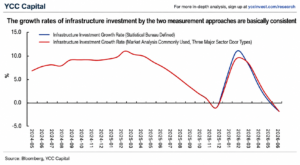
Infrastructure investment has long been one of China’s most reliable macroeconomic stabilizers. When private demand weakens or the property cycle turns lower, Beijing has historically reached for infrastructure spending as its preferred countercyclical tool. It is tangible, politically visible, and capable of supporting employment across multiple sectors.
Yet the first half of 2026 tells a different story.
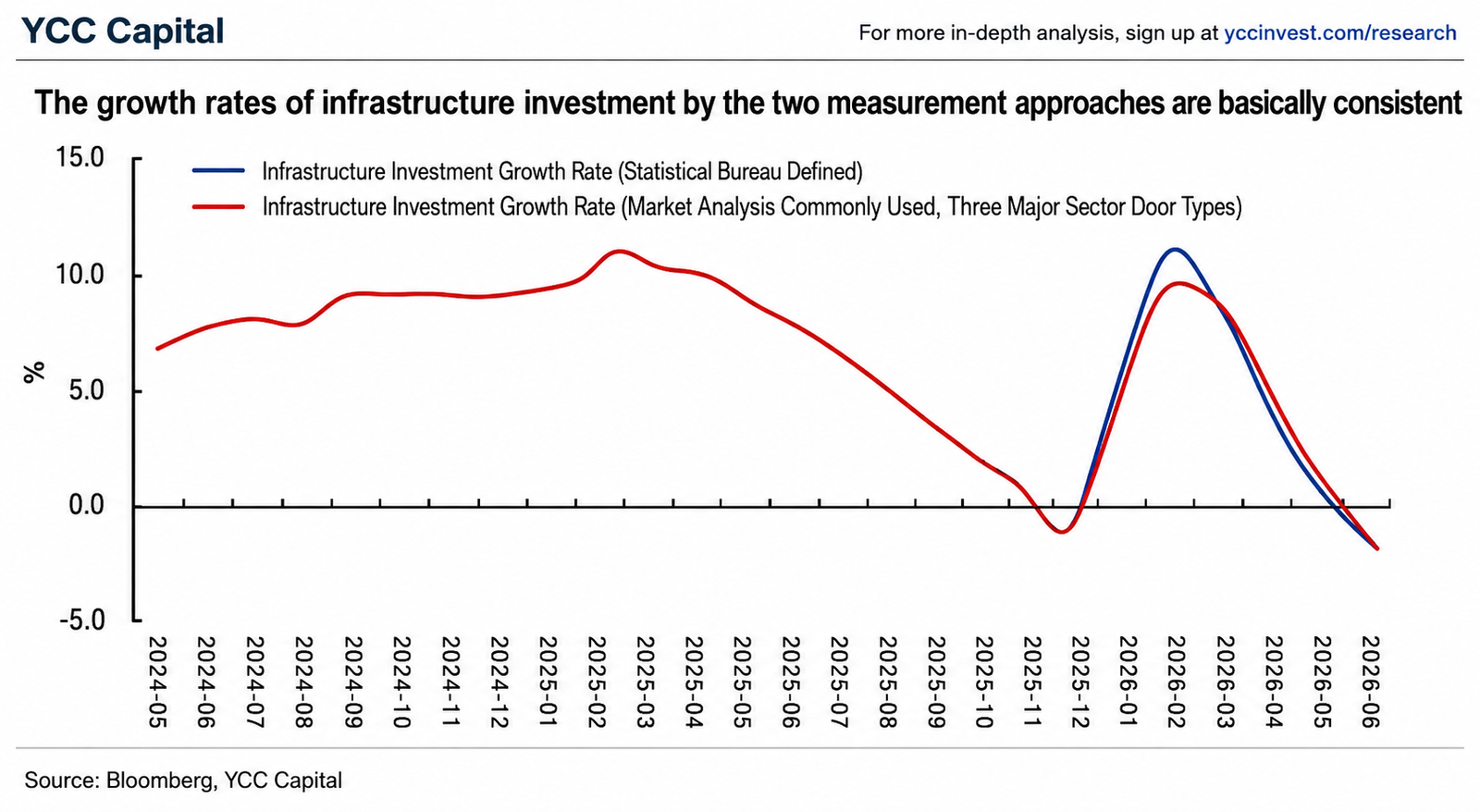
Instead of cushioning the slowdown, infrastructure investment itself has become another weak link in China’s economy. Official statistics show infrastructure investment contracting by 2.4% year-on-year during January–June, marking one of the weakest performances since the pandemic period. For investors accustomed to Beijing deploying massive infrastructure stimulus whenever growth falters, the disappointment has been striking.
The immediate explanation is straightforward: fiscal spending has been slower than expected. But that interpretation misses the larger structural shift.
At YCC Capital, we believe today’s infrastructure weakness reflects three overlapping forces rather than a simple policy delay. First, China’s local governments are operating under increasingly binding fiscal constraints after years of debt accumulation. Second, policymakers are gradually reallocating public resources away from physical construction toward social expenditure and human capital investment. Third, the country’s investment opportunity set is becoming less attractive as decades of rapid urbanization leave fewer genuinely productive megaprojects to pursue.
Anyone who has watched a city mature understands the analogy. Building the first subway line transforms an economy. Building the twentieth extension often produces much smaller returns. China increasingly resembles the latter case.
The encouraging news is that cyclical conditions should improve in the second half of the year. Project approvals are progressing, fiscal disbursements are likely to accelerate, and comparison effects become considerably easier. Nevertheless, investors should resist interpreting a second-half rebound as evidence that China’s traditional infrastructure-driven growth model has returned. It has not.
Instead, the country appears to be entering a phase where infrastructure remains an important stabilizer but no longer serves as the dominant engine of economic expansion.
Infrastructure Weakness Is Broad—but Not Uniform
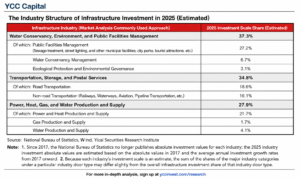
Headline figures paint a discouraging picture, yet the underlying composition tells a far more nuanced story.
Infrastructure investment has not collapsed across every category. Rather, the sector has experienced what could best be described as a K-shaped divergence, with traditional local-government-led projects weakening sharply while nationally strategic sectors continue expanding at healthy rates.
This distinction matters because it reveals where Beijing still possesses both fiscal capacity and political willingness to invest.
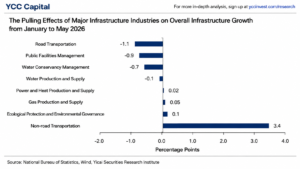
The largest drags on overall infrastructure activity have come from three sectors:
- Road transportation
- Water conservancy
- Public facilities management
Together these categories account for more than half of China’s infrastructure investment and collectively reduced overall infrastructure growth by roughly 2.7 percentage points during the first five months of 2026.
Road transportation investment declined 5.7% year-over-year, reflecting slowing construction of highways, urban rail systems and conventional road networks.
Public facilities—including municipal utilities, sewage treatment systems, street lighting, parks and urban public amenities—also weakened materially.
Water conservancy experienced the sharpest deterioration, falling from rapid double-digit expansion last year into outright contraction.
These sectors share one common characteristic: they depend heavily on local government finances.
By contrast, infrastructure projects receiving stronger central government backing continue to display considerable resilience.
Investment in:
- Water transportation increased 23.3%
- Aviation infrastructure rose 21.7%
- Railway investment remained positive at 5.1%
- Telecommunications, broadcasting and satellite infrastructure expanded 16.8%
The difference is revealing.
Projects considered nationally strategic—high-speed rail corridors, logistics networks, digital infrastructure and communications capacity—continue receiving funding despite broader fiscal pressures. Local projects with lower strategic priority have borne the brunt of budget tightening.
This divergence increasingly defines China’s infrastructure landscape.
China’s Fiscal Priorities Are Quietly Changing
One of the least appreciated developments in China’s public finances is not simply the amount of spending but where that spending is being directed.
For decades, China’s development model overwhelmingly favored investment in physical assets—roads, bridges, industrial parks and municipal expansion.
That balance has gradually begun shifting.
Budget allocations increasingly prioritize healthcare, education, social security and housing support rather than traditional infrastructure construction.
By 2025, these people-oriented expenditures accounted for approximately 41% of total fiscal spending, nearly six percentage points higher than in 2013.
Meanwhile, expenditure categories directly associated with infrastructure—including transportation, agriculture and water resources, urban community development and environmental protection—have steadily declined as a share of overall government spending.
Recent budget execution reinforces this transition.
During January through May 2026:
- Social security expenditure rose 6.7%
- Healthcare spending increased 5.7%
Meanwhile:
- Urban community spending fell 5.0%
- Agriculture and water spending declined 13.2%
- Transportation spending slipped 0.7%
This shift reflects a deeper strategic calculation.
China’s demographic profile is deteriorating rapidly. An aging population requires greater healthcare expenditure, pension support and social welfare commitments. At the same time, diminishing returns from additional physical infrastructure make social investment relatively more attractive.
The result is an economy where fiscal policy increasingly focuses on improving household resilience rather than simply constructing additional concrete.
For long-term investors, this represents an important structural evolution rather than a temporary adjustment.
Fiscal Money Has Become the Decisive Variable
Infrastructure investment has always relied upon multiple funding channels.
These include government budget spending, financing by state-owned enterprises—particularly local government financing vehicles (LGFVs)—and private investment.
Historically, LGFVs provided the dominant source of infrastructure financing.
Today that picture is changing.
Although direct fiscal funding represents only around one-fifth of total infrastructure investment, its importance has increased significantly since 2020 as local financing platforms face tighter borrowing constraints.
Between 2020 and 2024, budget-funded infrastructure financing expanded at an average annual pace of 14.8%, almost double the average growth rate recorded during the preceding four years.
This makes fiscal disbursement timing far more influential than before.
Unfortunately, fiscal execution during the first half of 2026 was notably slower than planned.
Infrastructure-related spending under the general public budget reached only 32.5% of the annual allocation by May, significantly below the expected schedule of 41.7%.
New special bond issuance followed a similarly slow trajectory, with only 34% of the annual quota completed during the same period.
The consequence was entirely predictable.
Projects dependent upon fiscal funding experienced slower construction activity, directly weighing on national infrastructure investment.
Why Did Fiscal Spending Slow?
At first glance, delayed spending appears inconsistent with Beijing’s objective of stabilizing growth.
The reality is considerably more complicated.
The first explanation is simply timing.
Many mature projects were intentionally accelerated into the first quarter, allowing available fiscal resources to be deployed rapidly. By the second quarter, however, replacement projects had not yet completed feasibility studies, approvals or planning procedures, creating a temporary gap between successive construction waves.
Second, project screening has become substantially more conservative.
China continues expanding pilot programs that allow local governments greater autonomy in approving special bond projects. While this decentralization increases flexibility, it simultaneously places greater responsibility on provincial authorities to demonstrate commercial viability, repayment capacity and long-term operational sustainability.
In practice, this means more detailed reviews and longer approval timelines.
Quality increasingly outweighs speed.
Third, local governments have been forced to divide administrative attention across multiple priorities.
Debt restructuring, implementation of nationwide market reforms, regulatory compliance and promotion of fair competition have all competed with infrastructure development for scarce administrative resources.
Taken together, these factors have slowed project launches without necessarily indicating an outright collapse in infrastructure ambitions.
Local Government Financing Is No Longer the Main Growth Engine
For years, China’s local government financing vehicles functioned as the hidden engine behind infrastructure expansion.
That era is gradually ending.
The proportion of infrastructure financed through state-owned enterprises has steadily declined as authorities continue addressing hidden local government debt.
This trend began several years ago rather than emerging suddenly in 2026.
Indeed, financing conditions for LGFVs have not materially deteriorated this year.
Net LGFV bond financing remains negative but has actually improved modestly compared with the same period in 2025.
This suggests that weaker infrastructure investment should not primarily be interpreted as a financing crisis.
Instead, China is experiencing the natural consequence of a longer-term policy transition.
Infrastructure is becoming increasingly dependent upon transparent fiscal budgeting rather than leveraged off-balance-sheet borrowing.
That change promotes financial stability but inevitably limits the explosive investment growth that characterized previous decades.
Why the Second Half Should Improve
Despite our cautious structural assessment, cyclical conditions appear considerably more favorable for the remainder of 2026.
Several forces should support a measurable recovery.
Large national projects—including integrated transportation corridors, logistics networks, energy security infrastructure and water systems—are expected to move from planning into construction during the second half.
Fiscal implementation should also accelerate.
With substantial annual budget allocations still available and special bond issuance running behind schedule, government spending has considerable room to increase.
YCC Capital estimates that infrastructure-related expenditures under the general budget could expand by nearly 8% year-over-year during the second half, representing a dramatic reversal from the contraction recorded earlier this year.
Special bond issuance should likewise accelerate as approved projects enter execution.
Base effects provide an additional tailwind.
Because infrastructure activity weakened materially last year, year-over-year comparisons become increasingly supportive as 2026 progresses.
These factors collectively argue for improving headline infrastructure growth during the remainder of the year.
YCC Capital Investment View
Markets should welcome stronger infrastructure activity in the second half, but expectations must remain realistic.
The likely rebound is best viewed as cyclical normalization rather than the beginning of another infrastructure supercycle.
China today faces very different structural conditions from those that fueled investment booms during the 2000s and early 2010s.
Population growth has peaked.
Urbanization is slowing.
Property development no longer generates the same demand for supporting infrastructure.
Local government balance sheets remain constrained.
Most importantly, policymakers themselves increasingly acknowledge that sustainable growth requires improving human capital and household resilience—not simply expanding physical assets.
This evolution reduces the probability that China will once again rely upon infrastructure spending as the primary engine of national growth.
For global investors, that distinction carries important implications.
Infrastructure stabilization may help prevent a sharper cyclical slowdown during the second half of 2026, but it is unlikely to reverse China’s broader trend toward slower potential growth.
The world’s second-largest economy is entering a more mature phase where investment efficiency matters more than investment volume.
That transition is economically rational, but it also suggests structurally lower growth, weaker commodity intensity and more selective opportunities for international capital allocation.
Sources: Bloomberg, YCC Capital.
Editorial Board
Ken Cao – Chief Strategist, Global Investment Strategy
Le Gao – Managing Analyst
Yui Nabeshima – Strategist
Mai Ikeda – Research Analyst
IMPORTANT DISCLAIMER
This research report is provided for informational and educational purposes only and does not constitute an offer to sell or a solicitation of an offer to buy any securities, financial instruments, or investment products. It is not intended as investment, legal, accounting, or tax advice and should not be relied upon as such. The views, opinions, and projections expressed herein are those of YCC Capital Management and its research personnel as of the date of publication and are subject to change without notice. Past performance is not indicative of future results.
YCC Capital Management, its affiliates, principals, and employees may hold long or short positions in securities or instruments discussed in this report and may trade for their own accounts or for client accounts in a manner inconsistent with the recommendations herein. This report is based on publicly available information and data believed to be reliable, but YCC Capital makes no representation or warranty, express or implied, as to the accuracy, completeness, or timeliness of such information. Forward-looking statements involve risks and uncertainties that could cause actual results to differ materially from those projected.
Recipients of this report should conduct their own independent due diligence and consult with their own financial, legal, and tax advisors before making any investment decisions. YCC Capital accepts no liability for any loss or damage arising from the use of or reliance on this report or its contents.
This report is intended solely for the use of the intended recipient(s) and may not be reproduced or redistributed for commercial purposes without the prior written consent of YCC Capital. © 2026 YCC Capital. All rights reserved. YCC Capital’s flagship vehicle, the YCC International Value Fund, LP, maintains a concentrated global macro value strategy with a focus on capital-flow-driven mispricings and asymmetric hedging opportunities. The Fund is registered in the State of Delaware, U.S. and structured as a 506(c) fund. Performance data, where referenced, has been verified by independent third parties including NAV Consulting; however, individual investor results may vary.
Contact Us
YCC Capital Research
Email: ir@yccinvest.com
Sign up for our free daily market insights at www.yccinvest.com.
For more related research:
China’s Fiscal Mirage: Tax Revenues Rebound, But Growth Engines Continue to Stall
China’s Fiscal Engine Shifts Gears: Revenue Recovery Emerges While Spending Power Waits in the Wings
China’s Growth Engine Loses Momentum: Why the Q2 GDP Miss Signals a Longer Road to Recovery
The Era of the Creditless Recovery: Why China’s New Economy Is Breaking the Old Financial Cycle