YCC CAPITAL
Emerging Markets & China Strategy
July 27, 2026
Executive Summary
A traveler can coast downhill for a surprisingly long distance even after stopping the pedals. China’s economy today resembles that rider. Export momentum continues to provide forward motion, industrial production remains resilient, and high-end manufacturing still attracts attention. Yet beneath the surface, the domestic engines that ultimately determine sustainable growth—household consumption, private investment, and property activity—continue to lose strength.
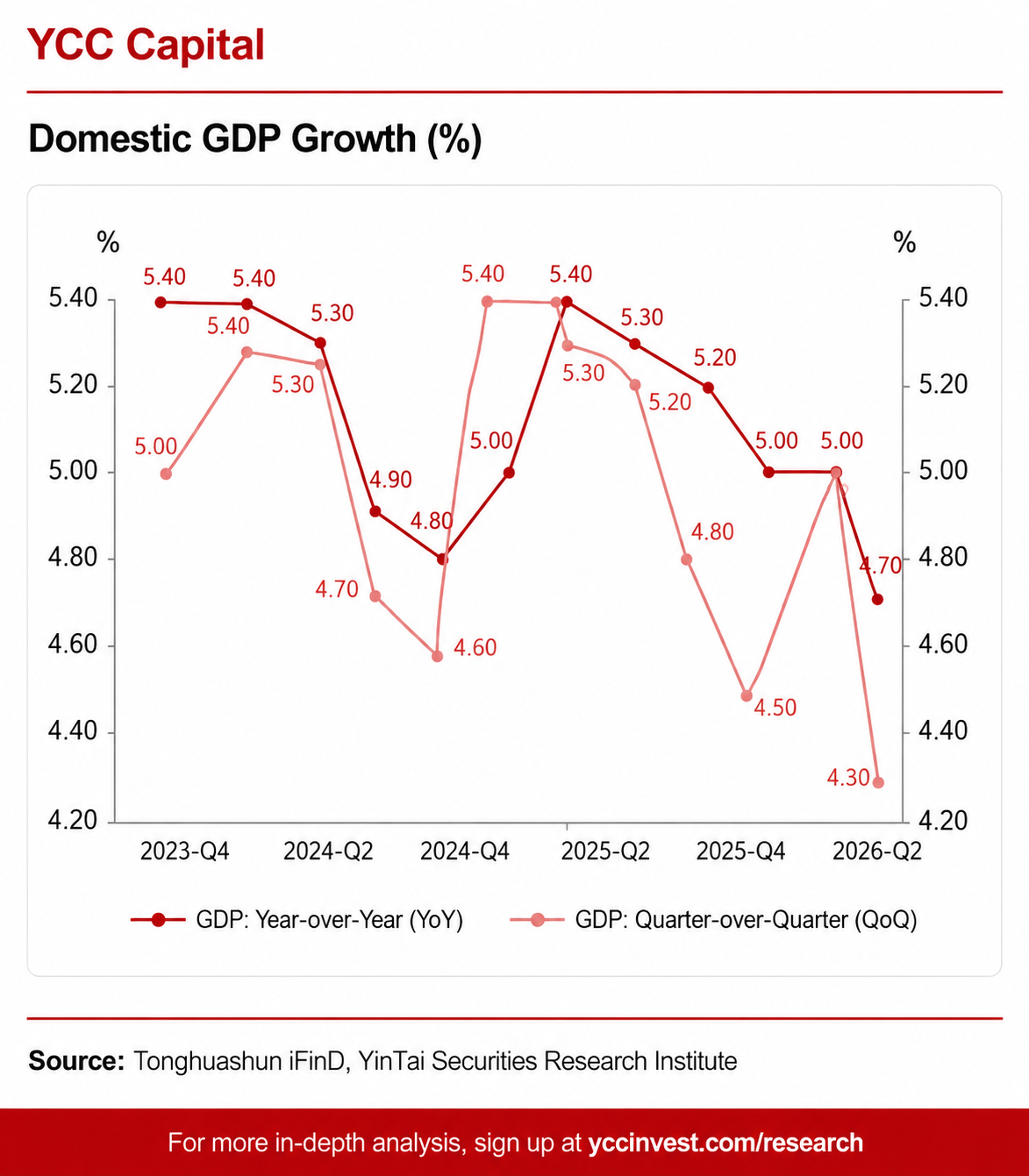
China reported first-half GDP growth of 4.7% year-over-year, remaining technically within the government’s official target range. However, the composition of growth has become increasingly unbalanced. Second-quarter GDP slowed sharply to 4.3%, the weakest quarterly expansion in more than three years and below market expectations. While exports continue to surprise on the upside, domestic demand is clearly deteriorating. Consumption remains subdued, fixed asset investment has weakened further, manufacturing investment is fading, infrastructure spending is losing momentum, and the real estate downturn continues despite tentative stabilization in housing prices.
At YCC Capital, we believe the headline numbers increasingly mask a deeper structural reality. China is becoming more dependent on external demand precisely when geopolitical fragmentation and trade tensions are making export-led growth less reliable over the medium term. The policy challenge is no longer simply generating growth—it is rebuilding confidence across households and private enterprises. That objective remains far more difficult than delivering incremental fiscal or monetary easing.
Our base case is that Beijing will continue introducing targeted policy support during the second half of the year. However, because official GDP growth remains close to target, authorities are unlikely to launch another large-scale stimulus package comparable to previous cycles. Instead, policymakers will prioritize accelerating implementation of existing measures while attempting to stabilize consumption and investment. In our assessment, these measures are likely to soften—but not reverse—the underlying structural slowdown.
Sources: Bloomberg, YCC Capital.
China’s Economy Remains Within Target, But Momentum Has Clearly Softened
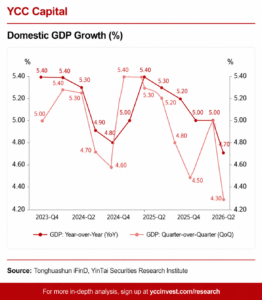
According to the National Bureau of Statistics, China’s economy expanded 4.7% year-over-year during the first half of 2026. Quarterly data, however, reveal a much more concerning trajectory.
First-quarter GDP grew 5.0%, while second-quarter growth slowed to 4.3%, with quarter-on-quarter growth of only 0.9%.
Although the annualized pace technically remains within the government’s stated target range of approximately 4.5%–5.0%, investors should avoid focusing solely on the headline. Growth quality matters far more than the aggregate figure.
The slowdown was primarily driven by weakening domestic demand. Since April, exports have remained exceptionally strong, but consumer spending and investment both deteriorated materially. As a result, external demand has increasingly become the economy’s primary growth pillar—a configuration that is difficult to sustain indefinitely.
From our perspective, this imbalance represents one of China’s most important macro vulnerabilities. Economies ultimately cannot rely forever on selling more abroad while households become increasingly cautious at home.
Sources: Bloomberg, YCC Capital.
Services and Technology Continue to Offset Traditional Weakness
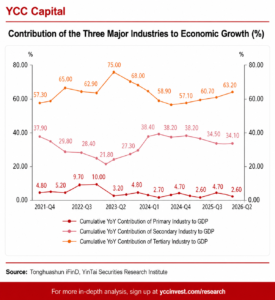
Not every component of the economy weakened during the second quarter.
One encouraging development was the continued expansion of China’s service sector. The tertiary industry contributed 66.1% of total economic growth during the first half, with its contribution reaching nearly 70% during the second quarter, representing a meaningful improvement over the previous year.
At the same time, newer sectors—including advanced manufacturing, digital technologies, artificial intelligence, and modern services—continued expanding rapidly. Official estimates indicate that these emerging industries contributed more than 40% of overall economic growth during the first half.
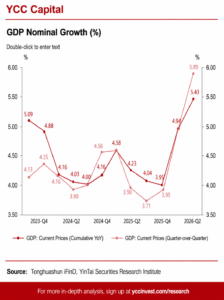
Another notable development was the recovery in nominal GDP growth.
Supported by modest improvements in domestic pricing, higher global commodity prices, continued AI-related investment, and Beijing’s campaign against excessive industrial price competition, nominal GDP growth accelerated to 5.9% in the second quarter.
Most importantly, China’s GDP deflator turned positive for the first time in roughly three years, reaching 1.5%.
While encouraging, we view this primarily as a cyclical improvement rather than evidence that China’s broader deflationary pressures have been fully resolved.
Industrial Production Continues to Benefit from Robust Export Demand
Industrial production remains one of the economy’s strongest-performing sectors.
Industrial value-added increased 5.3% year-over-year in June, exceeding consensus expectations and accelerating from May. During the first half of the year, industrial production expanded 5.4%.
The explanation remains straightforward.
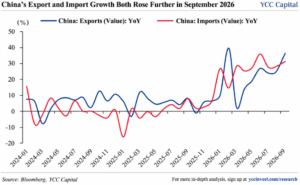
China’s exports, measured in U.S. dollars, surged 27.0% year-over-year in June, while export deliveries by industrial enterprises increased 14.8%. Strong overseas demand continues providing manufacturers with sufficient orders despite weakening domestic conditions.
This divergence has become increasingly visible across industrial sectors.
Manufacturing output rose 6.0%, significantly outperforming mining, which contracted 2.2%, partly reflecting stricter mine safety inspections following recent accidents. Utilities continued expanding steadily.
High-tech manufacturing remains especially impressive, growing 14.1%, substantially outperforming broader industrial production.
Transportation equipment manufacturing accelerated sharply, while computer, communications, electronics, and automobile production all maintained relatively strong growth.
The message is clear: China’s factories remain competitive internationally.
The more difficult question is whether overseas demand can continue carrying the broader economy if domestic demand continues weakening.
Consumer Spending Shows Only Modest Signs of Stabilization
June retail sales offered a modest positive surprise but remained far from robust.
Retail sales increased 1.0% year-over-year, improving from May’s decline and exceeding market expectations. First-half retail sales nevertheless expanded only 1.3%, highlighting the persistent weakness in household spending.
Both goods consumption and restaurant spending improved modestly during June.
Excluding automobiles, retail sales increased 3.0%, suggesting that vehicle-related weakness continues weighing heavily on aggregate consumption.
Several discretionary categories—including cosmetics, tobacco and alcohol, office supplies, and communications equipment—recorded stronger growth, partly reflecting favorable base effects.
However, major household purchases remained soft.
Sales of home appliances continued contracting, jewelry sales remained negative, and automobile sales fell 16.1%, showing virtually no improvement.
Household confidence continues to face significant headwinds.
When families become uncertain about employment prospects, income growth, or housing wealth, they naturally postpone large purchases. China’s consumers appear to be behaving precisely this way.
This cautious mindset represents one of the biggest obstacles to achieving a durable domestic recovery.
Investment Is Becoming an Increasingly Serious Concern
If consumption is weak, investment looks even weaker.
Fixed asset investment fell 5.7% during the first half of the year, deteriorating significantly from previous months and performing considerably below market expectations.
Private investment declined 8.5%, underscoring the continued reluctance of private enterprises to expand capacity despite repeated policy support.
Both manufacturing investment and infrastructure investment weakened simultaneously.
Manufacturing investment slipped into negative territory, while broad infrastructure investment also contracted.
Several factors contributed to this slowdown.
Local governments continue facing fiscal constraints, limiting their ability to finance new infrastructure projects. At the same time, exceptionally hot weather in northern China and severe flooding across southern regions disrupted construction activity during the second quarter.
Nevertheless, temporary weather disruptions cannot fully explain the broader trend.
Private businesses remain hesitant to commit long-term capital amid uncertain demand and a still-fragile property sector. Until confidence improves meaningfully, investment is likely to remain subdued.
Real Estate Remains the Economy’s Largest Structural Drag
The property market continues illustrating the distinction between cyclical stabilization and genuine recovery.
Nearly every measure of real estate development weakened further during June.
Property investment declined 18.0% year-over-year during the first half.
Housing starts contracted 23.4%.
Construction activity remained deeply negative.
Completed housing projects also continued declining.
Meanwhile, both residential sales area and sales value deteriorated further compared with the previous month.
These figures indicate that developers remain highly cautious regarding future demand.
The one encouraging development lies in housing prices.
New-home prices in first-tier cities have now increased on a month-over-month basis for four consecutive months. Second- and third-tier cities continue recording declines, but the pace of decline has moderated.
Among China’s 70 major cities, 20 cities recorded monthly increases in new-home prices, the highest number since mid-2025.
Second-hand housing prices also stabilized modestly in major metropolitan areas, with Beijing, Shanghai, Guangzhou, and Shenzhen all recording monthly gains.
From YCC Capital’s perspective, however, investors should be careful not to overinterpret these improvements.
Price stabilization does not necessarily imply a healthy property market.
Transaction volumes remain weak, developers continue facing funding challenges, and new construction activity remains depressed. Housing prices can stabilize while the broader property sector continues contracting.
We therefore view the current environment as one of stabilization rather than recovery.
Policy Outlook: Incremental Support Rather Than Massive Stimulus
As growth momentum softens, policymakers will almost certainly respond with additional countercyclical measures.
However, we do not expect a repeat of the large-scale stimulus campaigns deployed during previous downturns.
There are several reasons.
First, headline GDP growth remains within the government’s official target range.
Second, policymakers continue prioritizing financial stability and debt control alongside economic growth.
Third, Beijing increasingly appears focused on improving policy efficiency rather than maximizing headline stimulus.
Accordingly, policy efforts during the second half are likely to emphasize faster implementation of existing programs rather than introducing dramatically larger fiscal packages.
Measures supporting household consumption, improving local government financing conditions, and selectively stabilizing the housing market are likely to receive greater attention.
Whether these policies ultimately succeed will depend less on liquidity and more on confidence.
Confidence, unlike credit, cannot simply be injected into the economy.
Investment Implications
For global investors, China’s latest macro data reinforce several important themes.
Export-oriented manufacturers, advanced technology firms, and selected industrial leaders continue benefiting from resilient overseas demand.
By contrast, sectors tied closely to domestic discretionary consumption, residential construction, and private investment are likely to face a more challenging operating environment.
The divergence between China’s externally competitive manufacturing sector and its weaker domestic economy is becoming increasingly pronounced.
This creates selective opportunities rather than broad-based bullishness.
From an asset allocation perspective, we continue favoring diversified global exposure over concentrated China risk. While China’s economy is unlikely to experience an outright collapse, neither do we see convincing evidence that it is entering a sustained reacceleration. Instead, investors should prepare for an environment characterized by slower trend growth, persistent policy intervention, and widening performance gaps across industries.
The broader lesson extends beyond China itself. Global supply chains remain deeply intertwined with Chinese manufacturing, yet long-term capital increasingly seeks economies offering stronger domestic demand, more transparent institutions, and greater policy predictability. Those structural shifts will continue shaping international investment flows well beyond this year’s economic data.
At YCC Capital, our strategic view remains unchanged: China retains world-class manufacturing capabilities and technological strengths, but its structural growth model is undergoing a difficult transition. Until household confidence, private investment, and property markets recover in a durable manner, China’s economy is likely to remain increasingly dependent on exports—a strategy that becomes more challenging in an increasingly fragmented global trading system.
Editorial Board
Ken Cao, Chief Strategist, Global Investment Strategy
Le Gao, Managing Analyst
Yui Nabeshima, Strategist
Mai Ikeda, Research Analyst
IMPORTANT DISCLAIMER
This research report is provided for informational and educational purposes only and does not constitute an offer to sell or a solicitation of an offer to buy any securities, financial instruments, or investment products. It is not intended as investment, legal, accounting, or tax advice and should not be relied upon as such. The views, opinions, and projections expressed herein are those of YCC Capital Management and its research personnel as of the date of publication and are subject to change without notice. Past performance is not indicative of future results.
YCC Capital Management, its affiliates, principals, and employees may hold long or short positions in securities or instruments discussed in this report and may trade for their own accounts or for client accounts in a manner inconsistent with the recommendations herein. This report is based on publicly available information and data believed to be reliable, but YCC Capital makes no representation or warranty, express or implied, as to the accuracy, completeness, or timeliness of such information. Forward-looking statements involve risks and uncertainties that could cause actual results to differ materially from those projected.
Recipients of this report should conduct their own independent due diligence and consult with their own financial, legal, and tax advisors before making any investment decisions. YCC Capital accepts no liability for any loss or damage arising from the use of or reliance on this report or its contents.
This report is intended solely for the use of the intended recipient(s) and may not be reproduced or redistributed for commercial purposes without the prior written consent of YCC Capital. © 2026 YCC Capital. All rights reserved. YCC Capital’s flagship vehicle, the YCC International Value Fund, LP, maintains a concentrated global macro value strategy with a focus on capital-flow-driven mispricings and asymmetric hedging opportunities. The Fund is registered in the State of Delaware, U.S. and structured as a 506(c) fund. Performance data, where referenced, has been verified by independent third parties including NAV Consulting; however, individual investor results may vary.
Contact Us
YCC Capital Research
For institutional inquiries or media requests:
Sign up for our free daily macro and market insights at www.yccinvest.com.
Primary source material: macroeconomic report provided by the user.
For more related research: