YCC CAPITAL
Emerging Markets & China Strategy
22 July 2026
YCC Capital Perspective
Every economic cycle eventually arrives at a moment when policymakers have to answer a deceptively simple question: if growth slows and the private sector refuses to borrow, who steps in?
For China, the answer has increasingly become the government.
Over the past five years, government borrowing has transformed from a supporting policy instrument into the dominant engine sustaining economic activity. What once served as a temporary counter-cyclical buffer has gradually evolved into a structural pillar supporting demand, infrastructure investment, local government finances, and financial stability itself.
Yet debt is much like borrowing time from the future. Initially it creates flexibility. Eventually it begins to reduce it.
Imagine a household repeatedly refinancing its mortgage while income stagnates. Monthly cash flow remains manageable for years, but each refinancing leaves less room to absorb future shocks. China’s public finances increasingly resemble this dynamic. Borrowing continues to stabilize the present, but each additional round delivers progressively smaller gains while future obligations quietly accumulate.
This report examines China’s evolving government debt architecture, the shifting balance between central and local government borrowing, and the implications for investors across fixed income, currencies and global asset allocation.
Our conclusion is straightforward.
China still possesses significant fiscal capacity compared with many developed economies. However, expanding debt is no longer generating the economic multiplier it once did. Fiscal policy is increasingly preventing deterioration rather than creating sustained acceleration, implying that government leverage can stabilize the economy but is unlikely to restore the high-growth model of previous decades.
Executive Summary
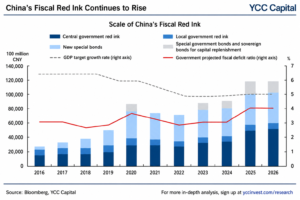
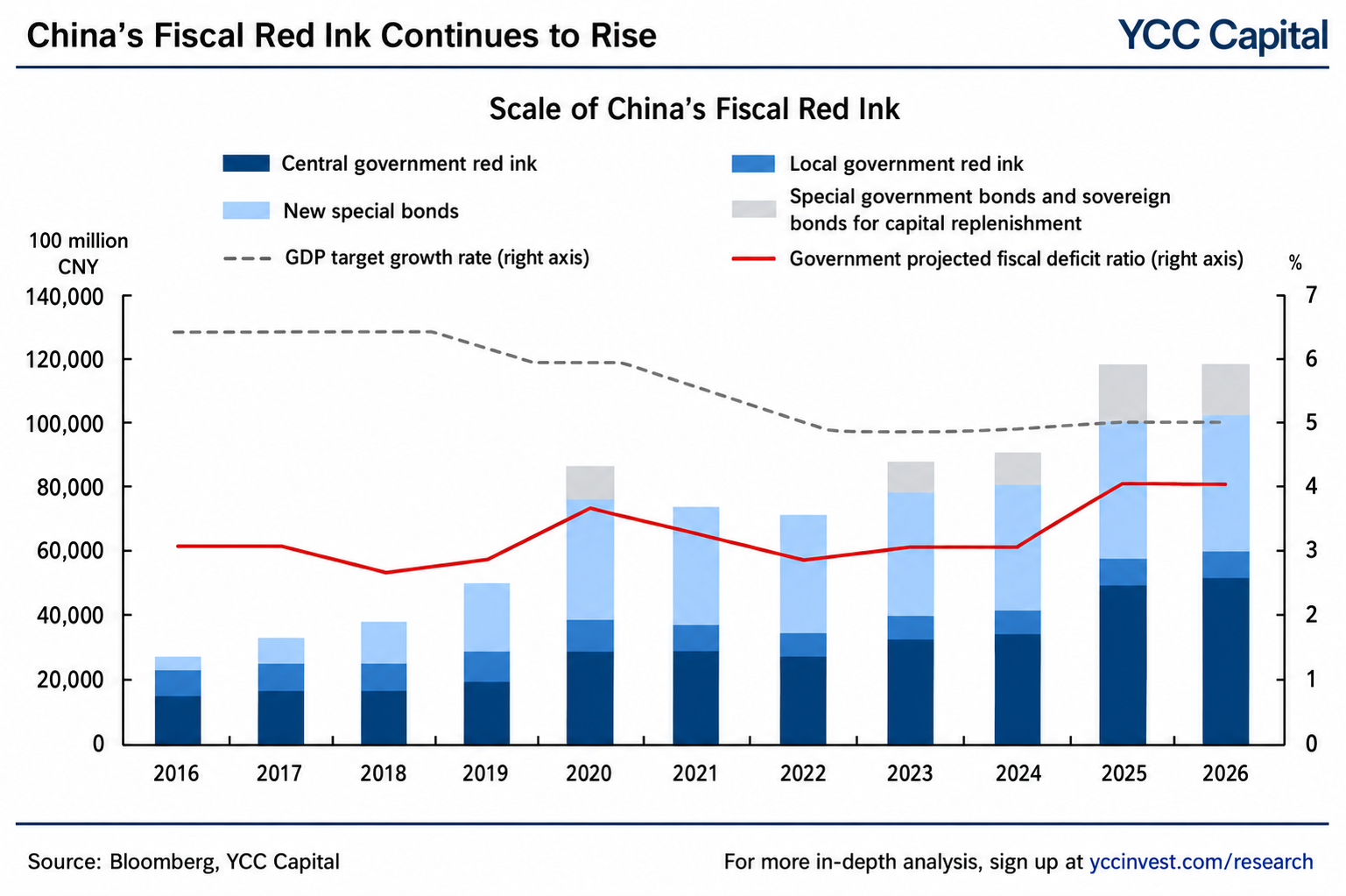
China’s government debt has entered a new phase of expansion. Outstanding government bonds now exceed RMB 100 trillion, accounting for nearly half of China’s domestic bond market. By year-end 2026, total government debt is projected to approach RMB 110 trillion, with central government bonds reaching roughly RMB 47.5 trillion and local government bonds approximately RMB 62 trillion.
The rapid increase reflects persistent weakness in private-sector demand. Household deleveraging, subdued corporate borrowing and a prolonged property downturn have forced fiscal policy to shoulder a growing share of economic stabilization.
Government borrowing now contributes more than 40% of China’s total credit expansion. Yet despite its increasing scale, its effectiveness has steadily diminished. Every additional unit of government borrowing now produces less than one-tenth of a unit of incremental GDP, compared with more than one unit before 2015.
The implication is clear: China is experiencing diminishing fiscal returns.
Government Debt Has Become the Backbone of China’s Credit System
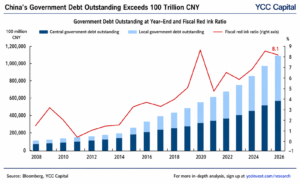
China’s bond market has undergone a remarkable structural transformation.
Government securities—including both sovereign and local government bonds—now represent approximately 49.8% of the entire domestic bond market, totaling approximately RMB 102.1 trillion as of June 2026.
This expansion has not occurred accidentally.
Fiscal revenues have weakened as land sales collapsed and domestic demand softened. Meanwhile, policymakers have remained reluctant to pursue large-scale household income transfers comparable to Western fiscal responses during recent crises.
Instead, Beijing has relied on debt-financed investment.
This approach has allowed authorities to sustain infrastructure spending, support strategic industries, stabilize employment and contain financial risks without fundamentally changing the country’s state-led development model.
However, there is an important distinction between expanding balance sheets and expanding productivity.
Debt can finance bridges.
It cannot guarantee traffic.
Fiscal Sustainability Is Becoming Increasingly Challenging
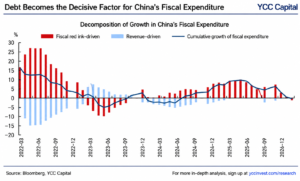
China’s government leverage ratio has now climbed above 70% of GDP, continuing an upward trajectory that has accelerated since the pandemic.
The underlying drivers are straightforward.
Government revenues have struggled to keep pace with spending commitments.
Property-related revenues have deteriorated sharply.
Land-sale income, once the cornerstone of local government finance, has fallen by more than half from its 2021 peak.
At the same time, infrastructure commitments, industrial policy initiatives and debt servicing obligations have continued expanding.
As a result, borrowing increasingly determines fiscal spending capacity.
Instead of tax revenues financing expenditures with debt filling temporary gaps, the sequence has effectively reversed.
Debt issuance increasingly determines how much fiscal spending can occur.
This marks an important institutional shift.
Government financing is no longer simply supporting fiscal policy.
It has become fiscal policy.
The Declining Efficiency of Fiscal Expansion
Perhaps the most striking development is the steady deterioration in fiscal efficiency.
During earlier periods of rapid urbanization and infrastructure expansion, government borrowing generated substantial economic returns.
Roads connected manufacturing hubs.
High-speed rail improved logistics.
Utilities expanded productive capacity.
Today’s environment is fundamentally different.
China already possesses one of the world’s largest infrastructure networks.
Demographic aging reduces housing demand.
Private-sector investment remains cautious.
Consumer confidence has yet to recover meaningfully.
Consequently, incremental borrowing increasingly finances refinancing, debt restructuring and maintenance rather than creating entirely new productive assets.
According to the report, the GDP generated per unit of new government debt has fallen below 0.1, compared with levels exceeding 1 before 2015.
This is perhaps the single most important statistic in understanding China’s current macroeconomic trajectory.
The country is not running out of financing capacity.
It is running into diminishing economic returns.
Central Government Bonds Remain Beijing’s Primary Counter-Cyclical Tool
Among China’s fiscal instruments, sovereign bonds continue to serve as the central government’s principal stabilization mechanism.
For 2026, net sovereign bond financing is expected to reach approximately RMB 6.7 trillion.
Issuance accelerated early in the year before slowing during the second quarter, suggesting heavier supply during the second half as ultra-long special sovereign bonds and recapitalization bonds are brought to market.
Special sovereign bonds occupy a unique position within China’s fiscal framework.
Unlike ordinary government bonds, they finance specific strategic objectives outside the standard fiscal deficit.
Historically they have funded bank recapitalizations, sovereign wealth fund creation, pandemic response measures and national strategic initiatives.
Today’s issuance continues that pattern.
Ultra-long bonds finance national infrastructure priorities, advanced manufacturing and strategic modernization, while recapitalization bonds strengthen the financial system.
From a market perspective, sovereign bond yields continue to reflect three primary forces:
First, monetary policy determines short-term funding costs.
Second, economic fundamentals shape long-term expectations.
Third, structural demand—including persistent demand from banks, insurers and institutional investors—continues compressing yields.
With China’s property downturn encouraging capital to migrate toward fixed-income assets, demand for government bonds remains exceptionally strong.
YCC Capital expects the 10-year Chinese government bond yield to remain broadly anchored around the 1.7%-1.8% range over the medium term, although periods of heavy issuance may generate temporary upward pressure.
Local Government Debt: The Engine—and the Weakness—of China’s Fiscal System
If sovereign borrowing represents Beijing’s policy flexibility, local government debt represents China’s greatest fiscal vulnerability.
Outstanding local government debt now exceeds RMB 58 trillion and is projected to approach RMB 62 trillion by the end of 2026.
Unlike central government borrowing, local government debt directly finances regional investment projects, transportation infrastructure, industrial parks and urban redevelopment.
For years this model powered China’s rapid expansion.
Today it faces increasing strain.
New special-purpose bonds officially remain focused on infrastructure investment, yet their composition has changed markedly.
An increasing share now finances debt restructuring and land reserve programs rather than genuinely new investment.
During 2025, more than 40% of newly issued special-purpose bonds were directed toward debt resolution or land reserves.
In 2026, that proportion remains approximately one-third.
Consequently, only around RMB 1.5 trillion of current issuance ultimately supports new construction projects.
The shift is subtle but important.
China is gradually moving from financing growth toward financing balance-sheet repair.
Rising Debt Servicing Pressures
The growing debt burden has another consequence.
Debt service increasingly consumes local fiscal resources.
Interest expenses continue rising while land revenues continue declining.
After seasonal adjustment, debt principal and interest payments now consume nearly 30% of local governments’ broad fiscal revenues.
This creates a classic refinancing cycle.
Existing obligations require additional borrowing.
Additional borrowing generates larger future repayments.
Larger repayments require further refinancing.
As long as borrowing costs remain low and market access remains open, the system can continue functioning.
However, it becomes progressively less flexible over time.
This explains why Beijing has placed increasing emphasis on managing refinancing risks rather than simply expanding borrowing.
Hidden Debt Resolution: Beijing’s Most Ambitious Fiscal Clean-Up
While officially recognized government bonds dominate China’s fiscal landscape, they tell only part of the story. Running parallel to the formal balance sheet is another layer of liabilities that has shaped local government finance for nearly two decades: hidden debt.
These obligations—primarily accumulated through Local Government Financing Vehicles (LGFVs), bank loans, trust products, leasing arrangements, and other off-balance-sheet financing structures—were created to circumvent earlier restrictions on direct local government borrowing. During the years of rapid urbanization, they allowed provinces and municipalities to finance roads, industrial parks, subway systems, housing projects and public infrastructure without formally expanding government debt.
The model worked exceptionally well while land prices were rising and economic growth remained comfortably above 7%.
It became far more difficult once both engines slowed simultaneously.
China’s property downturn dramatically reduced local fiscal revenues, while slower economic growth weakened cash flows generated by many infrastructure projects. Assets that once appeared self-financing suddenly required refinancing, creating mounting rollover risks across the local government financing system.
Recognizing these pressures, Beijing has shifted from simply containing hidden debt toward systematically eliminating it.
The current debt restructuring campaign represents the largest fiscal cleanup effort since China’s modern local government bond market was established.
According to official policy implementation summarized in the source report, authorities launched a RMB 10 trillion debt resolution package beginning in late 2024. The program combines RMB 6 trillion of special refinancing bonds issued over three years with an additional RMB 800 billion annually in newly authorized special-purpose bonds over five years dedicated specifically to debt restructuring.
By June 2026, approximately RMB 7.7 trillion of the planned funding had already been issued, representing close to 80% completion of the formal program. When supplementary refinancing measures are included, cumulative debt-resolution funding deployed over the past two and a half years reaches roughly RMB 9.1 trillion. More than one-third of all local government bond issuance during the first half of 2026 was directed toward debt restructuring rather than new investment.
The scale alone illustrates Beijing’s priorities.
Stability has overtaken expansion.
Local Government Financing Vehicles Are Being Rewritten
The campaign extends well beyond replacing one type of debt with another.
Beijing is fundamentally redesigning the institutional role of Local Government Financing Vehicles.
For years, LGFVs functioned as the unofficial financial arms of local governments. Markets generally assumed implicit state guarantees, allowing these entities to borrow at relatively attractive financing costs despite often weak commercial fundamentals.
That assumption is gradually disappearing.
Recent policy directives require financing platforms to transition into commercially operated enterprises capable of surviving without automatic government support. New borrowing has become increasingly restricted, and provinces are expected to remove financing platforms from official government support lists according to a defined timetable.
Progress has been substantial.
By the end of 2025, more than 82% of financing platforms had reportedly exited the official list, while outstanding operating financial liabilities had fallen by over 74%. Meanwhile, the outstanding stock of LGFV bonds declined from approximately RMB 10.7 trillion at the end of 2023 to around RMB 9.3 trillion by mid-2026.
These numbers represent more than accounting adjustments.
They signal one of the most significant structural reforms in China’s public finance system since the introduction of standardized local government bonds.
The government’s objective is increasingly clear: replace opaque, implicitly guaranteed liabilities with transparent, standardized public debt that investors can price more accurately.
Can China Eliminate Hidden Debt?
The official timetable remains ambitious.
The Ministry of Finance intends to complete the nationwide hidden debt resolution process by the end of 2028, while related policy documents require financing platform reform to be substantially completed by mid-2027. Based on the pace described in the source report, hidden debt could decline to roughly RMB 3.5-4.0 trillion by the end of 2026, compared with an officially disclosed balance of RMB 10.5 trillion at the end of 2024.
Even so, the remaining task should not be underestimated.
Many of the easier liabilities have already been refinanced.
The remaining obligations are likely to be concentrated in fiscally weaker regions where economic growth is slower, land markets remain depressed and refinancing capacity is more constrained.
The challenge therefore shifts from reducing aggregate debt to resolving regional asymmetries.
Some provinces possess diversified tax bases, advanced manufacturing sectors and relatively healthy public finances.
Others continue to rely heavily on declining property markets and limited fiscal flexibility.
This divergence will become increasingly important for investors evaluating China’s municipal credit landscape over the coming years.
YCC Capital Strategic View
China’s debt expansion should not be interpreted simply as evidence of an impending fiscal crisis.
Nor should it be viewed as evidence that fiscal stimulus alone can restore the country’s previous growth model.
Reality lies between these extremes.
Unlike many emerging markets, China finances the overwhelming majority of its government borrowing domestically, maintains extensive control over its banking system, and continues to possess substantial policy flexibility. These characteristics significantly reduce the probability of a sudden sovereign funding crisis.
However, none of these advantages eliminate the fundamental arithmetic of declining returns on debt.
Each additional round of borrowing now appears to stabilize existing activity rather than generate a proportionate increase in new economic output.
In other words, Beijing is purchasing stability—not acceleration.
That distinction matters enormously for long-term investors.
Over the coming decade, we expect China’s macroeconomic performance to be increasingly characterized by lower volatility, slower trend growth and greater reliance on administrative policy intervention. The economy is unlikely to experience a disorderly collapse, but neither does it appear positioned to regain the investment-led dynamism that defined earlier decades.
For global investors, this suggests a different framework for assessing China.
Rather than viewing fiscal stimulus as a catalyst for powerful cyclical recoveries, it should increasingly be viewed as a mechanism that places a floor beneath growth while gradually reducing systemic financial risks.
Investment Implications
For fixed-income investors, continued fiscal expansion alongside accommodative monetary policy should help maintain relatively low sovereign yields over the medium term, although heavier issuance calendars may create temporary supply-driven volatility.
For equity investors, fiscal support is likely to remain concentrated in sectors aligned with national strategic priorities—including advanced manufacturing, industrial upgrading, selected infrastructure and technology—rather than broad-based consumer reflation.
Regional and property-related exposures remain considerably more vulnerable. Local government balance-sheet repair, declining land revenues and ongoing restructuring of financing platforms imply that property-driven growth is unlikely to return as China’s primary economic engine.
From a global asset-allocation perspective, China’s experience reinforces a broader lesson visible across many mature economies.
Debt can postpone adjustment.
It rarely eliminates it.
The coming years will therefore be defined less by how much Beijing can borrow, and more by whether the capital being deployed ultimately generates sustainable productivity gains.
That question—not the headline debt figure itself—will determine China’s long-term economic trajectory.
Editorial Board
Ken Cao
Chief Strategist, Global Investment Strategy
Le Gao
Managing Analyst
Yui Nabeshima
Strategist
Mai Ikeda
Research Analyst
IMPORTANT DISCLAIMER
This research report is provided for informational and educational purposes only and does not constitute an offer to sell or a solicitation of an offer to buy any securities, financial instruments, or investment products. It is not intended as investment, legal, accounting, or tax advice and should not be relied upon as such. The views, opinions, and projections expressed herein are those of YCC Capital Management and its research personnel as of the date of publication and are subject to change without notice. Past performance is not indicative of future results.
YCC Capital Management, its affiliates, principals, and employees may hold long or short positions in securities or instruments discussed in this report and may trade for their own accounts or for client accounts in a manner inconsistent with the recommendations herein. This report is based on publicly available information and data believed to be reliable, but YCC Capital makes no representation or warranty, express or implied, as to the accuracy, completeness, or timeliness of such information. Forward-looking statements involve risks and uncertainties that could cause actual results to differ materially from those projected.
Recipients of this report should conduct their own independent due diligence and consult with their own financial, legal, and tax advisors before making any investment decisions. YCC Capital accepts no liability for any loss or damage arising from the use of or reliance on this report or its contents.
This report is intended solely for the use of the intended recipient(s) and may not be reproduced or redistributed for commercial purposes without the prior written consent of YCC Capital. © 2026 YCC Capital. All rights reserved. YCC Capital’s flagship vehicle, the YCC International Value Fund, LP, maintains a concentrated global macro value strategy with a focus on capital-flow-driven mispricings and asymmetric hedging opportunities. The Fund is registered in the State of Delaware, U.S. and structured as a Rule 506(c) fund. Performance data, where referenced, has been verified by independent third parties including NAV Consulting; however, individual investor results may vary.
Contact Us
YCC Capital Research
For institutional inquiries and research requests:
Email: ir@yccinvest.com
Sign up for our free daily global market insights at:
For more related research:
China’s Fiscal Engine Shifts Gears: Revenue Recovery Emerges While Spending Power Waits in the Wings
Oil, Rates, and Risk: Why the Middle East Shock Is Repricing Global Fixed Income