YCC CAPITAL
Global Fixed Income & Currency Strategy
September 15, 2026
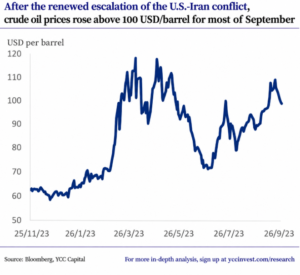
The global macro backdrop has become materially less forgiving. An escalating Middle East conflict has pushed crude oil back above $100 per barrel just as U.S. inflation is proving more persistent than markets had hoped. That combination is forcing investors to reconsider a comfortable assumption embedded in asset prices for much of the year: that monetary tightening was essentially finished. We believe the next phase will be defined by a renewed contest between resilient U.S. growth, energy-driven inflation and increasingly expensive sovereign financing.
The practical analogy is familiar. A household can absorb either a higher gasoline bill or a higher mortgage payment. When both rise together, discretionary spending becomes harder. Markets face the same squeeze today: oil is taxing the real economy while higher Treasury yields are raising the discount rate on virtually every financial asset.
Oil Reopens the Inflation Question
Middle East risks intensified further as disruptions to Saudi Arabia’s east-west oil infrastructure compounded concerns around shipping through the Strait of Hormuz and Red Sea. Brent crude moved back above $107 per barrel, forcing the market to price a larger probability of sustained supply disruption.
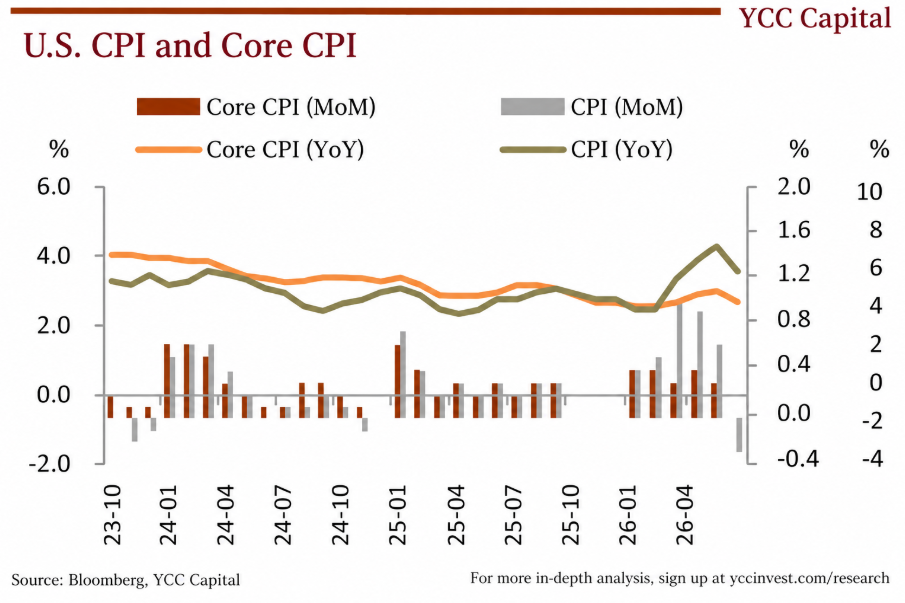
This matters because U.S. inflation was already showing renewed persistence. August headline CPI increased 0.4% month-on-month and 3.4% year-on-year. Core CPI rose 0.3% month-on-month, exceeding the 0.2% consensus expectation, while the annual rate eased only marginally to 2.4%.
Energy was the obvious accelerant. Energy prices rose 2.1% during August after falling 1.5% in July and were 16.3% higher year-on-year. Energy commodities jumped 4.2%, gasoline rose 3.9%, and fuel oil surged 10.1%. Gasoline alone accounted for more than one-third of the monthly increase in headline CPI.
Food inflation remained comparatively contained, rising 0.1% month-on-month and 2.7% year-on-year. The more important signal came from services. Core services increased 0.3%, while shelter rebounded 0.3%. More concerning for the Federal Reserve, core services excluding housing—the so-called supercore measure—rose approximately 0.51% month-on-month, its strongest reading since January.
Airfares increased 2.7%, hotel prices rebounded 2.4%, communications prices climbed 2.3%, and education costs rose 0.8%. Medical prices and motor-vehicle insurance provided some offset, but the broader message remains uncomfortable: underlying services inflation has not disappeared.
Producer prices reinforce that conclusion. Final-demand PPI rose 0.4% in August and accelerated to 5.4% year-on-year from 4.8%. Core PPI excluding food, energy and trade services advanced 0.3% month-on-month and 4.7% year-on-year. Goods prices increased 1.1%, led by a 4.2% rise in energy and an extraordinary 24.1% monthly increase in diesel prices.
Source: Bloomberg, YCC Capital.
The Federal Reserve Is Back in Play
Markets have responded quickly. Pricing for a 25-basis-point September rate increase climbed toward 90% following the inflation data, while expectations referenced during the week implied roughly an 86% probability of tightening and increasingly contemplated two additional increases before year-end.
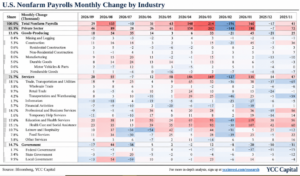
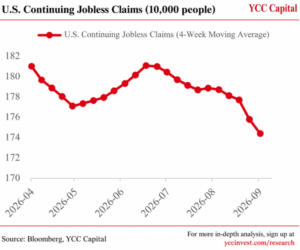
We remain cautiously constructive on the U.S. economy rather than interpreting higher rates as evidence of imminent recession. Employment remains resilient, consumption has not collapsed, and corporate earnings have provided U.S. equities with a meaningful cushion. The S&P 500 was down only 0.8% over the latest week and remained 11.85% higher year-to-date; the Nasdaq was down 0.66% for the week while retaining a 13.30% year-to-date gain.
The bigger vulnerability is duration. Two-year Treasury yields rose 26 basis points over the week to 4.37%, five-year yields increased 24 basis points to 4.54%, and ten-year yields climbed 18 basis points to 4.78%. The 10-year yield is again approaching the psychologically important 5% threshold.
Fiscal policy adds another layer. President Trump reiterated a proposed $5,000 universal payment plan over the weekend, reviving concerns about federal deficits, Treasury issuance and the inflationary consequences of additional fiscal stimulus. Whatever the final policy design, bond investors increasingly require compensation not merely for inflation risk but for supply risk.
In our view, 5% is therefore more than a round number. It is where the Treasury market begins transmitting noticeably tighter financial conditions into mortgages, corporate refinancing, equity valuations and global capital flows.
China: Strong Exports Mask a Fragile Domestic Engine
China’s August data continue to display an uncomfortable split between strong external demand and weak domestic demand. Dollar-denominated exports increased 25.0% year-on-year, while imports rose 28.2%, expanding the trade surplus to approximately $119.1 billion.
High-technology manufacturing, semiconductors, electric vehicles, batteries and demand associated with global AI capital expenditure remain important export engines. Export-market diversification has also supported shipments to emerging economies.
Yet these figures should not be mistaken for evidence of a broad domestic recovery. Stronger imports largely reflect semiconductors, energy and industrial inputs associated with manufacturing investment rather than a decisive revival in household consumption. Property-sector adjustment remains unresolved, consumer demand is subdued, and traditional consumer-goods exports are comparatively weak.
Inflation tells a similar story. August CPI rose 0.8% year-on-year and 0.4% month-on-month, while core CPI edged up to 1.0%. Food prices remained 1.4% lower year-on-year despite seasonal increases in fresh vegetables.
PPI increased 3.8% year-on-year and 0.4% month-on-month, reversing July’s 0.7% monthly decline. Non-ferrous metals processing prices rose 20.8% year-on-year, petroleum and coal-processing prices increased 11.1%, and oil and gas extraction prices gained 10.5%.
This is improvement in prices, but the distinction matters: much of it is cost-push reflation rather than demand-pull reflation. Rising oil and commodity inputs can lift nominal prices without repairing household confidence or property demand. China therefore remains vulnerable to a recovery that looks stronger in industrial statistics than it feels in everyday economic life.
Chinese equities reflected that fragility. The Shanghai Composite declined 1.07% during the week, the CSI 300 fell 0.83%, and the Hang Seng Index dropped 3.30%. Hong Kong technology was particularly weak, losing 5.45% for the week and remaining 21.67% lower year-to-date.
Source: Bloomberg, YCC Capital.
Cross-Asset Signals: Energy Wins, Duration Loses
Oil was the week’s dominant asset move. WTI gained 9.30% to roughly $100 per barrel, while Brent advanced 8.35% to $104.32 in the weekly market table. Year-to-date gains approached 97% for WTI and 111% for Brent.
Metals were weaker as higher global yields overwhelmed the inflation-hedge narrative. COMEX gold declined 1.93% and silver fell 2.59%. LME copper dropped 1.31%. The message is important: when real and nominal yields rise aggressively, even assets traditionally associated with inflation protection can struggle.
The dollar index remained comparatively stable at 99.09. USD/CNY stood near 6.71, while the yen strengthened against the renminbi during the week. We expect currency volatility to increase if the Fed and Bank of Japan produce divergent policy surprises.
Japan deserves a differentiated view. The 10-year JGB yield has risen to 2.91%, up 92.1 basis points year-to-date, creating near-term valuation and financing challenges. Nevertheless, we continue to regard Japan’s adjustment as part of a cyclical normalization rather than evidence of structural deterioration. Japan’s longer-term corporate-governance improvements, capital discipline and normalization of domestic price formation remain constructive forces even as markets digest higher rates.
YCC Strategic View
The coming week carries unusually concentrated event risk: U.S. retail sales, the September Federal Reserve decision, the Bank of Japan meeting, Chinese financial and activity data, and further developments in the Middle East.
Our base case is that U.S. economic resilience survives the current tightening impulse, but the price investors pay for that resilience is a higher-for-longer rate structure. We would therefore be selective with long-duration exposure until the inflation consequences of the oil shock become clearer.
China presents almost the reverse configuration: headline industrial and trade numbers remain impressive, but domestic transmission is weak. We would resist extrapolating export strength into a durable broad-based recovery and remain cautious toward China-sensitive risk assets.
The central market question is no longer simply whether inflation is falling. It is whether inflation can fall while oil exceeds $100, employment remains firm and fiscal policy stays expansionary. That is a considerably higher hurdle—and it is why the 5% line in the Treasury market matters.
Source: Bloomberg, YCC Capital.
Editorial Board
Ken Cao, Chief Strategist, Global Investment Strategy; Le Gao, Managing Analyst; Yui Nabeshima, Strategist; Mai Ikeda, Research Analyst.
IMPORTANT DISCLAIMER
This research report is provided for informational and educational purposes only and does not constitute an offer to sell or a solicitation of an offer to buy any securities, financial instruments, or investment products. It is not intended as investment, legal, accounting, or tax advice and should not be relied upon as such. The views, opinions, and projections expressed herein are those of YCC Capital Management and its research personnel as of the date of publication and are subject to change without notice. Past performance is not indicative of future results.
YCC Capital Management, its affiliates, principals, and employees may hold long or short positions in securities or instruments discussed in this report and may trade for their own accounts or for client accounts in a manner inconsistent with the recommendations herein. This report is based on publicly available information and data believed to be reliable, but YCC Capital makes no representation or warranty, express or implied, as to the accuracy, completeness, or timeliness of such information. Forward-looking statements involve risks and uncertainties that could cause actual results to differ materially from those projected.
Recipients of this report should conduct their own independent due diligence and consult with their own financial, legal, and tax advisors before making any investment decisions. YCC Capital accepts no liability for any loss or damage arising from the use of or reliance on this report or its contents.
This report is intended solely for the use of the intended recipient(s) and may not be reproduced or redistributed for commercial purposes without the prior written consent of YCC Capital. © 2026 YCC Capital. All rights reserved. YCC Capital’s flagship vehicle, the YCC International Value Fund, LP, maintains a concentrated global macro value strategy with a focus on capital-flow-driven mispricings and asymmetric hedging opportunities. The Fund is registered in the State of Delaware, U.S and structured as a 506(c) fund. Performance data, where referenced, has been verified by independent third parties including NAV Consulting; however, individual investor results may vary.
Contact Us
For research inquiries, contact ir@yccinvest.com. Sign up for free daily market insight at yccinvest.com.
YCC Capital Research | Sign up for free daily market insight at www.yccinvest.com
For more related research:
Oil, Rates, and Risk: Why the Middle East Shock Is Repricing Global Fixed Income
The Fed’s Hawkish Pause Raises the Bar: Why Real Yields Now Hold the Key to Global Markets
Two Economies, Two K’s: China’s Weak Domestic Loop Meets America’s AI-Led Expansion