YCC CAPITAL
Global Fixed Income & Currency Strategy
October 6, 2026
September’s U.S. employment report delivered something markets have been waiting for: clearer evidence that labor demand is cooling while labor supply is recovering. Payroll growth disappointed sharply, prior months were revised lower, wage growth moderated, and unemployment edged higher. Yet this is not a clean recession signal. The more interesting development is that the labor market’s supply-demand imbalance has turned slightly negative for the first time since April. In our view, America is moving from labor scarcity toward labor normalization—an important distinction for the Federal Reserve and for investors trying to separate cyclical cooling from genuine economic deterioration.
September Payrolls: A Clear Downshift
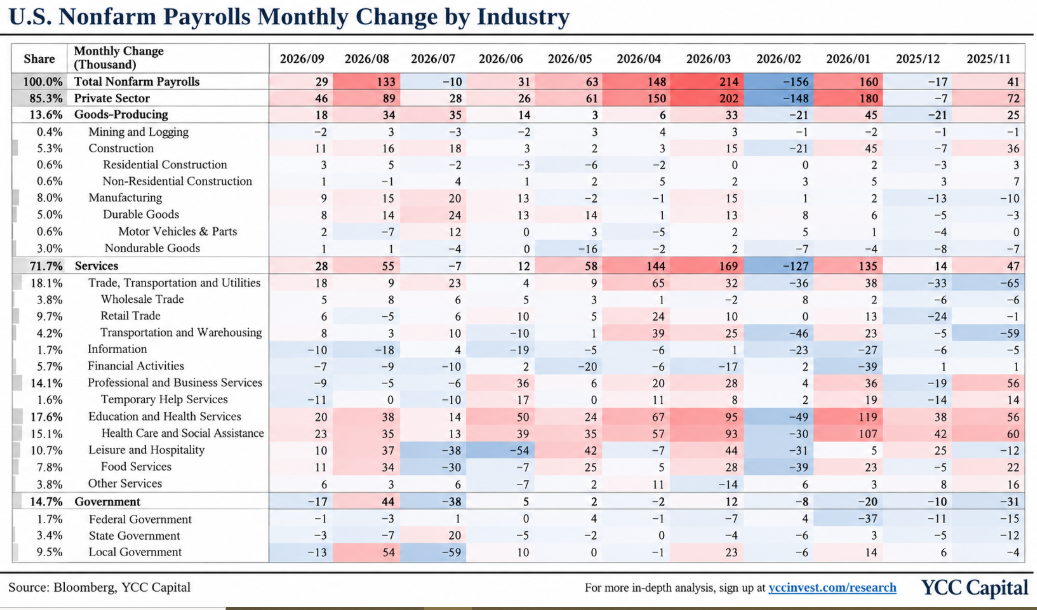
Nonfarm payrolls increased by just 29,000 in September, dramatically below the 90,000 consensus estimate. August payroll growth was revised down from 162,000 to 133,000, while cumulative revisions to the previous two months removed 60,000 jobs. The three-month average consequently stands at only 51,000, after the previously reported average was itself revised down from 71,000.
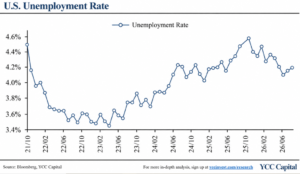
Unemployment simultaneously rose to 4.2%, versus 4.1% expected and previously. Wage pressure also softened: average hourly earnings increased only 0.1% month over month, compared with expectations and the previous reading of 0.3%, while year-over-year wage growth slowed to 3.0% from 3.1%.
The contrast with August is striking. September brought weaker headline hiring, meaningful downward revisions and renewed deterioration in the employment trend. Markets initially responded in textbook fashion: Treasury yields fell, gold rose and U.S. equity futures advanced as investors marked down expectations for further tightening. But much of the Treasury and gold move subsequently reversed, while equities retained their gains.
That reversal matters. Markets are telling us that one weak employment print is no longer sufficient to rewrite the monetary-policy narrative.
The Headline Is Weak; the Composition Is Weaker
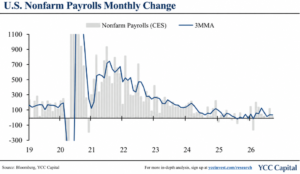
September hiring was unusually concentrated. Of the 29,000 net jobs created, education and healthcare contributed roughly 20,000. More industries contracted than in August, while employment diffusion deteriorated sharply.
Some previous distortions also faded. Local-government employment swung from +54,000 in August to -13,000, while leisure and hospitality hiring slowed from +37,000 to +10,000 as earlier event-related volatility normalized.
Strip out government, education and healthcare, and leisure and hospitality—categories that can be volatile or less representative of contemporaneous private demand—and the remaining economy generated only 16,000 jobs. There is a modest silver lining: year-over-year employment growth across these residual industries appears to be bottoming. The labor market is losing breadth, but it is not uniformly collapsing.
The one-month employment diffusion index fell to 49%, meaning fewer than half of measured industries expanded payrolls versus August, the weakest reading since November 2025. That resembles a restaurant where a few tables remain crowded while much of the dining room has quietly emptied. Business is still being done; it is simply becoming much less broadly distributed.
AI Is Already Reshaping the Employment Map
September also reinforces an emerging divergence between building AI infrastructure and deploying AI applications.
Construction employment associated with data-center investment increased by 11,000, manufacturing gained 9,000, and trade and transportation added 18,000. Together these areas generated approximately 38,000 jobs. Meanwhile, information technology lost 10,000, and financial activities lost 7,000, for a combined decline of 17,000.
We would resist reducing every sector-level move to AI, but the direction is worth watching. The physical build-out of the AI economy remains labor- and capital-intensive, while adoption increasingly allows information-heavy businesses to reconsider headcount. The first phase of the AI boom poured concrete and installed servers; the next phase increasingly asks what those servers can do instead of additional white-collar labor.
There is an important statistical caveat. The initial response rate for the September Current Employment Statistics survey was only 53.1%, its lowest since October 2024. September payrolls therefore deserve a wider-than-usual confidence interval, and subsequent revisions could be substantial.
Why Higher Unemployment Is Not Entirely Bad News
The household survey contains perhaps the most constructive element of the release.
The U.S. labor force expanded by 485,000 people in September. Approximately 139,000 came from natural population growth, while another 346,000 reflected people moving from outside the labor force into it. The labor-force participation rate consequently increased 0.2 percentage point to 61.8%.
Of those 485,000 additional labor-force participants, approximately 406,000 became employed and 78,000 were unemployed. The employment-to-population ratio increased about 0.12 percentage point to 59.21%, while the unemployment rate increased roughly 0.04 point on an unrounded basis to 4.18%.
That distinction is critical. Rising unemployment caused by layoffs tells a very different story from rising unemployment caused by people returning to the labor force.
September looks much more like the latter. Among the net increase of 78,000 unemployed workers, re-entrants increased by 152,000 and new entrants by 116,000, while voluntary job leavers actually declined by 173,000. On a non-seasonally adjusted basis, foreign-born workers were an important contributor to the improvement in labor supply.
The aggregate labor supply-demand gap consequently moved from approximately +304,000 to -31,000, entering negative territory for the first time since April. America has moved, at least temporarily, from excess labor demand toward mild excess supply.
Why Markets Refused to Declare Victory
The immediate reduction in tightening expectations proved short-lived. There are several reasons.
First, payroll data have become unusually noisy. July initially showed contraction, August surprised dramatically to the upside, and September has now surprised sharply downward. Investors should be cautious about extrapolating any single observation.
Second, expectations had already adjusted substantially. Following softer oil prices, mechanical downward revisions to PCE inflation associated with the BEA’s annual update, and Federal Reserve communication suggesting potentially only one additional increase this year, implied odds of an October hike had already fallen dramatically—from around 70% after the September 23 S&P Global U.S. PMI release to as low as 17% following September payrolls. Much of the dovish repricing had therefore happened before investors could comfortably celebrate the weak employment number.
Most importantly, the U.S. economy remains difficult to categorize. Growth data have stayed resilient even as labor-market breadth has deteriorated. The economy appears to have exited the smooth, trend-like deceleration associated with the soft-landing narrative and entered a noisier phase. Whether the next chapter is continued K-shaped divergence or a broader recovery remains unresolved.
YCC Strategic View: Cooling Is Not Cracking
Our interpretation remains cautiously constructive on the United States. September is evidence of labor-market normalization, not yet evidence of an American hard landing.
For Treasuries, softer employment and wages provide fundamental support, but investors should not assume a straight-line rally in duration. Persistent economic resilience, uncertainty surrounding inflation, oil prices and the policy path can keep the front end volatile and long yields vulnerable to renewed upward pressure.
For equities, slower wage inflation combined with continued economic expansion is potentially constructive, particularly if labor cooling occurs without a collapse in household income. Yet narrow employment breadth argues for selectivity rather than indiscriminate risk-taking.
October may prove especially difficult because investors are trading not merely economic data but uncertainty itself. AI investment, Middle East developments and the November 3 U.S. midterm elections all complicate the signal. Once the election passes, greater clarity around the 2027 fiscal outlook and AI-related policy could remove part of that uncertainty.
The central message is therefore straightforward: the American labor market has loosened, but it has not broken. The difference between those two conditions may determine whether 2027 begins with recession anxiety or with the more favorable combination of moderating inflation, better labor supply and continued U.S. expansion.
Source: Bloomberg, YCC Capital
Editorial Board
Ken Cao, Chief Strategist, Global Investment Strategy; Le Gao, Managing Analyst; Yui Nabeshima, Strategist; Mai Ikeda, Research Analyst.
IMPORTANT DISCLAIMER
This research report is provided for informational and educational purposes only and does not constitute an offer to sell or a solicitation of an offer to buy any securities, financial instruments, or investment products. It is not intended as investment, legal, accounting, or tax advice and should not be relied upon as such. The views, opinions, and projections expressed herein are those of YCC Capital Management and its research personnel as of the date of publication and are subject to change without notice. Past performance is not indicative of future results.
YCC Capital Management, its affiliates, principals, and employees may hold long or short positions in securities or instruments discussed in this report and may trade for their own accounts or for client accounts in a manner inconsistent with the recommendations herein. This report is based on publicly available information and data believed to be reliable, but YCC Capital makes no representation or warranty, express or implied, as to the accuracy, completeness, or timeliness of such information. Forward-looking statements involve risks and uncertainties that could cause actual results to differ materially from those projected.
Recipients of this report should conduct their own independent due diligence and consult with their own financial, legal, and tax advisors before making any investment decisions. YCC Capital accepts no liability for any loss or damage arising from the use of or reliance on this report or its contents.
This report is intended solely for the use of the intended recipient(s) and may not be reproduced or redistributed for commercial purposes without the prior written consent of YCC Capital. © 2026 YCC Capital. All rights reserved. YCC Capital’s flagship vehicle, the YCC International Value Fund, LP, maintains a concentrated global macro value strategy with a focus on capital-flow-driven mispricings and asymmetric hedging opportunities. The Fund is registered in the State of Delaware, U.S and structured as a 506(c) fund. Performance data, where referenced, has been verified by independent third parties including NAV Consulting; however, individual investor results may vary.
Contact Us
For research inquiries, contact ir@yccinvest.com. Sign up for free daily market insight at yccinvest.com.
YCC Capital Research | Sign up for free daily market insight at www.yccinvest.com
For more related research:
China’s Consumer Mirage: Why Better Employment Data Is Hiding a More Fragile Recovery
The Cooling Beneath the Surface: Why America’s Labor Market Is Losing Momentum Without Breaking
Warsh Draws the Line: The Fed’s Rate Hike Is a Warning, Not an Ending
Has Peak Hawkishness Arrived? Why the Fed’s Toughest Message May Also Mark the Turning Point
The Fed’s Hawkish Turn: One More Hike, Not a New Hiking Cycle
The World Cup Jobs Boom: Reality, Hype, and What FIFA 2026 Means for the U.S. Labor Market