
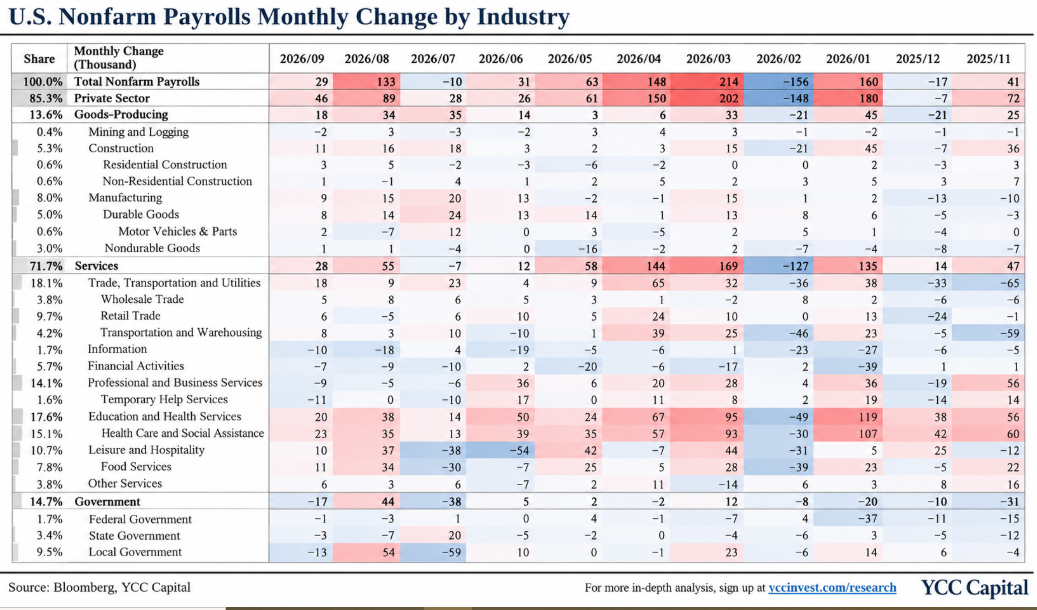
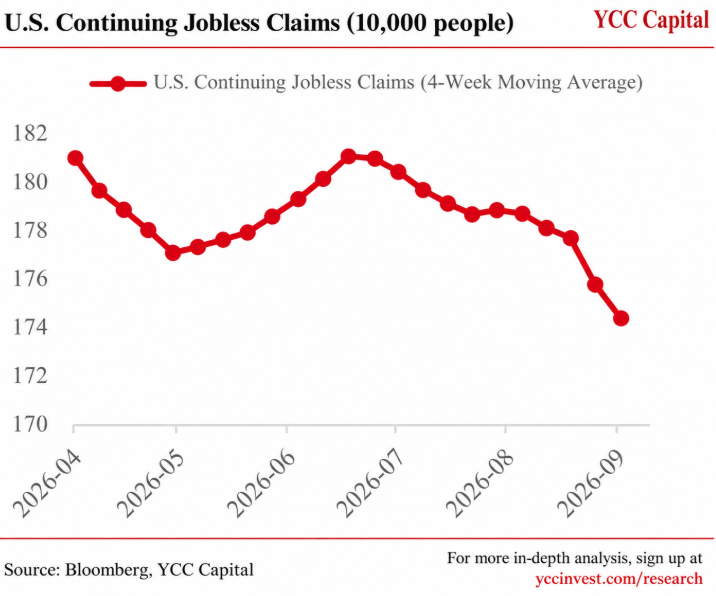
YCC CAPITAL Global Fixed Income & Currency Strategy October 6, 2026 September’s U.S. employment report delivered something markets have been waiting for: clearer evidence that labor demand is cooling while labor supply is recovering. Payroll growth disappointed sharply, prior months were revised lower, wage growth moderated, and unemployment edged higher. Yet this is not a clean recession signal. The more interesting development is that the labor market’s supply-demand imbalance has turned slightly negative for the first time since April. In our view, America is moving from labor scarcity toward labor normalization—an important distinction for the Federal Reserve and for investors trying to separate cyclical cooling from genuine economic deterioration. September Payrolls: A Clear Downshift Nonfarm payrolls increased by just 29,000 in September, dramatically below the 90,000 consensus estimate. August payroll growth was revised down from 162,000 to 133,000, while cumulative revisions to the previous two months removed 60,000 jobs. The three-month average consequently stands at only 51,000, after the previously reported average was itself revised down from 71,000. Unemployment simultaneously rose to 4.2%, versus 4.1% expected and previously. Wage pressure also softened: average hourly earnings increased only 0.1% month over month, compared with expectations and the previous reading of 0.3%, while year-over-year wage growth slowed to 3.0% from 3.1%. The contrast with August is striking. September brought weaker headline hiring, meaningful downward revisions and renewed deterioration in the employment trend. Markets initially responded in textbook fashion: Treasury yields fell, gold rose and U.S. equity futures advanced as investors marked down expectations for further tightening. But much of the Treasury and gold move subsequently reversed, while equities retained their gains. That reversal matters. Markets are telling us that one weak employment print is no longer sufficient to rewrite the monetary-policy narrative. The Headline Is Weak; the Composition Is Weaker September hiring was unusually concentrated. Of the 29,000 net jobs created, education and healthcare contributed roughly 20,000. More industries contracted than in August, while employment diffusion deteriorated sharply. Some previous distortions also faded. Local-government employment swung from +54,000 in August to -13,000, while leisure and hospitality hiring slowed from +37,000 to +10,000 as earlier event-related volatility normalized. Strip out government, education and healthcare, and leisure and hospitality—categories that can be volatile or less representative of contemporaneous private demand—and the remaining economy generated only 16,000 jobs. There is a modest silver lining: year-over-year employment growth across these residual industries appears to be bottoming. The labor market is losing breadth, but it is not uniformly collapsing. The one-month employment diffusion index fell to 49%, meaning fewer than half of measured industries expanded payrolls versus August, the weakest reading since November 2025. That resembles a restaurant where a few tables remain crowded while much of the dining room has quietly emptied. Business is still being done; it is simply becoming much less broadly distributed. AI Is Already Reshaping the Employment Map September also reinforces an emerging divergence between building AI infrastructure and deploying AI applications. Construction employment associated with data-center investment increased by 11,000, manufacturing gained 9,000, and trade and transportation added 18,000. Together these areas generated approximately 38,000 jobs. Meanwhile, information technology lost 10,000, and financial activities lost 7,000, for a combined decline of 17,000. We would resist reducing every sector-level move to AI, but the direction is worth watching. The physical build-out of the AI economy remains labor- and capital-intensive, while adoption increasingly allows information-heavy businesses to reconsider headcount. The first phase of the AI boom poured concrete and installed servers; the next phase increasingly asks what those servers can do instead of additional white-collar labor. There is an important statistical caveat. The initial response rate for the September Current Employment Statistics survey was only 53.1%, its lowest since October 2024. September payrolls therefore deserve a wider-than-usual confidence interval, and subsequent revisions could be substantial. Why Higher Unemployment Is Not Entirely Bad News The household survey contains perhaps the most constructive element of the release. The U.S. labor force expanded by 485,000 people in September. Approximately 139,000 came from natural population growth, while another 346,000 reflected people moving from outside the labor force into it. The labor-force participation rate consequently increased 0.2 percentage point to 61.8%. Of those 485,000 additional labor-force participants, approximately 406,000 became employed and 78,000 were unemployed. The employment-to-population ratio increased about 0.12 percentage point to 59.21%, while the unemployment rate increased roughly 0.04 point on an unrounded basis to 4.18%. That distinction is critical. Rising unemployment caused by layoffs tells a very different story from rising unemployment caused by people returning to the labor force. September looks much more like the latter. Among the net increase of 78,000 unemployed workers, re-entrants increased by 152,000 and new entrants by 116,000, while voluntary job leavers actually declined by 173,000. On a non-seasonally adjusted basis, foreign-born workers were an important contributor to the improvement in labor supply. The aggregate labor supply-demand gap consequently moved from approximately +304,000 to -31,000, entering negative territory for the first time since April. America has moved, at least temporarily, from excess labor demand toward mild excess supply. Why Markets Refused to Declare Victory The immediate reduction in tightening expectations proved short-lived. There are several reasons. First, payroll data have become unusually noisy. July initially showed contraction, August surprised dramatically to the upside, and September has now surprised sharply downward. Investors should be cautious about extrapolating any single observation. Second, expectations had already adjusted substantially. Following softer oil prices, mechanical downward revisions to PCE inflation associated with the BEA’s annual update, and Federal Reserve communication suggesting potentially only one additional increase this year, implied odds of an October hike had already fallen dramatically—from around 70% after the September 23 S&P Global U.S. PMI release to as low as 17% following September payrolls. Much of the dovish repricing had therefore happened before investors could comfortably celebrate the weak employment number. Most importantly, the U.S. economy remains difficult to categorize. Growth data have stayed resilient even as labor-market breadth has deteriorated. The economy appears to have exited the smooth,
Higher for Longer, Narrower at the Top The Rate Reality Behind America’s AI Boom
YCC CAPITAL Global Fixed Income & Currency Strategy October 1, 2026 YCC Perspective The most important market signal today is not simply that Treasury yields are rising. It is why they are rising. Resilient U.S. activity, renewed energy-price risk, a Federal Reserve increasingly uncomfortable with inflation, and an extraordinary AI infrastructure investment cycle are all competing for capital at the same time. That combination is pushing the long end of the Treasury curve higher even as U.S. equities—particularly AI-linked technology—continue to absorb the pressure surprisingly well. The result is an unusual market: monetary conditions are becoming more restrictive, yet the companies closest to the AI capital-spending cycle are behaving as though a new investment supercycle has begun. Our central view is that the Fed is likely to remain restrictive in the near term, with another rate increase a meaningful possibility as policymakers confront persistent inflation. Yet the picture should change as we move into 2027. If the energy shock fades and elevated borrowing costs increasingly restrain demand, the conditions for eventual policy easing can re-emerge. For investors, that means living with two clocks: the inflation clock, which is currently keeping rates high, and the growth clock, which is gradually transmitting those rates into the real economy. Treasury Yields Are Sending a Message U.S. Treasury yields moved sharply higher as markets absorbed stronger economic data, renewed geopolitical uncertainty and increasingly hawkish Federal Reserve communication. The 30-year Treasury yield briefly reached 5.5252%, its highest level since 2004, while the 10-year yield approached 5.23% intraday. The move reflects more than monetary policy. AI infrastructure requires enormous amounts of capital for data centers, semiconductors, memory, networking equipment and power infrastructure. At the same time, government financing needs remain substantial. Capital has therefore become a more contested resource. Think of the bond market as the price of renting money. When governments, corporations and a rapidly expanding technology investment cycle all arrive at the rental counter together, the price naturally rises. U.S. economic activity has given the Fed little reason to rush toward accommodation. The September preliminary S&P U.S. Composite PMI rose to 58.4 from 56.0 in August, reaching its highest level since July 2021. Labor-market indicators also remain consistent with an economy that has not fallen into broad contraction. There are nevertheless pockets of weakness. Existing- and new-home sales remain subdued, while the University of Michigan consumer sentiment index stood at 48.1, pointing to a household sector that feels considerably less comfortable than headline growth data might suggest. This distinction matters. The U.S. economy remains resilient, but resilience should not be confused with immunity to high rates. Hormuz Keeps an Inflation Risk Premium Alive The Middle East remains an important variable for global rates. Prospects for restoring normal shipping through the Strait of Hormuz remain uncertain. Diplomatic proposals briefly reduced market anxiety, but negotiations failed to produce a durable resolution. The implication for investors is straightforward: energy markets must continue carrying a geopolitical risk premium. Oil matters to the Fed because an energy shock can migrate beyond gasoline and utility bills. Higher transportation, manufacturing and logistics costs can eventually affect broader pricing behavior. The critical question is therefore not whether oil rises for several weeks, but whether higher energy costs become embedded in underlying inflation. If that happens, expectations for eventual Fed easing would need to move further into the future. The Fed Is Leaning Against Inflation Again Recent Federal Reserve communication shows a broad concern that inflation remains too elevated for comfort. New York Fed President John Williams has indicated that another increase this year could represent a reasonable policy path given current inflation risks, while emphasizing that policy remains dependent on incoming employment, inflation and financial-condition data. Cleveland Fed President Beth Hammack has emphasized resilient output, a labor market near full employment and inflation risks that remain tilted upward. Higher long-term Treasury yields tighten financial conditions, but in her framing they do not necessarily indicate that markets have lost confidence in the Fed’s inflation-fighting credibility. Philadelphia Fed President Anna Paulson has highlighted resilient consumption, AI investment and labor-market conditions while placing underlying inflation around 2.5%–3%, still meaningfully above the Fed’s 2% objective. Energy prices, Middle East developments and AI-related construction demand represent additional potential sources of inflation pressure. Minneapolis Fed President Neel Kashkari has similarly stressed that inflation pressures extend beyond volatile food and energy categories. Fed Governor Michael Barr has pointed to strong growth and resilient employment alongside inflation that has not yet established a convincing path back toward target. Vice Chair Philip Jefferson, meanwhile, focused his latest remarks on discount-window modernization and Treasury-market functioning rather than the near-term policy-rate trajectory. Improving the discount window could reduce the probability that banks are forced to sell Treasury securities during periods of stress, strengthening the resilience of both Treasury and short-term funding markets. Market pricing reflects this more hawkish environment. Fed funds futures indicated substantial expectations for additional tightening through the remaining 2026 meetings. AI Is Keeping the Equity Market Afloat—but Narrow The equity market is telling a very different story from the bond market. Over the latest week, the S&P 500 gained 1.21% and the Nasdaq 100 rose 3.25%, while the Russell 2000 declined 0.8%. That divergence is important. Investors are not indiscriminately buying risk. Capital remains concentrated in large technology companies and businesses positioned directly inside the AI investment chain. The renewed enthusiasm around personal AI agents has reinforced expectations that AI commercialization is moving beyond model training toward a broader computing ecosystem. At the same time, investors are beginning to consider the disruptive implications of AI agents for conventional software, online travel and some internet-platform business models. We see a meaningful distinction between the infrastructure layer and the application layer. For application businesses, monetization frequently depends on assumptions about future customer adoption, willingness to pay and competitive positioning. Hardware economics are easier to observe in real time. Accelerators, memory and related infrastructure have orders, shipments and revenue recognition that investors can monitor. That does not make every AI hardware company
The Fed’s Hawkish Turn: One More Hike, Not a New Hiking Cycle
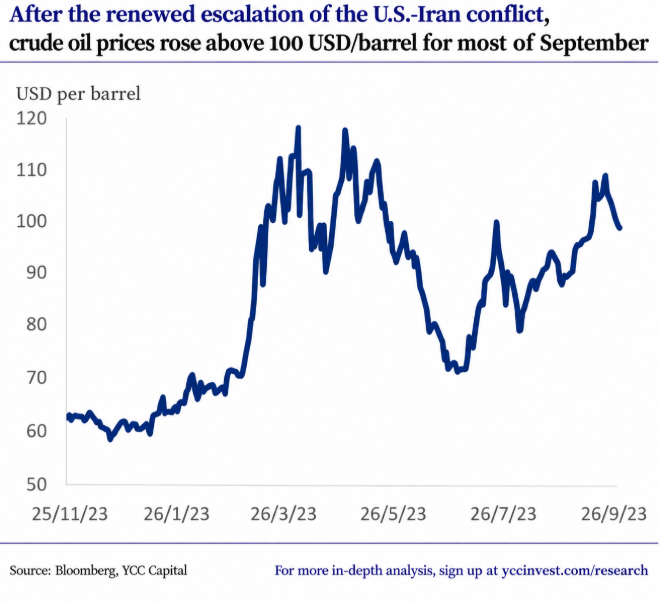
YCC CAPITAL Global Fixed Income & Currency Strategy September 26, 2026 Bloomberg, YCC Capital The macro picture entering the fourth quarter is becoming more complicated, but not necessarily more fragile. The U.S. economy continues to demonstrate an ability to absorb shocks that would normally have produced a sharper slowdown: higher oil prices, renewed Federal Reserve tightening, expensive mortgages and persistent geopolitical uncertainty. August retail sales and payrolls surprised materially to the upside, while AI-related capital expenditure remains a powerful structural support. Yet resilience has a price. Stronger demand, firmer employment and an oil shock centered on the Middle East give the Fed less room to declare victory over inflation. Our base case is therefore a pause in October followed by another 25bp rate increase in December. We do not interpret this as the beginning of a sustained hiking cycle. Rather, it looks more like an insurance premium against inflation becoming embedded again. For investors, that distinction matters enormously. A single additional hike is a repricing event. A new hiking cycle would be a regime change. Middle East: The Oil Risk Has Become a Two-Chokepoint Problem September marked a renewed escalation in U.S.-Iran tensions after August briefly appeared to favor diplomacy over military confrontation. Military activity intensified in early September around southern Iran and the Strait of Hormuz, while the disruption subsequently spread toward Saudi energy infrastructure and Red Sea transportation routes. The important change is not simply that Hormuz remains dangerous. The risk architecture has broadened. Saudi Arabia’s East-West pipeline, which connects eastern oil-producing regions with the Red Sea port of Yanbu, was temporarily disrupted following a drone attack. The pipeline has capacity of roughly 4–5 million barrels per day, equivalent to approximately 4%–5% of global oil supply, and represents one of the most important alternatives when Hormuz is impaired. At the same time, threats around the Bab el-Mandeb and Red Sea shipping corridor have increased. That creates the possibility of a simultaneous Hormuz-plus-Red-Sea bottleneck. Brent consequently climbed above $100/bbl during September, reaching roughly $108.75/bbl on September 15, before diplomatic signals helped bring prices back toward $99 by September 23. Our assessment is that Hormuz is likely to remain in a state of partial opening combined with high-risk transportation for a meaningful portion of the fourth quarter. Full normalization probably requires a more formal political or ceasefire agreement. We therefore raise our year-end Brent baseline from $80–90/bbl to $90–100/bbl, with much of the fourth quarter potentially trading within a $90–110/bbl range. A renewed military escalation or additional restrictions on Hormuz could push Brent toward $110–120/bbl or higher. Oil shocks rarely move through the economy like a light switch. They behave more like water slowly finding cracks in a building: transportation first, then corporate margins, household purchasing power and ultimately inflation expectations. That delayed transmission is one reason the Fed cannot comfortably ignore today’s energy shock. The U.S. Economy: Resilient, but Increasingly K-Shaped August data strengthened our conviction that the U.S. economy remains more resilient than headline recession concerns suggest. Retail sales increased 1.2% month over month, reversing July’s revised 0.5% decline and exceeding the 0.8% consensus expectation. Gasoline-station sales jumped 3.1%, but this was not merely an oil-price story. Excluding gasoline, retail sales still rose approximately 1.1%, while inflation-adjusted sales increased around 0.8%. The GDP-relevant retail control group was even stronger, rising 1.4%, compared with a 0.4% decline in July. Non-store retailing increased 2.6%, electronics and appliance sales 1.6%, restaurant spending 1.2%, and auto-related sales 0.6%. This is the American economy’s recurring surprise: the consumer bends, but has not yet broken. Manufacturing tells a different story. Industrial production was approximately flat in August, while manufacturing output declined 0.3%. Motor vehicle and parts production fell 1.2%, computer and electronics output declined 0.5%, and business-equipment production fell 0.5%. We do not read this as the end of the AI investment cycle. Data centers, servers, networking equipment and semiconductors should continue supporting equipment investment. Instead, the divergence is becoming clearer: AI-intensive investment remains strong while traditional manufacturing struggles. Housing remains the clearest weak point. Housing starts declined 2.6% to an annualized 1.275 million units. Single-family starts rebounded 7.6%, but multifamily construction fell 22.5%. Building permits dropped 2.7% to 1.394 million, while existing-home sales declined 2.0% to an annualized 3.98 million. With 30-year mortgage rates around 6.81% following the Fed’s September increase, affordability remains heavily constrained. Inflation and Employment Complicate the Fed’s Job August core CPI accelerated more than expected on a monthly basis. Importantly, however, the composition was less alarming than the headline suggests. Lodging away from home, transportation services, tuition and wireless-service charges contributed disproportionately, and several components appear seasonal or potentially one-off. Year-over-year headline CPI remained around 3.4%, while core CPI eased approximately 0.1 percentage point to 2.4%. We continue to believe the peak inflation phase has passed. The risk, however, has become less comfortable because elevated oil prices can feed into core inflation with a lag. Employment delivered an equally important surprise. Nonfarm payrolls increased 162,000 in August versus consensus expectations of roughly 55,000, while June and July payrolls were revised upward by a combined 55,000. Unemployment edged from 4.09% to 4.14%, but labor-force participation simultaneously increased 0.2 percentage point to 61.6%, making the unemployment-rate increase considerably less troubling. Average hourly earnings rose 0.27% month over month, compared with 0.16% in July. The message is not that the labor market has returned to boom conditions. It is that the feared rapid deterioration has not materialized. Fed Strategy: Pause in October, Hike in December The Federal Reserve raised its target range by 25bp to 3.75%–4.00% in September. The meeting delivered several hawkish signals, including stronger growth assumptions, lower unemployment projections and higher inflation forecasts. The dot plot was particularly notable. Of 18 officials submitting projections, 12 expected another 25bp increase this year, four anticipated two additional increases, and only two expected no further hike. Even so, we expect the Fed to pause in October. Monetary policy operates with long and variable lags, and policymakers have good reason to observe how
Oil, Inflation and the 5% Line: The Bond Market’s New Stress Test
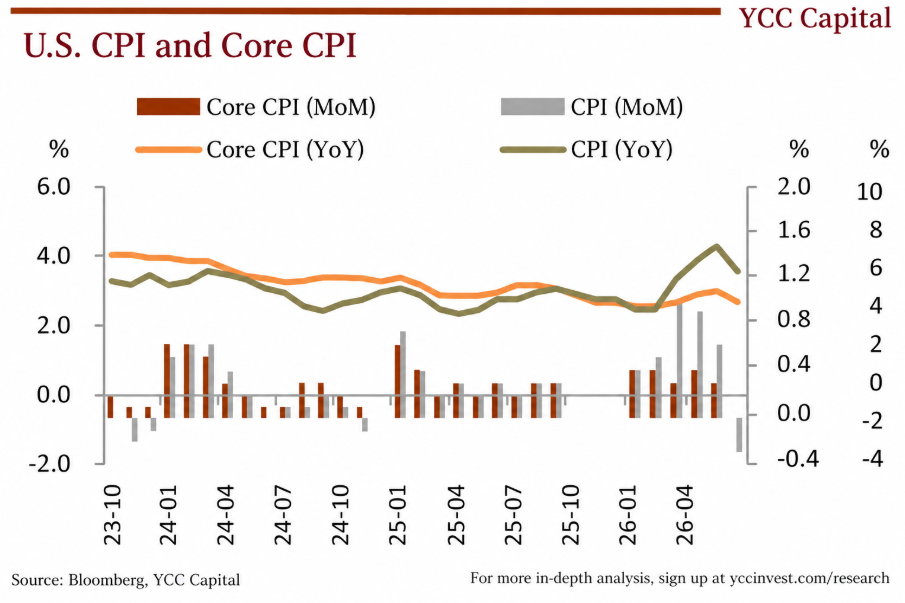
YCC CAPITAL Global Fixed Income & Currency Strategy September 15, 2026 The global macro backdrop has become materially less forgiving. An escalating Middle East conflict has pushed crude oil back above $100 per barrel just as U.S. inflation is proving more persistent than markets had hoped. That combination is forcing investors to reconsider a comfortable assumption embedded in asset prices for much of the year: that monetary tightening was essentially finished. We believe the next phase will be defined by a renewed contest between resilient U.S. growth, energy-driven inflation and increasingly expensive sovereign financing. The practical analogy is familiar. A household can absorb either a higher gasoline bill or a higher mortgage payment. When both rise together, discretionary spending becomes harder. Markets face the same squeeze today: oil is taxing the real economy while higher Treasury yields are raising the discount rate on virtually every financial asset. Oil Reopens the Inflation Question Middle East risks intensified further as disruptions to Saudi Arabia’s east-west oil infrastructure compounded concerns around shipping through the Strait of Hormuz and Red Sea. Brent crude moved back above $107 per barrel, forcing the market to price a larger probability of sustained supply disruption. This matters because U.S. inflation was already showing renewed persistence. August headline CPI increased 0.4% month-on-month and 3.4% year-on-year. Core CPI rose 0.3% month-on-month, exceeding the 0.2% consensus expectation, while the annual rate eased only marginally to 2.4%. Energy was the obvious accelerant. Energy prices rose 2.1% during August after falling 1.5% in July and were 16.3% higher year-on-year. Energy commodities jumped 4.2%, gasoline rose 3.9%, and fuel oil surged 10.1%. Gasoline alone accounted for more than one-third of the monthly increase in headline CPI. Food inflation remained comparatively contained, rising 0.1% month-on-month and 2.7% year-on-year. The more important signal came from services. Core services increased 0.3%, while shelter rebounded 0.3%. More concerning for the Federal Reserve, core services excluding housing—the so-called supercore measure—rose approximately 0.51% month-on-month, its strongest reading since January. Airfares increased 2.7%, hotel prices rebounded 2.4%, communications prices climbed 2.3%, and education costs rose 0.8%. Medical prices and motor-vehicle insurance provided some offset, but the broader message remains uncomfortable: underlying services inflation has not disappeared. Producer prices reinforce that conclusion. Final-demand PPI rose 0.4% in August and accelerated to 5.4% year-on-year from 4.8%. Core PPI excluding food, energy and trade services advanced 0.3% month-on-month and 4.7% year-on-year. Goods prices increased 1.1%, led by a 4.2% rise in energy and an extraordinary 24.1% monthly increase in diesel prices. Source: Bloomberg, YCC Capital. The Federal Reserve Is Back in Play Markets have responded quickly. Pricing for a 25-basis-point September rate increase climbed toward 90% following the inflation data, while expectations referenced during the week implied roughly an 86% probability of tightening and increasingly contemplated two additional increases before year-end. We remain cautiously constructive on the U.S. economy rather than interpreting higher rates as evidence of imminent recession. Employment remains resilient, consumption has not collapsed, and corporate earnings have provided U.S. equities with a meaningful cushion. The S&P 500 was down only 0.8% over the latest week and remained 11.85% higher year-to-date; the Nasdaq was down 0.66% for the week while retaining a 13.30% year-to-date gain. The bigger vulnerability is duration. Two-year Treasury yields rose 26 basis points over the week to 4.37%, five-year yields increased 24 basis points to 4.54%, and ten-year yields climbed 18 basis points to 4.78%. The 10-year yield is again approaching the psychologically important 5% threshold. Fiscal policy adds another layer. President Trump reiterated a proposed $5,000 universal payment plan over the weekend, reviving concerns about federal deficits, Treasury issuance and the inflationary consequences of additional fiscal stimulus. Whatever the final policy design, bond investors increasingly require compensation not merely for inflation risk but for supply risk. In our view, 5% is therefore more than a round number. It is where the Treasury market begins transmitting noticeably tighter financial conditions into mortgages, corporate refinancing, equity valuations and global capital flows. China: Strong Exports Mask a Fragile Domestic Engine China’s August data continue to display an uncomfortable split between strong external demand and weak domestic demand. Dollar-denominated exports increased 25.0% year-on-year, while imports rose 28.2%, expanding the trade surplus to approximately $119.1 billion. High-technology manufacturing, semiconductors, electric vehicles, batteries and demand associated with global AI capital expenditure remain important export engines. Export-market diversification has also supported shipments to emerging economies. Yet these figures should not be mistaken for evidence of a broad domestic recovery. Stronger imports largely reflect semiconductors, energy and industrial inputs associated with manufacturing investment rather than a decisive revival in household consumption. Property-sector adjustment remains unresolved, consumer demand is subdued, and traditional consumer-goods exports are comparatively weak. Inflation tells a similar story. August CPI rose 0.8% year-on-year and 0.4% month-on-month, while core CPI edged up to 1.0%. Food prices remained 1.4% lower year-on-year despite seasonal increases in fresh vegetables. PPI increased 3.8% year-on-year and 0.4% month-on-month, reversing July’s 0.7% monthly decline. Non-ferrous metals processing prices rose 20.8% year-on-year, petroleum and coal-processing prices increased 11.1%, and oil and gas extraction prices gained 10.5%. This is improvement in prices, but the distinction matters: much of it is cost-push reflation rather than demand-pull reflation. Rising oil and commodity inputs can lift nominal prices without repairing household confidence or property demand. China therefore remains vulnerable to a recovery that looks stronger in industrial statistics than it feels in everyday economic life. Chinese equities reflected that fragility. The Shanghai Composite declined 1.07% during the week, the CSI 300 fell 0.83%, and the Hang Seng Index dropped 3.30%. Hong Kong technology was particularly weak, losing 5.45% for the week and remaining 21.67% lower year-to-date. Source: Bloomberg, YCC Capital. Cross-Asset Signals: Energy Wins, Duration Loses Oil was the week’s dominant asset move. WTI gained 9.30% to roughly $100 per barrel, while Brent advanced 8.35% to $104.32 in the weekly market table. Year-to-date gains approached 97% for WTI and 111% for Brent. Metals were weaker as higher global yields overwhelmed the inflation-hedge narrative.
The Yen’s False Bottom: Intervention Can Break Momentum, Not Rewrite Fundamentals
YCC CAPITAL Global Fixed Income & Currency Strategy August 10, 2026 YCC Perspective The yen’s violent rebound after coordinated U.S.-Japan intervention has reopened a deceptively simple question: was the currency merely weak, or had it become genuinely mispriced? Our conclusion is that both can be true. The yen had clearly overshot fundamentals when USD/JPY approached 164, but the forces behind its multi-year depreciation have not disappeared. Intervention can change the speed of the train; it cannot, by itself, change the direction of the tracks. For investors, that distinction matters. Japan is not facing permanent decline. Many of today’s pressures are cyclical: unfavorable energy costs, a still-wide yield gap with the United States, and unusually powerful carry-trade momentum. Japan’s long-term investment case remains supported by improving corporate governance, stronger capital discipline and normalization after decades of distorted monetary settings. The near-term currency problem, however, is real. Intervention Finally Drew a Line The yen has weakened dramatically since 2021, moving from roughly ¥100 per dollar toward ¥160. It briefly stabilized in the first half of 2025 as the dollar softened and monetary-policy expectations began to diverge, with the Federal Reserve easing while the Bank of Japan gradually normalized policy. Depreciation resumed later, however, and USD/JPY reached 163.99 on July 23, 2026—around its weakest level in nearly four decades. Three forces have been particularly important. First, Japan’s fiscal expansion and relatively accommodative policy posture have kept investors wary of the interaction between debt servicing and monetary normalization. Second, higher energy prices associated with Middle East instability have damaged Japan’s terms of trade, pushing the trade balance back toward deficit from May. Third, markets have become increasingly sensitive to the possibility that U.S. rates remain higher for longer, or even rise faster than Japanese rates. The interesting feature is that the yen has recently weakened even as the 10-year U.S.-Japan yield spread narrowed. The traditional compass stopped pointing north. Shorter-dated rate differentials have become more informative, suggesting investors increasingly care about the next few central-bank meetings rather than simply the long-run yield gap. Japan had already spent heavily defending the currency. Intervention between April 29 and May 1, 2024 approached ¥10 trillion, followed by more than ¥5 trillion in July. Those operations totaled roughly ¥15.3 trillion. Between April 28 and May 27, 2026, authorities deployed another approximately ¥11.73 trillion. Each episode bought time, but the depreciation trend eventually returned. That changed materially on July 30. During New York trading, USD/JPY fell from around 162.8 to 157.8 in roughly 50 minutes, implying an appreciation of about five yen and an intraday move of roughly 3.3%. A second jump followed after the New York Fed, acting under Treasury direction, conducted rate checks with market participants. On July 31, U.S. authorities reportedly participated directly in yen purchases. The intervention was subsequently acknowledged by both governments. It represented the first coordinated U.S.-Japan currency intervention in roughly 15 years. The strategic logic extends beyond Japan. A disorderly yen decline raises imported inflation for Japanese households—the kind of pressure consumers feel not in economic models but at the supermarket, the petrol station and in monthly utility bills. For Washington, persistent Japanese reserve liquidation could eventually translate into Treasury selling, potentially putting additional upward pressure on already-elevated long-term U.S. yields. Supporting yen stability therefore also helps protect the plumbing of the dollar-based financial system. Japan’s planned use of the Federal Reserve’s Foreign and International Monetary Authorities repo facility is important in this context. FIMA allows approved foreign monetary authorities to obtain temporary dollar liquidity against U.S. Treasury collateral rather than selling those Treasuries outright. By August 4, USD/JPY had retreated to 157.7455, leaving the yen roughly 4% stronger than its recent trough. History Says Intervention Works—But Usually as a Circuit Breaker The historical record is clear: coordinated interv ention can be extremely effective in the short term, particularly when it alters market expectations. The 1985 Plaza Accord helped engineer a dramatic dollar decline, with the yen strengthening from roughly ¥250 per dollar to around ¥120 in less than three years. In 1995, coordinated G7 action moved in the opposite direction and helped end an extreme yen-appreciation cycle after USD/JPY had fallen below 80. During the 1998 Asian financial crisis, Japan’s unilateral intervention had achieved relatively little despite substantial spending. Joint U.S.-Japan action proved more powerful: USD/JPY fell from around 146 to 136 in two days, and the yen later appreciated toward 102 over the following year as broader crisis dynamics shifted. The 2011 intervention after the Great East Japan Earthquake offers another useful precedent. Safe-haven flows had driven the yen toward a postwar high around 76 per dollar. Coordinated G7 selling of yen quickly disrupted the appreciation trend, although the currency briefly revisited those levels months later before entering a durable depreciation cycle. The lesson is not that intervention is ineffective. It is that intervention works best when fundamentals are ready to cooperate. Policymakers can break a speculative feedback loop, but they cannot indefinitely overpower productivity, trade flows and interest-rate differentials. Is the Yen Actually Undervalued? YCC Capital estimates the yen’s equilibrium value using a cointegration framework covering quarterly observations from the first quarter of 1990 through the first quarter of 2026, a total of 145 observations. The framework uses five core variables: relative U.S.-Japan GDP per capita as a productivity proxy; relative CPI levels as a purchasing-power indicator; the 10-year U.S.-Japan government-bond yield differential; Japan’s trade balance as a percentage of GDP; and the difference between U.S. and Japanese public-debt ratios. ADF testing indicates the relevant series are integrated of order one. A basic OLS specification exhibits serial correlation, so two additional approaches are used: one incorporating AR(1) and AR(2) residual terms, and another incorporating lagged USD/JPY. Both materially improve residual behavior, with Durbin-Watson statistics moving toward two. Residual stationarity supports a long-run cointegrating relationship. The most consistent result is the interest-rate channel. The U.S.-Japan yield differential carries a positive and statistically significant coefficient across all three specifications, confirming that wider U.S. yield premiums remain a central driver of
The Hike That May Never Come: Positioning for a Hawkish Fed Without Chasing the Fear
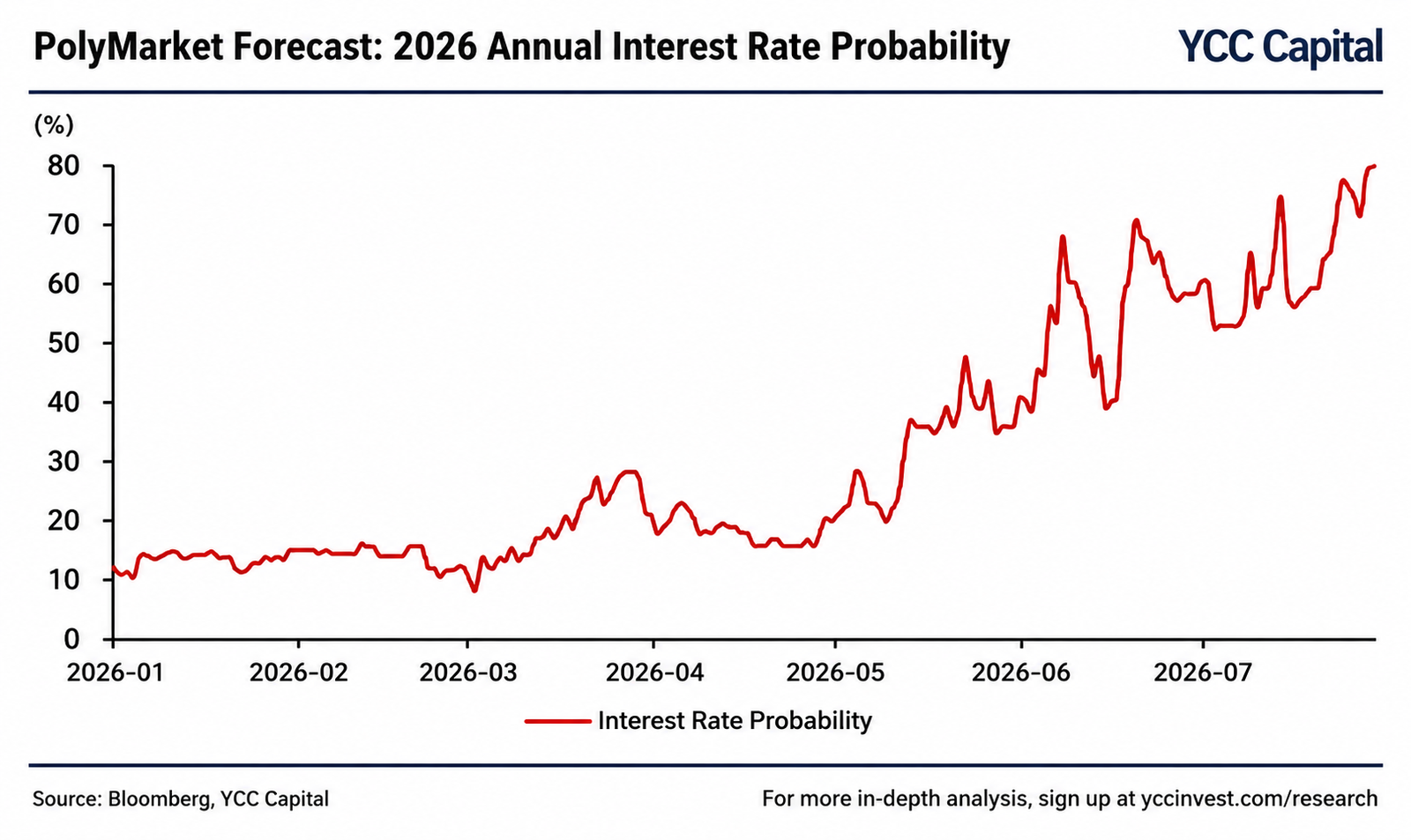
YCC CAPITAL Global Fixed Income & Currency Strategy August 1, 2026 YCC Capital Perspective Markets have moved rapidly from debating when the Federal Reserve might cut rates to asking whether it may need to raise them again. Federal-funds futures have priced roughly 41 basis points of tightening for 2026, while prediction-market estimates of a rate increase have risen sharply from around 10% before the late-February U.S.–Iran confrontation to nearly 80%. YCC Capital believes that this repricing has gone too far. The Federal Reserve has room to raise rates, but room is not the same as necessity. The U.S. economy remains resilient rather than overheated, labor-market pressures are moderate, and the recent inflation rebound has been driven primarily by energy rather than broad demand. Our base case is that the policy rate remains unchanged through year-end, accompanied by deliberately hawkish communication that allows markets to tighten financial conditions on the Fed’s behalf. This is the monetary-policy equivalent of a parent lowering their voice rather than raising it: the message becomes more serious even when no immediate action follows. For investors, that distinction matters. A hawkish hold can hurt asset prices at first, but history suggests the damage is usually front-loaded and followed by recovery once policy uncertainty fades. Growth Is Cooling, Not Collapsing The U.S. economy performed better than expected during the first half of 2026, supported by delayed government expenditure, tax relief, resilient household spending and strong artificial-intelligence infrastructure investment. Real GDP growth is estimated to have reached approximately 2.6% in the first quarter and 2.3% in the second quarter. Momentum should moderate during the second half. We expect year-over-year GDP growth of approximately 1.7% in the third quarter and 2.1% in the fourth. Household tax refunds were concentrated between February and April, so their support for consumption will fade. Higher fuel costs are also beginning to erode purchasing power. Real disposable-income growth declined from 1.4% in January to negative 1.1% in April, its first contraction in roughly three years. Historical relationships suggest that every 10% increase in gasoline prices may reduce cumulative consumption and GDP growth over the following two to four quarters by approximately 0.23 and 0.15 percentage points, respectively. The roughly 30% increase in gasoline prices during the second quarter could therefore subtract about 0.5 percentage points from third-quarter consumption growth and 0.25 percentage points from GDP growth. That is a slowdown, not a recession call. The American economy still has substantial internal support from investment, productivity and corporate profitability. We remain cautiously optimistic on the United States, although the path ahead is likely to feel more uneven at the household level than aggregate data imply. The Labor Market Is Balanced Rather Than Overheated Monthly payroll growth recovered from an average of roughly 10,000 in 2025 to approximately 92,000 during the first six months of 2026. Yet the underlying indicators do not resemble the labor shortage that preceded the 2022 tightening cycle. The ratio of job openings to unemployed workers is near 1.0, a six-year low. Average weekly hours remain around 34.3, compared with approximately 34.9 during the pandemic-era labor squeeze. Hiring, resignation and dismissal rates have fallen to 3.2%, 1.9% and 1.1%, respectively, all close to ten-year lows. Three-month average wage growth of approximately 3.5% is broadly consistent with 2% inflation when combined with productivity growth of around 1.5%. We expect unemployment to rise moderately from 4.3% to approximately 4.5% by year-end. Initial and continuing unemployment claims are already drifting upward, while AI-related substitution is becoming more visible in entry-level technology and financial-sector employment. This is not a labor market demanding higher rates. Inflation’s Energy Spike Should Fade Headline CPI reached 4.2% in May, driven largely by a 23% year-over-year increase in energy prices. Energy contributed almost 60% of the headline inflation rate. As geopolitical tensions eased and oil prices retreated, gasoline prices fell by more than 10% in June, subtracting an estimated 0.5 percentage points from monthly CPI. We expect headline and core CPI to ease from approximately 3.9% and 2.8% in the second quarter to 3.3% and 2.6% in the third quarter. Fourth-quarter readings may settle near 3.2% and 2.7%. Core goods prices are already softening as tariff pass-through nears completion and weaker real-income growth constrains demand. Market rents also point toward further shelter disinflation. Zillow rent growth slowed to 1.7% in June, below its pre-pandemic pace of roughly 4%, while the Bureau of Labor Statistics’ new-tenant rent index suggests that official shelter inflation could decline by another 0.9 percentage points by year-end. The distinction is critical. Monetary policy is effective against excessive demand; it is far less precise against an oil-price shock. Raising rates to offset temporary fuel inflation would be like turning down every light in the house because one room has become too warm. Taylor Rules Show Capacity, Not Compulsion Forward-looking Taylor Rule models incorporating policy inertia and expected inflation place an appropriate policy rate at approximately 3.6%–3.7%, almost exactly in line with the current 3.6% rate. Static models generate higher estimates, including approximately 3.9% using trimmed-mean PCE and 6.5% using headline PCE, but these backward-looking calculations are unusually vulnerable to temporary supply shocks. The estimated 29-basis-point gap between the current rate and the trimmed-mean static-rule estimate is also smaller than the average 44-basis-point gap observed during the 2025 tariff shock, when the Fed chose not to tighten. Under a baseline unemployment rate of 4.3%, a reliable six-month tightening signal would likely require trimmed-mean PCE inflation above 2.6% or three-month average headline PCE above 4.2%. That could require Brent crude to remain above approximately $120 per barrel for at least two months. A rate-cut signal would require trimmed-mean PCE near 2.2% or three-month headline PCE around 2.8%, broadly consistent with oil remaining in the $60–$70 range for three months. Neither threshold has been met. The Fed can therefore maintain hawkish language while leaving the policy rate unchanged. Investment Implications: Endure the First Wave Across six historical hawkish-hold episodes, equities, bonds and precious metals generally weakened during the first one to
The Fed’s Hawkish Pause Raises the Bar: Why Real Yields Now Hold the Key to Global Markets
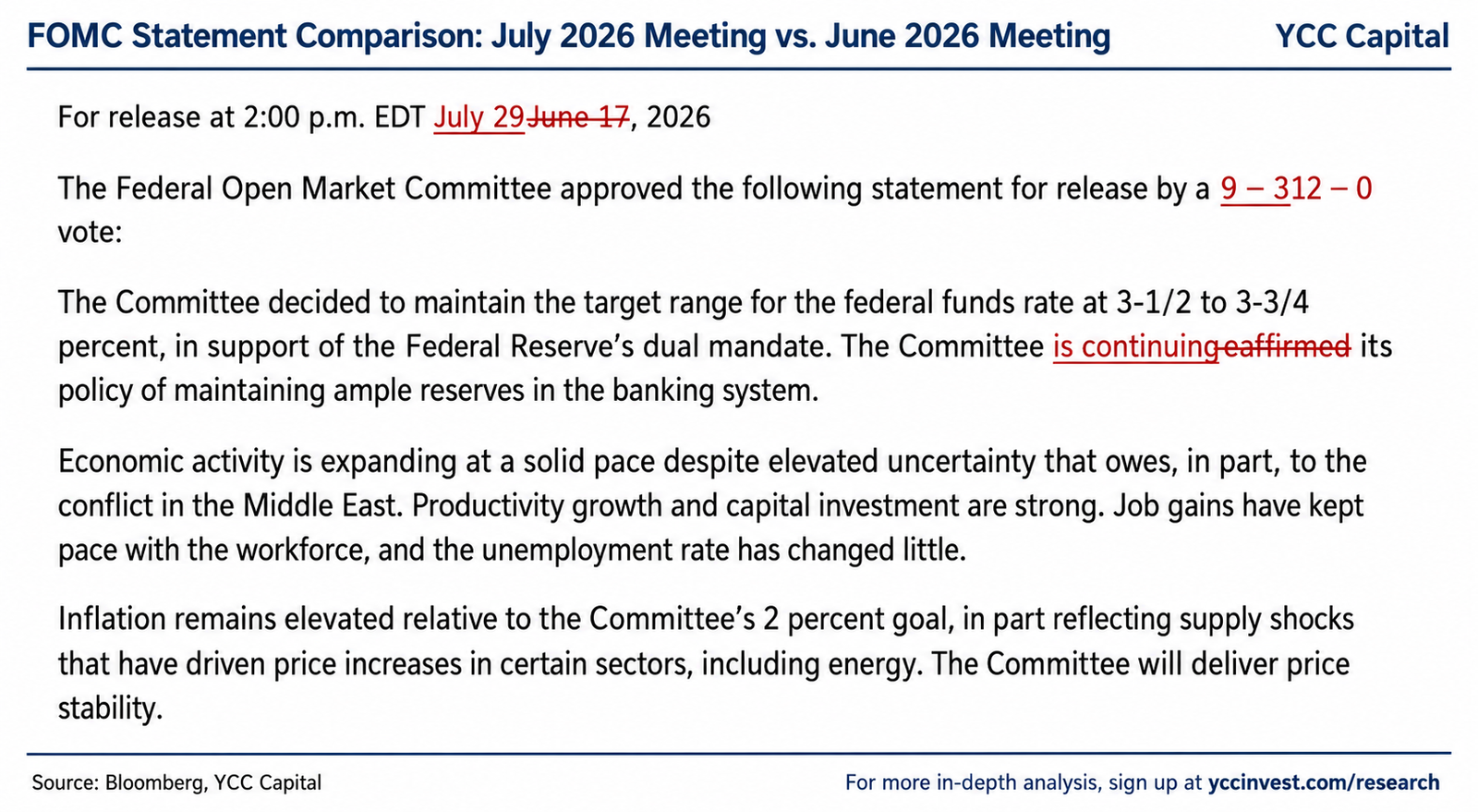
YCC CAPITAL Global Fixed Income & Currency Strategy July 31, 2026 Executive Perspective There are moments when central banks move markets by changing interest rates. Then there are moments—arguably more consequential—when they move markets without touching rates at all. The Federal Reserve’s July 2026 meeting belonged firmly in the second category. By leaving the federal funds rate unchanged while revealing an unusually divided Committee, Chair Kevin Warsh delivered perhaps the strongest hawkish message possible without actually raising rates. Rather than surprising markets with another hike, the Fed chose to signal that inflation remains an unfinished battle and that further tightening remains firmly on the table. For investors, the implication extends well beyond one FOMC meeting. The next phase of the cycle is unlikely to be determined simply by whether the Fed hikes again. Instead, the interaction between geopolitical risks, energy prices, inflation expectations, technology-driven productivity, and—above all—the trajectory of U.S. real interest rates—is becoming the central macro variable for virtually every major asset class. At YCC Capital, we believe investors should increasingly focus on the resistance to further increases in U.S. real yields, as this may ultimately determine whether markets transition toward recovery or experience another wave of de-risking. A Hawkish Hold Instead of a Hike The Federal Reserve voted 9-3 to keep the federal funds target range unchanged at 3.50%-3.75%, marking the first significant internal division within the voting committee in recent meetings. Rather than representing policy uncertainty, the split vote served as a deliberate communication tool, highlighting growing hawkish sentiment inside the Federal Open Market Committee. Compared with the June meeting, the official statement changed very little. Policymakers continued to describe the U.S. economy as expanding at a solid pace despite elevated uncertainty stemming from Middle East tensions. Strong productivity growth, resilient capital investment, and stable labor market conditions remained central elements of the Fed’s assessment. Inflation language likewise remained largely unchanged. The Committee reiterated that inflation continues to exceed its 2% objective, partly reflecting supply disruptions that have pushed prices higher in several industries, particularly energy. The most meaningful shift therefore came not from the wording of the statement, but from the voting pattern itself. Three dissenting votes against holding rates effectively communicated that a meaningful bloc within the Committee believes additional tightening may soon become necessary. This represents a notably different signaling strategy than a conventional rate increase. Instead of immediately tightening financial conditions through higher policy rates, the Fed tightened expectations while preserving optionality. Warsh Sends an Unmistakably Hawkish Message Chair Kevin Warsh reinforced this message during the post-meeting press conference. First, he repeatedly emphasized that the Federal Reserve’s 2% inflation target leaves no room for flexibility. Temporary improvements in monthly inflation data are insufficient to alter the Committee’s broader assessment. According to Warsh, inflation has remained above target for more than five years, making a durable return to price stability the overwhelming priority. Second, Warsh continued reducing the importance of forward guidance. He argued that outside crisis periods, the Federal Reserve should refrain from excessively steering market expectations and instead allow financial markets to interpret incoming economic information independently. This represents an important philosophical shift toward a more market-driven pricing environment. Third, he forcefully defended the Fed’s institutional independence, reiterating that monetary policy would not be influenced by political pressure, financial market volatility, or external commentary. Finally, Warsh highlighted an emerging source of uncertainty rarely emphasized in previous meetings: artificial intelligence investment. Massive corporate spending on memory chips, logic semiconductors, and AI infrastructure could eventually reshape aggregate supply. At the same time, policymakers remain uncertain whether this investment boom will alleviate inflation through productivity gains or instead create new inflationary pressures across broader sectors of the economy. Markets Receive Mixed Signals Financial markets reacted in a nuanced fashion following the announcement. Short-term Treasury yields retreated modestly as investors concluded that an immediate rate hike had been avoided. Longer-dated Treasury yields, however, moved higher, reflecting persistent inflation concerns and uncertainty regarding the longer-term policy outlook. Gold prices strengthened despite the hawkish rhetoric, suggesting investors increasingly view geopolitical uncertainty and inflation risks as offsetting forces against higher interest rates. U.S. equities remained under pressure, while the U.S. dollar weakened noticeably following the meeting. At first glance, these moves appear contradictory. Yet they reveal a market attempting to reconcile two competing narratives. On one hand, the Federal Reserve remains committed to restrictive monetary policy. On the other hand, persistent geopolitical risks and higher energy prices may eventually slow economic activity enough to limit how far real interest rates can continue rising. Much like a driver climbing a steep mountain road, the Fed continues pressing the accelerator, but investors are increasingly questioning how much further the engine can realistically go before gravity begins working in the opposite direction. Three Macro Variables Will Shape the Next Two Months 1. Middle East Geopolitics Remains the Primary Inflation Wildcard The evolution of U.S.-Iran negotiations and the security of shipping through the Strait of Hormuz remain critical. Oil prices rebounded sharply during July following renewed disruptions and heightened uncertainty surrounding regional maritime security. Although President Trump later signaled renewed willingness to return to negotiations, the durability of any ceasefire remains uncertain. Should shipping disruptions persist while global inventories remain relatively tight, energy prices could transmit inflationary pressure much more aggressively than during the second quarter. For the Federal Reserve, this creates a difficult policy dilemma. Higher inflation expectations driven by oil may prevent real yields from rising substantially further while simultaneously delaying any eventual policy easing. 2. Real Interest Rates Have Become the Market’s Most Important Indicator Since May and June, the Fed’s increasingly hawkish framework has supported a stronger U.S. dollar and tighter global financial conditions. Looking ahead, however, sustained increases in oil prices may begin lifting inflation expectations faster than nominal yields can rise. If that occurs, real interest rates could face increasing upward resistance. This distinction matters enormously because real yields—not nominal rates—represent the true discount rate for financial assets. A stabilization or decline in real yields would
One More Surge Before the Turn? Why U.S. Treasury Yields Could Climb Further Before the Market Finally Finds Relief
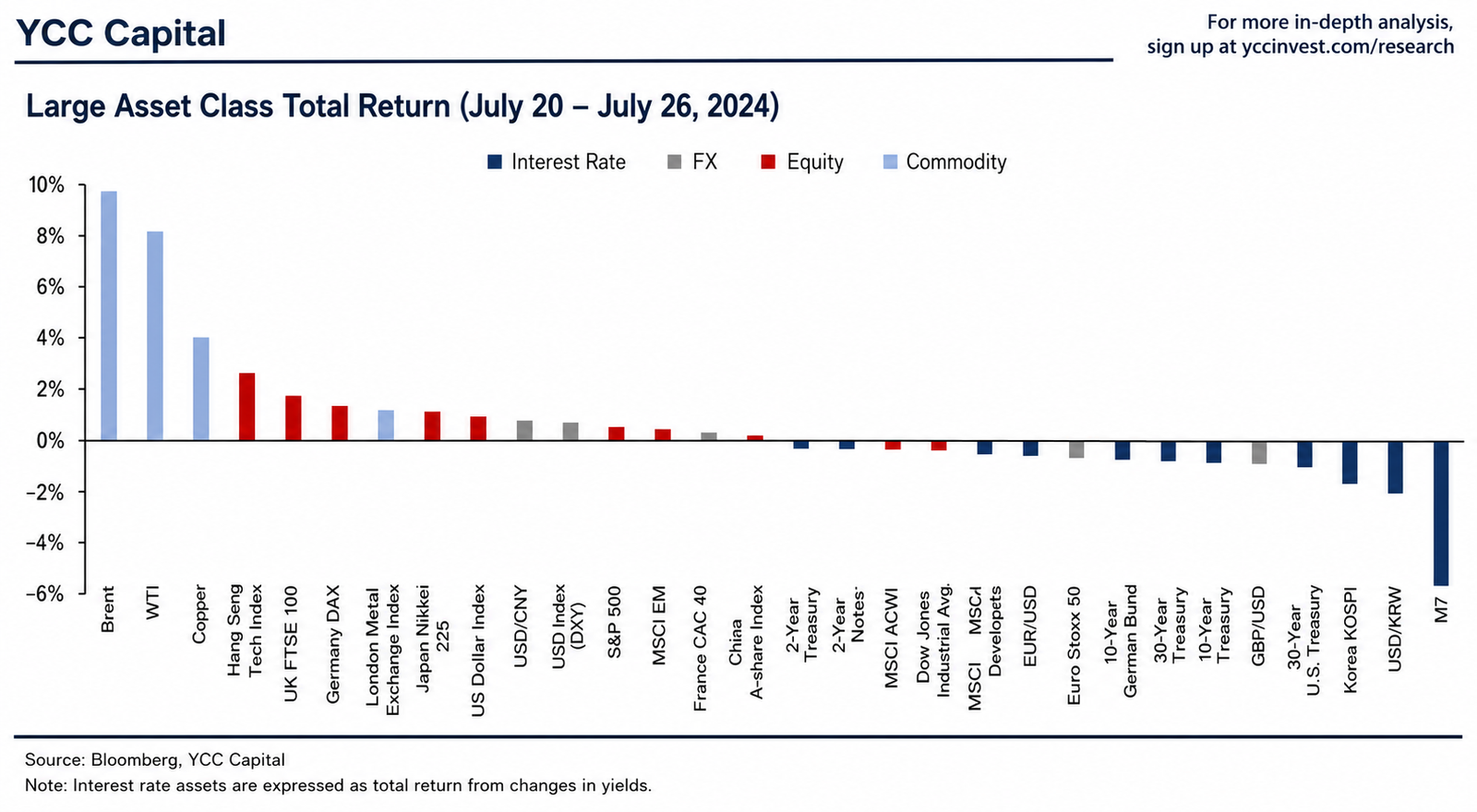
YCC CAPITAL Global Fixed Income & Currency Strategy July 28, 2026 Executive Summary Markets often resemble an experienced marathon runner approaching the final hill. Fatigue is visible, confidence begins to waver, and every upward step feels increasingly difficult. Yet many of the strongest rallies begin only after that final climb. Today’s U.S. Treasury market appears to be approaching precisely such a moment. During the past week, investors navigated an unusually challenging combination of geopolitical uncertainty, renewed energy inflation, elevated Treasury yields, and persistent questions surrounding the long-term economics of artificial intelligence investment. Despite generally solid earnings from major U.S. technology companies, equity leadership continued to rotate while fixed income markets increasingly shifted their focus toward inflation risks rather than slowing growth. At YCC Capital, we believe the most important development has been the composition—not merely the magnitude—of the recent increase in Treasury yields. Unlike earlier moves during May and June, which were primarily driven by stronger growth expectations and higher terminal-rate assumptions, the latest surge has been overwhelmingly concentrated in short-term Treasury yields and reflects a renewed repricing of inflation risks. This distinction carries important implications for investors across global asset classes. The coming week may prove pivotal. Markets face an unusually dense calendar that includes the July Federal Open Market Committee (FOMC) meeting, the Bank of Japan policy decision, second-quarter U.S. GDP data, and June PCE inflation figures. Together, these events could temporarily push Treasury yields higher before financial conditions eventually begin exerting a stronger restraining influence on economic activity later this quarter. Our base case remains that the U.S. economy continues to demonstrate resilience, although tighter financial conditions should gradually slow activity as the third quarter progresses. Accordingly, we believe Treasury yields may experience one final upward test before entering a more sustainable period of stabilization. YCC Perspective Every investment cycle teaches the same lesson in a different form: markets rarely reverse when consensus expects them to. Instead, turning points often arrive only after investors have become convinced that prevailing trends will continue indefinitely. Today’s Treasury market reflects that psychology. Rising oil prices, renewed geopolitical uncertainty, and persistent inflation concerns have convinced many participants that yields must continue climbing. While further upside risks certainly remain over the near term, history suggests that such late-cycle consensus positioning often marks the final phase rather than the beginning of a prolonged trend. For long-term investors, understanding where yields are coming from matters just as much as where they are headed. Global Markets Review: Energy Once Again Takes Center Stage Global financial markets remained heavily influenced by geopolitical developments throughout the past week. Escalating tensions in the Middle East increased concerns surrounding shipping routes through the Red Sea and Strait of Hormuz, prompting another sharp rise in crude oil prices and reigniting fears of renewed global inflationary pressure. Brent crude advanced nearly 10% during the week, briefly trading above $100 per barrel and becoming the strongest-performing major global asset class. The move reinforced expectations that energy markets remain highly sensitive to geopolitical developments and that inflation risks have not fully disappeared from the macroeconomic landscape. Meanwhile, the U.S. dollar strengthened alongside Treasury yields, creating additional headwinds for global risk assets. Equity performance became increasingly fragmented across regions. European equity markets, benefiting from their relatively defensive sector composition, posted modest gains. In contrast, technology-heavy U.S. indices experienced renewed pressure despite earnings that generally exceeded consensus expectations. South Korean equities also underperformed amid weakness across semiconductor shares. The divergence highlights an increasingly selective market environment in which investors are rewarding stability while becoming more cautious toward sectors requiring substantial future capital investment. Technology earnings illustrated this dynamic particularly well. Alphabet reported results that comfortably exceeded expectations, with cloud computing growth confirming that enterprise demand for artificial intelligence remains exceptionally robust. Yet investors remained unconvinced that elevated AI-related capital expenditures will generate sufficient returns on invested capital over time. Strong revenue growth alone was no longer enough; markets increasingly demanded visible improvements in cash flow generation and profitability. Intel similarly delivered results that surpassed expectations, but the positive surprise failed to produce a lasting improvement in broader market sentiment. Investors continue distinguishing between strong current earnings and confidence in future capital efficiency. This evolving market psychology suggests that valuation discipline is gradually replacing enthusiasm as the dominant driver of technology performance. Why Treasury Yields Are Rising: Looking Beneath the Surface The recent climb in U.S. Treasury yields has been both rapid and consequential. Since the beginning of July, the 10-year Treasury yield has risen by more than 20 basis points, reaching an intraday high of approximately 4.71%. Equally notable, the two-year Treasury yield has climbed from roughly 4.13% to 4.37%, signaling that investors have materially repriced the outlook for near-term monetary policy. Rather than reflecting optimism about stronger long-term economic growth, this move has been concentrated at the front end of the yield curve—a crucial distinction for understanding what markets are pricing today. During May and June, higher Treasury yields were largely driven by improving growth expectations and assumptions that the Federal Reserve would maintain restrictive policy for longer. The latest move tells a different story. Since late June, almost four-fifths of the increase in the 10-year yield can be attributed to the rise in two-year yields, with only a modest contribution coming from changes in the term spread. In other words, markets are not demanding substantially higher compensation for holding long-duration bonds. Instead, they are increasingly concerned that inflation may remain more persistent than previously expected. A useful way to understand this shift is to imagine driving through dense fog. When visibility deteriorates, drivers naturally slow down—not because the road itself has changed, but because uncertainty has increased. Financial markets behave similarly. Investors today are demanding higher compensation not simply because they expect inflation to be higher, but because they are less certain about how inflation will evolve over the coming quarters. The report’s decomposition of Treasury yields supports this interpretation. Inflation expectations embedded in Treasury Inflation-Protected Securities (TIPS) account for roughly half
Oil, Rates, and Risk: Why the Middle East Shock Is Repricing Global Fixed Income
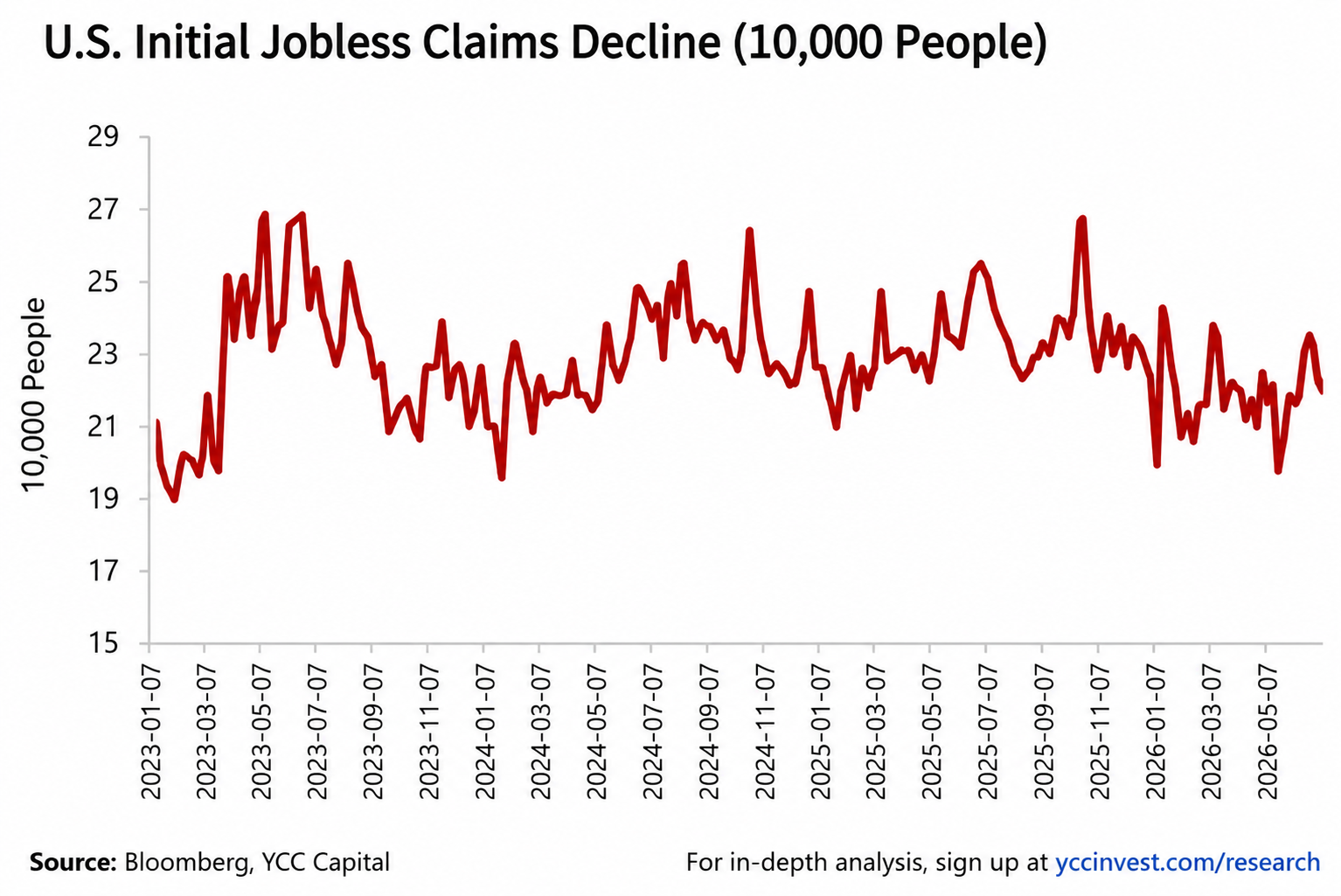
YCC Perspective Every market cycle has a catalyst that reminds investors that geopolitics never truly disappears. For much of the past year, attention centered on artificial intelligence, earnings resilience, and monetary policy. Yet history repeatedly demonstrates that unexpected geopolitical shocks can rapidly reorder market priorities. The renewed escalation between the United States and Iran is a timely reminder. Within days, investors shifted from debating the timing of future Federal Reserve easing toward reassessing inflation risks, energy security, and sovereign bond valuations. Just as a family preparing a household budget suddenly thinks differently after gasoline prices surge, financial markets immediately recalibrate expectations when oil becomes more expensive. Higher energy costs ripple through transportation, manufacturing, logistics, and ultimately consumer prices. That chain reaction explains why bond markets—not equities—often deliver the clearest real-time verdict on geopolitical crises. At YCC Capital, we believe the latest developments reinforce an important strategic lesson: inflation risks remain more persistent than many investors anticipated, even as economic growth gradually moderates. Executive Summary The past week was dominated by a sharp deterioration in geopolitical conditions after military confrontation between the United States and Iran intensified once again. Oil markets responded immediately, with WTI crude advancing more than 4% to approximately US$72 per barrel, while sovereign bond yields across developed markets moved decisively higher as investors priced a renewed inflation premium. The U.S. Treasury market reflected this shift most clearly. The benchmark 10-year Treasury yield climbed 7 basis points to 4.56%, extending the gradual repricing that has unfolded since early summer. European government bond markets followed suit, with yields rising across the United Kingdom, Germany, and France as investors reassessed both inflation expectations and future central bank policy trajectories. Equity markets produced a more mixed picture. Technology shares continued to outperform in the United States, lifting the Nasdaq Composite by 1.7%, while most European and Northeast Asian equity indices weakened amid heightened geopolitical uncertainty. Hong Kong equities outperformed on short-covering activity despite continuing structural concerns surrounding China’s domestic economy. Foreign exchange markets remained comparatively stable. The U.S. dollar index edged modestly higher, reflecting continued demand for dollar-denominated assets, while gold unexpectedly weakened despite elevated geopolitical risks, illustrating that higher real interest rates continue to offset traditional safe-haven demand. Overall, last week’s market action reinforces our view that investors are entering a regime where inflation uncertainty—not recession—is becoming the dominant driver of global fixed-income pricing. Global Markets at a Glance Global financial markets displayed increasing divergence across asset classes. Equity investors continued rewarding sectors benefiting from secular technological investment, particularly artificial intelligence infrastructure, while simultaneously reducing exposure to more cyclical international markets facing slower growth and higher energy costs. Meanwhile, fixed-income investors adopted a far more cautious stance. Rising energy prices, renewed geopolitical uncertainty, and increasingly hawkish central bank communication collectively pushed government bond yields higher across most developed economies. Among major asset classes: Asset Weekly Performance WTI Crude Oil +4.1% Nasdaq Composite +1.7% Hang Seng Index +3.5% Gold -1.6% U.S. 10Y Treasury Yield +7 bps German 10Y Bund Yield +14 bps UK 10Y Gilt Yield +11.2 bps Source: Bloomberg, YCC Capital Rather than representing isolated movements, these price changes collectively point toward one consistent macro narrative: markets increasingly expect inflation risks to remain elevated while central banks maintain restrictive policy settings for longer than previously anticipated. Federal Reserve: Hawkish Messaging Becomes Increasingly Difficult to Ignore The release of the June FOMC meeting minutes confirmed that policymakers remain considerably more concerned about inflation than financial markets had expected only a few months ago. Although officials ultimately voted to leave policy rates unchanged, the discussion revealed growing disagreement regarding the appropriate future policy path. Several participants argued that recent developments—including higher energy prices and supply disruptions—could justify an additional rate increase if inflation fails to moderate. More importantly, the Committee signaled a meaningful communication shift. Many policymakers favored removing language that had previously implied an easing bias, replacing it with a more data-dependent framework emphasizing inflation risks rather than downside growth concerns. This represents an important evolution in Federal Reserve thinking. Earlier in the year, markets largely interpreted policy discussions through the lens of slowing growth. Today, policymakers appear increasingly focused on ensuring that inflation expectations remain firmly anchored. The Federal Reserve’s Semiannual Monetary Policy Report reinforced this message. The report emphasized that tariffs, elevated commodity prices, continued Middle East instability, and sustained investment associated with artificial intelligence infrastructure have all contributed to stronger inflationary pressures than previously anticipated. Taken together, these developments suggest that the Federal Reserve remains committed to price stability even if doing so requires maintaining restrictive monetary conditions for an extended period. From an investment perspective, this reduces the likelihood of aggressive policy easing during the second half of 2026. U.S. Economy: Slower, But Still Remarkably Resilient Economic data released during the week painted a picture of moderation rather than deterioration. Initial unemployment claims declined modestly to approximately 215,000, remaining near historically low levels. Although continuing claims increased, employers continue demonstrating considerable reluctance to implement widespread layoffs. Instead, corporate America appears to be pursuing what has become one of the defining characteristics of this economic cycle: slowing hiring rather than accelerating job losses. This distinction matters enormously. Businesses that spent years struggling to recruit workers are understandably hesitant to reduce payroll aggressively, even as demand growth slows. Maintaining experienced employees today may prove considerably cheaper than attempting to rebuild workforces once economic momentum strengthens again. Consequently, labor market adjustment continues occurring gradually rather than abruptly. Meanwhile, June’s ISM Services PMI eased slightly to 54.0, remaining comfortably above the expansion threshold of 50. Several components deserve particular attention. Business activity and new orders moderated modestly, suggesting demand growth is cooling but remains fundamentally healthy. Employment improved meaningfully, re-entering expansion territory after several weaker months. Most encouragingly, the prices-paid component declined to its lowest level in four months, indicating that cost pressures have begun easing despite renewed energy price volatility. Collectively, these indicators portray an economy transitioning toward slower—but still positive—growth rather than entering recession. At YCC Capital,
The Dollar’s Second Wind: Why Confidence—Not Just Interest Rates—Is Driving the Greenback Higher
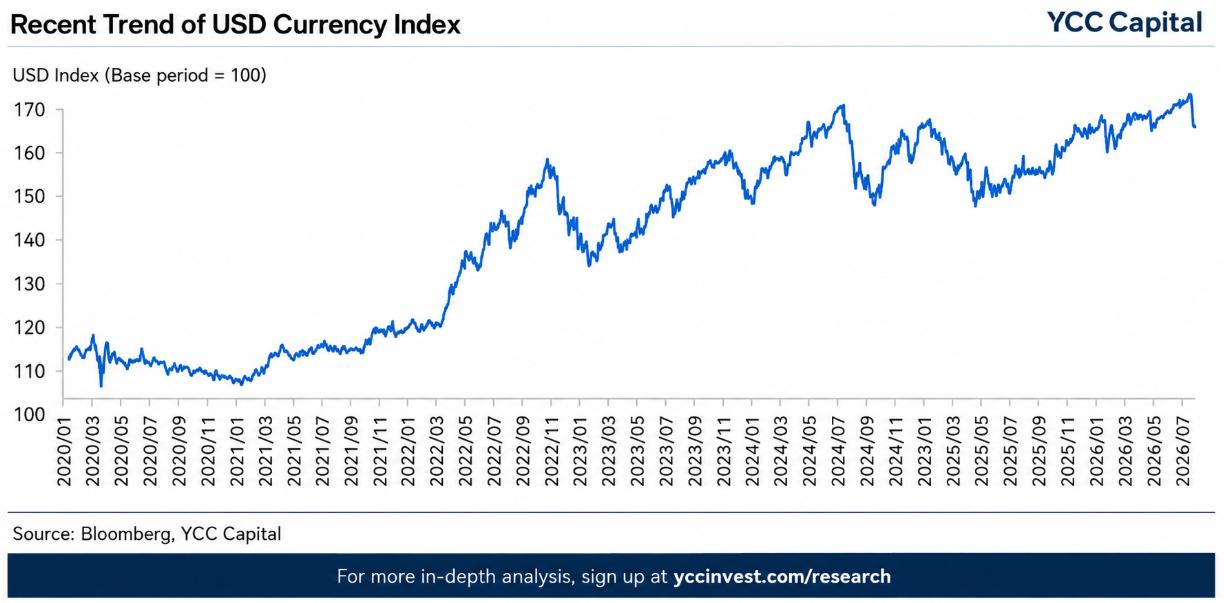
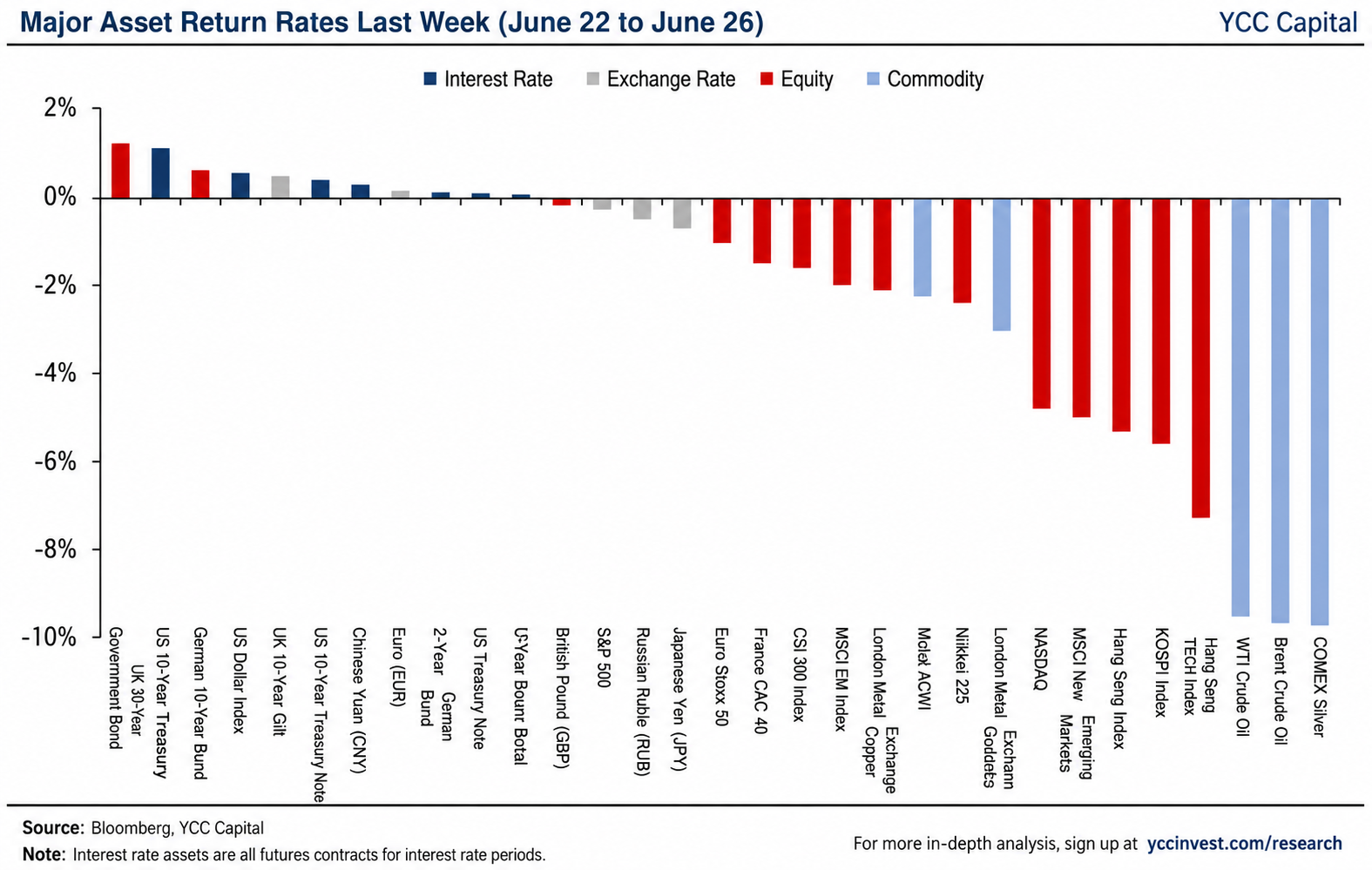
YCC CAPITAL Global Fixed Income & Currency Strategy June 30, 2026 Executive Perspective Currencies rarely move for a single reason. At times they respond to interest rates, at others to capital flows, fiscal credibility, geopolitical shocks, or shifts in investor psychology. The recent appreciation of the U.S. dollar is a reminder that markets often evolve through changing narratives rather than changing data alone. Over the past two months, investors have become increasingly focused on one question: why has the dollar strengthened despite Treasury yields easing? Under traditional macro relationships, lower long-term yields should weaken a currency by reducing its return advantage. Yet the opposite has occurred. This apparent contradiction has confused many investors but, in our view, reflects an important transition in what is driving global capital allocation. Our assessment is that the dollar’s latest advance is no longer primarily a story of widening interest-rate differentials. Instead, it increasingly reflects an improvement in confidence surrounding U.S. financial assets and America’s institutional credibility. Markets are assigning a lower risk premium to holding dollars, allowing the currency to strengthen even as bond yields stabilize or drift lower. For investors, this distinction matters enormously. A rate-driven dollar rally typically ends once monetary expectations change. A confidence-driven rally, however, can persist longer while simultaneously reshaping performance across equities, commodities, fixed income, and emerging markets. Nevertheless, confidence is not the same as permanence. While the United States continues to enjoy structural advantages—including technological leadership, deep capital markets, and continued global demand for dollar assets—the foundations supporting the current rally remain vulnerable to political developments, fiscal outcomes, and geopolitical uncertainty. We therefore expect further near-term resilience but remain less convinced that an enduring multi-year dollar supercycle has begun. Markets Enter a New Phase of Rotation The final full trading week of June illustrated how quickly market leadership can change when investor narratives shift. The advancement of U.S.–Iran diplomatic negotiations significantly reduced fears of immediate supply disruptions in global energy markets. Oil prices consequently declined sharply, removing one of the principal inflation risks that had dominated markets earlier in the month. Ordinarily, cheaper oil would provide a broad tailwind for global equities. Instead, investors turned their attention elsewhere. Growing caution surrounding artificial intelligence valuations triggered another wave of profit-taking across semiconductor manufacturers and mega-cap technology companies. South Korean technology shares experienced particularly heavy selling amid reports suggesting slower-than-expected production expansion for advanced memory chips, while leveraged ETF warnings further amplified market volatility. The selling pressure subsequently spread into U.S. technology leaders. Even exceptionally strong earnings from Micron failed to reverse the broader rotation. Investors appeared increasingly willing to reduce exposure after one of the strongest AI-driven rallies in modern market history. As a result, market leadership broadened considerably. While the Nasdaq and the “Magnificent Seven” underperformed sharply, the Dow Jones Industrial Average generated positive weekly returns as capital rotated toward more cyclical and defensive sectors. Rather than exiting equities entirely, investors simply began redistributing risk across industries. This distinction is important. Broad market corrections often signal deteriorating macroeconomic expectations. Sector rotation, by contrast, usually reflects changing preferences within an otherwise healthy investment environment. The recent episode appears much closer to the latter. Across asset classes, precious metals and energy recorded the weakest performance. Silver and crude oil both suffered substantial declines, while gold extended its fourth consecutive weekly loss. Simultaneously, the U.S. Dollar Index climbed to its strongest level since May 2025. These developments reveal a market increasingly rewarding confidence rather than pure inflation hedging. Understanding the Dollar’s Two Distinct Rallies Although many observers describe the recent appreciation as one continuous move, we believe two separate phases have unfolded since May. The first stage was relatively conventional. Strong U.S. economic data consistently surprised to the upside, reinforcing expectations that the Federal Reserve would maintain restrictive monetary policy for longer than markets had previously anticipated. Following June’s Federal Open Market Committee meeting, policymakers delivered a more hawkish message than many investors expected, encouraging markets to push rate expectations further into the future. As expectations for higher policy rates strengthened, real interest-rate differentials between the United States and Europe widened materially. Higher real returns naturally attracted additional global capital into dollar-denominated assets, supporting the currency. This was the classic interest-rate story. However, the second stage has been fundamentally different. During the most recent week, Treasury yields drifted lower while the dollar continued strengthening. At the same time, gold prices fell decisively. Such a combination does not fit traditional macro relationships. Instead, it points toward falling dollar risk premiums rather than rising interest-rate advantages. Markets appear increasingly comfortable owning dollar assets because confidence in the broader U.S. financial framework has improved. That represents a subtle but important shift in investor psychology. Confidence Has Become the New Catalyst One of the principal catalysts emerged following public remarks from Treasury Secretary Scott Bessent emphasizing America’s commitment to maintaining dollar leadership within the international financial system. His comments extended beyond monetary policy. They addressed three broader themes: First, renewed expectations that Middle Eastern energy exports could increasingly reconnect with dollar-based settlement mechanisms. Second, confidence that U.S. economic growth could remain robust without generating a significant resurgence in inflation. Third, a commitment toward improving America’s long-run fiscal trajectory. Whether every objective ultimately materializes is less important than how markets interpreted the message. Investors increasingly viewed U.S. institutions as demonstrating greater policy coherence than had been feared only months earlier. When confidence improves, investors require less compensation for holding long-duration U.S. assets. Consequently, long-term Treasury yields may fall while the dollar simultaneously strengthens. Gold, meanwhile, typically struggles because part of its appeal derives from skepticism toward fiat currencies and sovereign credibility. As confidence in the dollar improves, that defensive demand naturally weakens. This helps explain why both Treasury yields and gold declined together while the dollar appreciated. Rather than contradicting one another, these asset movements collectively reflect declining systemic risk premiums. America’s Economic Foundation Remains More Durable Than Many Expected Recent macroeconomic releases continue to reinforce the picture of an economy that remains resilient
When the Tide Recedes: Why the U.S. Dollar Is Entering a New Era of Two-Way Risk
YCC CAPITAL Global Fixed Income & Currency Strategy June 28, 2026 Executive Perspective For much of the past three years, investors have become accustomed to viewing the U.S. dollar through a remarkably simple lens: stronger inflation leads to higher Federal Reserve rates, and higher rates translate into a stronger dollar. History, however, tells a far more nuanced story. Financial markets rarely reward obvious narratives for long. By the time central banks finally act, markets have often spent months pricing those decisions. What ultimately drives currencies is not merely the direction of interest rates, but the evolution of expectations relative to what investors already believe. Today, global markets once again stand at such an inflection point. Following a sharp resurgence in inflation driven primarily by Middle East energy disruptions, investors have rapidly shifted from expecting Federal Reserve easing to debating the possibility of renewed rate hikes. Yet just as markets have embraced a more hawkish consensus, the geopolitical backdrop is beginning to stabilize, energy prices are retreating, and the inflation impulse that fueled this policy repricing may already be fading. At YCC Capital, we believe investors should resist extrapolating recent dollar strength into a new structural bull market. While tighter global monetary conditions support the dollar in the near term, history suggests that tightening cycles seldom produce sustained one-directional moves in the U.S. Dollar Index (DXY). Instead, periods of elevated uncertainty often evolve into prolonged episodes of broad trading ranges as competing macroeconomic forces offset one another. Our base case is therefore that the second half of the year is likely to be characterized less by a decisive dollar trend and more by heightened volatility around a relatively stable equilibrium. Global Liquidity Has Quietly Entered a New Tightening Phase One of the least appreciated developments in today’s macro environment is that global liquidity conditions have shifted materially over recent months. While investors remain heavily focused on the Federal Reserve, the broader monetary landscape has changed more dramatically than many appreciate. Inflation generated by geopolitical disruptions—particularly through higher energy prices—has increasingly forced central banks around the world to reconsider previously anticipated easing cycles. This represents a meaningful departure from expectations earlier in the year. Only a few months ago, consensus forecasts largely revolved around synchronized global monetary easing. Instead, policymakers now face imported inflation driven not by domestic overheating but by geopolitical supply shocks. Across both developed and emerging economies, central banks have begun responding accordingly. Japan’s Bank of Japan has continued its historic normalization process, raising its policy rate to 1%—the highest level since the mid-1990s—while also signaling a slower pace of government bond purchase reductions beginning next year. Meanwhile, the European Central Bank has also adopted a more restrictive stance after inflationary pressures intensified. Several emerging market central banks have likewise shifted toward tightening. Taken collectively, these developments suggest that the extraordinary era of abundant global liquidity is gradually giving way to a more restrictive monetary environment. One useful gauge illustrating this transition is the Council on Foreign Relations’ Global Monetary Policy Tracker, which aggregates policy stances across 54 economies. During the second quarter, this indicator moved modestly into tightening territory for the first time in several quarters, reflecting that restrictive policy is no longer confined to the United States but is becoming increasingly global. Markets often resemble ocean tides more than light switches. Liquidity rarely disappears overnight. Instead, it gradually recedes until investors suddenly realize the shoreline has moved much farther than expected. That appears increasingly true today. Sources: Bloomberg, YCC Capital. Why Interest Rates Alone Rarely Determine the Dollar Conventional wisdom often assumes that higher U.S. interest rates automatically translate into a stronger dollar. Reality has been considerably more complicated. The Dollar Index is not a measure of America’s economic strength in isolation. Rather, it reflects the value of the dollar against a basket of major developed-market currencies including the euro, yen, pound sterling, Canadian dollar, Swedish krona and Swiss franc. Consequently, relative economic performance matters far more than absolute performance. If U.S. growth merely slows less than Europe or Japan, the dollar can appreciate even if domestic conditions deteriorate. Conversely, the dollar can weaken despite Fed tightening if overseas economies improve even faster. Equally important is the role of expectations. Modern monetary policy operates largely through forward guidance. Financial markets spend months—or even years—anticipating central bank decisions before those decisions actually occur. When policy announcements merely confirm expectations, little incremental capital flows into the currency. Instead, the largest currency moves occur when investors are surprised. The difference between reality and expectations—the so-called “expectation gap”—often proves far more influential than the policy action itself. Understanding this distinction helps explain why many tightening cycles have failed to generate sustained dollar appreciation. Four Tightening Cycles, Four Very Different Dollar Outcomes Looking back over the past three decades illustrates a remarkably consistent lesson: Federal Reserve tightening has rarely produced prolonged one-way appreciation in the Dollar Index. The 1994–1995 Surprise Tightening The 1994 tightening cycle remains unique in modern monetary history. At the time, the U.S. economy was only beginning to recover from recession. Inflation remained relatively subdued while unemployment was still elevated. Nevertheless, the Federal Reserve launched a rapid sequence of preventive rate hikes, lifting policy rates from 3% to 6%. Unlike today’s Fed, policymakers then provided relatively little forward guidance. Markets were caught off guard. Rather than strengthening, the dollar entered a sustained decline. Investors feared aggressive tightening would derail America’s recovery, triggering significant bond market volatility and capital outflows. Meanwhile, Europe’s comparatively stronger economic momentum attracted international investment away from the United States. Ironically, higher interest rates failed to support the dollar because markets viewed the policy itself as a source of instability. 2004–2006: When Good News Was Already Priced In The subsequent tightening cycle unfolded very differently. By 2004, Federal Reserve communication had improved dramatically. Markets had ample opportunity to anticipate gradual rate increases. When the first hike finally arrived, much of its positive impact had already been discounted. The Dollar Index initially weakened as investors took
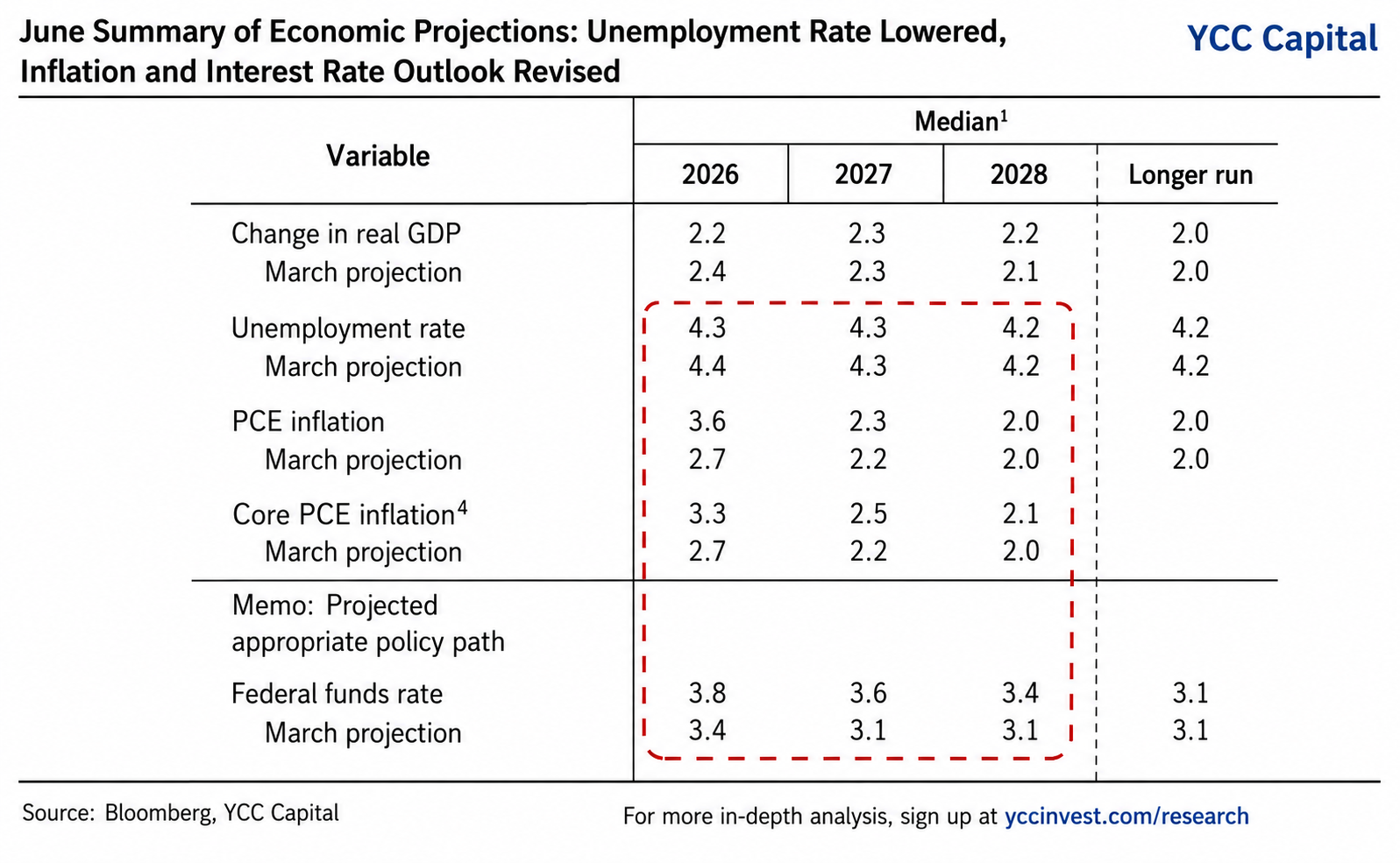
The Fed’s Hawkish Reset: From “When to Cut” to “Whether to Hike Again”
YCC CAPITAL Global Fixed Income & Currency Strategy June 21, 2026 YCC Perspective For much of the past two years, markets have been conditioned to ask a single question: When will the Federal Reserve cut rates? Following the June FOMC meeting, that question appears increasingly outdated. The Federal Reserve has not merely held rates steady. It has fundamentally altered the framework through which investors should interpret monetary policy. The June meeting signaled a decisive shift away from forward guidance, a renewed emphasis on inflation control, and a willingness to tolerate slower growth if necessary to restore price stability. In everyday life, this resembles a household that has spent years battling rising expenses. Rather than temporarily easing the budget to maintain comfort, the family decides to tighten spending despite short-term discomfort because inflation has become the larger long-term threat. The Fed increasingly appears to be making the same choice. Based on the June policy statement, updated economic projections, and revised dot plot, we believe investors should begin preparing for a world in which higher rates persist longer than consensus expectations. Executive Summary Key Takeaways The Federal Reserve left policy rates unchanged but significantly upgraded inflation projections and interest-rate expectations. Language implying future rate cuts was removed. The Fed effectively abandoned traditional forward guidance. Inflation has re-emerged as the central policy objective. Internal discussions have shifted from the timing of rate cuts toward the possibility of additional rate hikes. Markets have begun pricing the possibility of another hike as early as October. Higher-for-longer rates create a more challenging environment for long-duration assets. YCC View: The June meeting represents one of the most consequential communication shifts since the post-pandemic tightening cycle began. Investors should not underestimate the significance of this change. Source: Bloomberg, YCC Capital Event Overview In the early hours of June 18, 2026 (Beijing time), the Federal Reserve released its June monetary policy decision. The Committee: Kept the federal funds rate unchanged. Released updated quarterly economic projections. Published a revised dot plot showing higher expected future policy rates. Raised inflation forecasts. Lowered unemployment projections. Slightly reduced GDP growth expectations. The combination of these changes sends a clear signal: inflation concerns now outweigh growth concerns within the Federal Reserve’s policy framework. A New Era Under Governor Warsh The Fed Turns More Hawkish Although policy rates were unchanged, the message was anything but neutral. Several notable changes emerged: 1. Removal of Dovish Language The Federal Reserve eliminated language that suggested future rate cuts remained the base case. This is more important than a simple wording adjustment. Markets have relied heavily on forward guidance for more than a decade. By removing such language, policymakers have reduced their commitment to signaling future moves in advance. 2. Simplified Policy Statement The June statement was materially shorter and more streamlined than prior versions. 3. Reduced Transparency The Fed departed from the customary practice of providing detailed voting disclosures. 4. Higher Inflation Forecasts Officials significantly increased projections for: Headline PCE inflation Core PCE inflation 5. Higher Policy Rate Expectations The median policy-rate path for the coming years moved higher, indicating officials now expect tighter monetary conditions to persist longer than previously anticipated. 6. Institutional Restructuring Governor Warsh announced five new monetary-policy working groups and indicated a comprehensive review of Fed communication practices will be completed before year-end. Taken together, these developments suggest the beginning of a broader institutional transformation rather than a routine policy update. Inflation Is Back at the Center of the Policy Framework The Fed’s revised forecasts reveal a significant shift in priorities. The combination of: Higher inflation forecasts Lower unemployment forecasts Slightly weaker GDP forecasts suggests a new policy hierarchy. 1. The End of the Traditional Employment-Inflation Tradeoff Historically, the Federal Reserve balanced two competing mandates: Maximum employment Price stability Governor Warsh’s comments imply policymakers no longer view the current labor market as requiring such tradeoffs. The Fed appears to believe: Labor demand remains healthy. Labor supply is expanding. Employment conditions remain stable. As a result, policymakers may no longer feel compelled to tolerate elevated inflation simply to support growth. In practical terms, unless labor markets deteriorate dramatically, inflation control will likely remain the dominant objective. 2. Acknowledgment That Inflation Is More Persistent The revised projections are effectively an admission that inflation has proven more durable than expected. After years of repeated forecasts predicting a return to 2%, policymakers now appear increasingly skeptical that disinflation will proceed smoothly. This is a crucial psychological shift. For a central bank that has struggled for years to bring inflation back to target, credibility itself becomes an asset worth defending. The Fed is increasingly tying its institutional reputation to its anti-inflation commitment. 3. A Hawkish Dot Plot The updated dot plot represents one of the strongest hawkish signals from the meeting. According to the report, roughly half of policymakers are now considering the possibility of additional rate hikes before year-end. The policy conversation has therefore shifted from: “When should we cut?” to “Do we need to hike again?” That is a profound change in market narrative. The Warsh Doctrine: Lower Transparency, Greater Flexibility Rebuilding Central Bank Discretion One of the most striking aspects of the June meeting was the apparent effort to reduce policy transparency. Measures included: Shorter statements Less voting disclosure Elimination of forward guidance Rather than guiding markets, the Fed appears to be reclaiming flexibility. This approach resembles earlier eras of central banking when policymakers intentionally preserved uncertainty in order to maximize policy effectiveness. While markets may dislike reduced visibility, policymakers may view it as necessary to regain strategic flexibility. Challenging Traditional Economic Data Governor Warsh also questioned the usefulness of traditional government economic statistics. He highlighted: Frequent revisions Reporting lags Historical bias Instead, he expressed greater confidence in: Market pricing Private-sector data Real-time indicators This is potentially a major shift. For decades, investors built macroeconomic frameworks around government releases such as payrolls, CPI, and GDP. If policymakers increasingly prioritize alternative data sources, traditional macro forecasting models may become less reliable. A More Unified Fed Than