YCC Perspective
Every market cycle has a catalyst that reminds investors that geopolitics never truly disappears. For much of the past year, attention centered on artificial intelligence, earnings resilience, and monetary policy. Yet history repeatedly demonstrates that unexpected geopolitical shocks can rapidly reorder market priorities. The renewed escalation between the United States and Iran is a timely reminder. Within days, investors shifted from debating the timing of future Federal Reserve easing toward reassessing inflation risks, energy security, and sovereign bond valuations.
Just as a family preparing a household budget suddenly thinks differently after gasoline prices surge, financial markets immediately recalibrate expectations when oil becomes more expensive. Higher energy costs ripple through transportation, manufacturing, logistics, and ultimately consumer prices. That chain reaction explains why bond markets—not equities—often deliver the clearest real-time verdict on geopolitical crises.
At YCC Capital, we believe the latest developments reinforce an important strategic lesson: inflation risks remain more persistent than many investors anticipated, even as economic growth gradually moderates.
Executive Summary
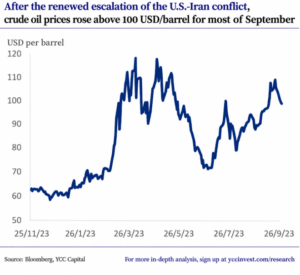
The past week was dominated by a sharp deterioration in geopolitical conditions after military confrontation between the United States and Iran intensified once again. Oil markets responded immediately, with WTI crude advancing more than 4% to approximately US$72 per barrel, while sovereign bond yields across developed markets moved decisively higher as investors priced a renewed inflation premium.
The U.S. Treasury market reflected this shift most clearly. The benchmark 10-year Treasury yield climbed 7 basis points to 4.56%, extending the gradual repricing that has unfolded since early summer. European government bond markets followed suit, with yields rising across the United Kingdom, Germany, and France as investors reassessed both inflation expectations and future central bank policy trajectories.
Equity markets produced a more mixed picture. Technology shares continued to outperform in the United States, lifting the Nasdaq Composite by 1.7%, while most European and Northeast Asian equity indices weakened amid heightened geopolitical uncertainty. Hong Kong equities outperformed on short-covering activity despite continuing structural concerns surrounding China’s domestic economy.
Foreign exchange markets remained comparatively stable. The U.S. dollar index edged modestly higher, reflecting continued demand for dollar-denominated assets, while gold unexpectedly weakened despite elevated geopolitical risks, illustrating that higher real interest rates continue to offset traditional safe-haven demand.
Overall, last week’s market action reinforces our view that investors are entering a regime where inflation uncertainty—not recession—is becoming the dominant driver of global fixed-income pricing.
Global Markets at a Glance
Global financial markets displayed increasing divergence across asset classes.
Equity investors continued rewarding sectors benefiting from secular technological investment, particularly artificial intelligence infrastructure, while simultaneously reducing exposure to more cyclical international markets facing slower growth and higher energy costs.
Meanwhile, fixed-income investors adopted a far more cautious stance. Rising energy prices, renewed geopolitical uncertainty, and increasingly hawkish central bank communication collectively pushed government bond yields higher across most developed economies.
Among major asset classes:
| Asset | Weekly Performance |
|---|---|
| WTI Crude Oil | +4.1% |
| Nasdaq Composite | +1.7% |
| Hang Seng Index | +3.5% |
| Gold | -1.6% |
| U.S. 10Y Treasury Yield | +7 bps |
| German 10Y Bund Yield | +14 bps |
| UK 10Y Gilt Yield | +11.2 bps |
Source: Bloomberg, YCC Capital
Rather than representing isolated movements, these price changes collectively point toward one consistent macro narrative: markets increasingly expect inflation risks to remain elevated while central banks maintain restrictive policy settings for longer than previously anticipated.
Federal Reserve: Hawkish Messaging Becomes Increasingly Difficult to Ignore
The release of the June FOMC meeting minutes confirmed that policymakers remain considerably more concerned about inflation than financial markets had expected only a few months ago.
Although officials ultimately voted to leave policy rates unchanged, the discussion revealed growing disagreement regarding the appropriate future policy path. Several participants argued that recent developments—including higher energy prices and supply disruptions—could justify an additional rate increase if inflation fails to moderate.
More importantly, the Committee signaled a meaningful communication shift. Many policymakers favored removing language that had previously implied an easing bias, replacing it with a more data-dependent framework emphasizing inflation risks rather than downside growth concerns.
This represents an important evolution in Federal Reserve thinking.
Earlier in the year, markets largely interpreted policy discussions through the lens of slowing growth. Today, policymakers appear increasingly focused on ensuring that inflation expectations remain firmly anchored.
The Federal Reserve’s Semiannual Monetary Policy Report reinforced this message.
The report emphasized that tariffs, elevated commodity prices, continued Middle East instability, and sustained investment associated with artificial intelligence infrastructure have all contributed to stronger inflationary pressures than previously anticipated.
Taken together, these developments suggest that the Federal Reserve remains committed to price stability even if doing so requires maintaining restrictive monetary conditions for an extended period.
From an investment perspective, this reduces the likelihood of aggressive policy easing during the second half of 2026.
U.S. Economy: Slower, But Still Remarkably Resilient
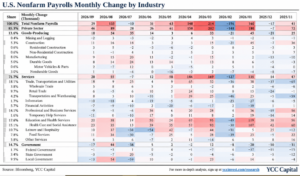
Economic data released during the week painted a picture of moderation rather than deterioration.
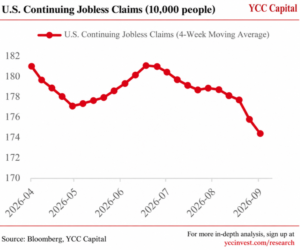
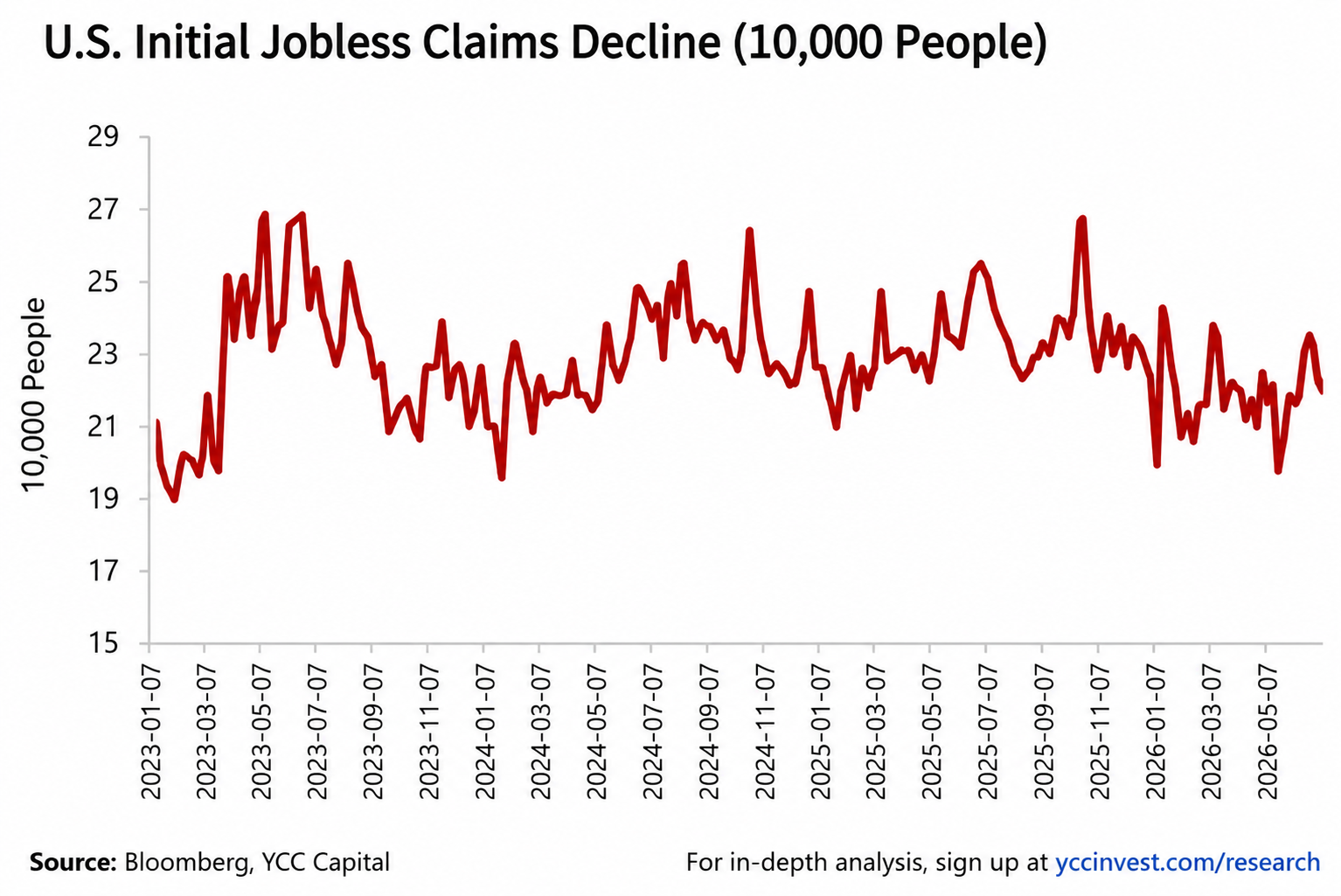
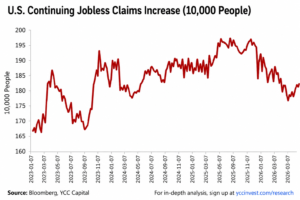
Initial unemployment claims declined modestly to approximately 215,000, remaining near historically low levels. Although continuing claims increased, employers continue demonstrating considerable reluctance to implement widespread layoffs.
Instead, corporate America appears to be pursuing what has become one of the defining characteristics of this economic cycle: slowing hiring rather than accelerating job losses.
This distinction matters enormously.
Businesses that spent years struggling to recruit workers are understandably hesitant to reduce payroll aggressively, even as demand growth slows. Maintaining experienced employees today may prove considerably cheaper than attempting to rebuild workforces once economic momentum strengthens again.
Consequently, labor market adjustment continues occurring gradually rather than abruptly.
Meanwhile, June’s ISM Services PMI eased slightly to 54.0, remaining comfortably above the expansion threshold of 50.
Several components deserve particular attention.
Business activity and new orders moderated modestly, suggesting demand growth is cooling but remains fundamentally healthy.
Employment improved meaningfully, re-entering expansion territory after several weaker months.
Most encouragingly, the prices-paid component declined to its lowest level in four months, indicating that cost pressures have begun easing despite renewed energy price volatility.
Collectively, these indicators portray an economy transitioning toward slower—but still positive—growth rather than entering recession.
At YCC Capital, we continue viewing the U.S. economy as fundamentally resilient. While higher interest rates are undoubtedly restraining activity, corporate balance sheets, household consumption, and labor markets remain considerably stronger than in previous late-cycle environments. This resilience supports our cautiously constructive medium-term outlook for U.S. assets, even as elevated yields may continue to create near-term volatility.
Geopolitical Flashpoint: The Strait of Hormuz Returns to Center Stage
The defining geopolitical development of the week was the renewed military escalation between the United States and Iran, culminating in a dangerous expansion of hostilities that extended beyond rhetoric and into strategic infrastructure.
According to multiple reports, Iran launched retaliatory strikes against U.S. military assets in the Middle East following fresh American military operations. More significantly, Iranian authorities announced the closure of the Strait of Hormuz “until further notice,” warning that any additional U.S. military intervention would invite broader retaliation across the region. Simultaneously, Washington responded with another round of military operations, while Oman intensified diplomatic efforts aimed at establishing a dual-navigation framework for commercial shipping through the Strait.
Whether the closure proves temporary or evolves into a prolonged disruption remains uncertain. Yet for financial markets, certainty is not required. The possibility alone is sufficient to trigger higher risk premiums.
Nearly one-fifth of globally traded crude oil passes through the Strait of Hormuz, making it arguably the single most strategically important maritime corridor in the global energy system. Any interruption—even if partial—immediately alters expectations for energy supply, transportation costs, inflation, and central bank policy.
History offers a useful reminder. During previous geopolitical crises in the Gulf, markets frequently reacted far more aggressively to uncertainty than to actual disruptions. Investors price probabilities, not just outcomes.
For policymakers, the challenge is equally complex. Higher oil prices function much like an unexpected tax on consumers and businesses, slowing growth while simultaneously lifting inflation. This combination complicates monetary policy, leaving central banks with fewer attractive options.
At YCC Capital, we believe investors should distinguish between short-term geopolitical volatility and longer-term structural market trends. While military tensions often generate sharp price swings, they rarely alter secular investment themes unless they produce sustained supply disruptions or fundamentally reshape global trade patterns. Nevertheless, the current episode reinforces the reality that geopolitical risk deserves a permanently higher allocation within portfolio construction than many investors assumed during the unusually stable decade preceding the pandemic.
Global Fixed Income: Inflation Risk Returns to the Driver’s Seat
Perhaps no asset class responded more clearly to last week’s developments than sovereign bonds.
Government bond markets across developed economies experienced a synchronized rise in yields as investors incorporated higher expected inflation, reduced expectations for near-term monetary easing, and modest increases in geopolitical risk premiums.
The adjustment was broad rather than localized.
The U.S. 10-year Treasury yield increased to 4.56%, reflecting stronger inflation expectations following the rebound in energy prices and increasingly hawkish Federal Reserve communication. While a seven-basis-point move may appear modest in isolation, it represents another incremental step in what has become a persistent repricing higher across the Treasury curve.
Importantly, Treasury yields are no longer responding exclusively to domestic economic data. Global geopolitical developments, commodity markets, fiscal deficits, and structural investment demand associated with artificial intelligence infrastructure are becoming increasingly important determinants of long-term interest rates.
This broader framework marks a notable departure from earlier phases of the tightening cycle, when inflation was viewed primarily through the lens of domestic labor markets.
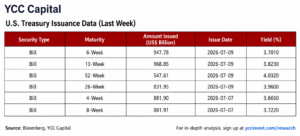
Treasury issuance during the week proceeded smoothly, with the U.S. Department of the Treasury successfully auctioning multiple short-dated bills across maturities ranging from four weeks to one year. Auction results suggested that investor demand remains healthy despite higher yields, reinforcing the view that global demand for U.S. government securities remains structurally robust.
From an allocation standpoint, YCC Capital believes higher Treasury yields should increasingly be viewed as opportunities rather than purely as headwinds. Investors can now obtain historically attractive nominal income while maintaining exposure to one of the world’s deepest and most liquid fixed-income markets. Although yields may continue drifting higher over the coming months, long-duration U.S. Treasuries are gradually becoming more compelling from a strategic perspective.
Europe: Bond Markets Follow Washington’s Lead
European sovereign bond markets largely mirrored developments in the United States.
The UK’s 10-year gilt yield rose 11.2 basis points to 4.88%, while Germany’s 10-year Bund yield climbed 14 basis points to 3.07%. France’s benchmark government bond yield increased 10.5 basis points to 3.83%.
Unlike the United States, however, Europe confronts a more challenging macroeconomic backdrop.
Economic growth remains subdued across much of the euro area, manufacturing activity continues to struggle, and elevated energy prices represent a larger drag on household purchasing power than in North America. Consequently, rising bond yields present policymakers with an uncomfortable dilemma: inflation risks argue for maintaining restrictive policy, while sluggish growth argues for greater monetary accommodation.
Financial markets currently appear to believe inflation concerns will dominate this debate, at least in the near term.
European equities reflected this tension. Major indices including Germany’s DAX and France’s CAC 40 retreated during the week as investors reassessed corporate earnings prospects under a higher-rate environment.
From our perspective, Europe remains a region characterized by cyclical rather than structural weakness. While selective opportunities undoubtedly exist, the macroeconomic backdrop remains less compelling than that of the United States, particularly given Europe’s greater exposure to imported energy costs and geopolitical disruptions.
Japan: Rising Yields Reflect Normalization Rather Than Crisis
Japan provided one of the week’s few exceptions to the broader global trend.
The 10-year Japanese Government Bond yield edged modestly lower by 0.7 basis points to 2.76%, diverging from rising yields elsewhere.
This movement should not be interpreted as evidence of deteriorating fundamentals. Rather, it reflects the unique dynamics surrounding the Bank of Japan’s ongoing normalization process and temporary shifts in domestic demand for government securities.
Japan continues progressing through a historic transition away from decades of ultra-loose monetary policy. While this adjustment inevitably introduces periods of volatility, the broader trajectory remains constructive.
Corporate governance reforms continue improving shareholder returns, wage growth has become increasingly sustainable, inbound tourism remains robust, and capital expenditure associated with digitalization and advanced manufacturing continues expanding.
Near-term fluctuations in bond yields therefore do little to alter our longer-term constructive outlook on Japan.
Rather than representing structural weakness, current challenges appear cyclical and manageable within the broader normalization process.
China and Emerging Markets: Temporary Relief Does Not Resolve Structural Challenges
Hong Kong equities outperformed global peers during the week, with the Hang Seng Index advancing more than 3%.
However, investors should avoid interpreting this rebound as evidence that China’s underlying economic challenges have materially improved.
The Chinese economy continues facing persistent structural headwinds, including weak household confidence, ongoing stress within the property sector, subdued private-sector investment, demographic deterioration, and declining productivity growth. Although policymakers remain willing to introduce incremental stimulus measures, these interventions have generally stabilized rather than fundamentally revitalized economic momentum.
Moreover, renewed geopolitical uncertainty and elevated global interest rates present additional challenges for emerging markets reliant upon external financing.
At YCC Capital, we continue to believe that selective opportunities may emerge within individual Chinese industries and companies. Nevertheless, from a top-down macro perspective, China remains one of the least attractive major economies over the medium term relative to developed market alternatives, particularly the United States and Japan.
For global asset allocators, the distinction between tactical rebounds and structural improvement remains critical.
Investment Strategy: Positioning for a Higher-for-Longer World
The past week’s developments reinforce a central theme that has increasingly defined our investment framework throughout 2026: markets are transitioning toward an environment characterized by persistently higher interest rates, greater geopolitical uncertainty, and more frequent inflation shocks.
Such an environment requires a different investment mindset than the ultra-low-rate era that dominated the decade following the Global Financial Crisis.
Investors should increasingly emphasize quality over speculation, cash flow over distant earnings, and resilience over leverage.
Within fixed income, higher sovereign yields are gradually restoring the asset class’s traditional role as both an income generator and portfolio stabilizer.
Within equities, companies demonstrating pricing power, durable competitive advantages, and strong balance sheets should continue outperforming businesses dependent upon cheap financing.
Commodities are also likely to remain an increasingly important portfolio diversifier as geopolitical fragmentation raises the probability of recurring supply disruptions.
Perhaps most importantly, diversification itself deserves renewed appreciation.
Financial history repeatedly reminds us that market shocks rarely emerge from the areas investors expect. Building portfolios capable of withstanding multiple macroeconomic scenarios—not merely forecasting the most likely outcome—remains the cornerstone of long-term capital preservation.
YCC Capital Strategic View
Our central outlook remains broadly unchanged despite the week’s geopolitical escalation.
The global economy continues slowing, but not collapsing.
Inflation continues moderating, but not disappearing.
Central banks continue approaching the end of tightening cycles, but are unlikely to deliver aggressive easing unless economic conditions deteriorate substantially.
Consequently, we expect bond market volatility to remain elevated throughout the second half of 2026 as investors repeatedly reassess the balance between growth and inflation.
Our preferred allocation continues to emphasize high-quality U.S. fixed income, selectively overweight U.S. equities—particularly companies benefiting from artificial intelligence investment and resilient domestic demand—and maintain a constructive long-term allocation to Japanese assets as monetary normalization proceeds.
Conversely, we remain cautious toward China, where structural economic imbalances continue to outweigh near-term policy support. While intermittent rallies are inevitable, sustainable outperformance will likely require much deeper reforms than currently appear politically feasible.
Looking ahead, investors should monitor three developments above all others: whether Middle East tensions disrupt energy flows for a prolonged period, whether inflation expectations become unanchored, and whether the Federal Reserve’s resolve to maintain price stability remains intact. The interaction of these forces will shape global asset returns far more than any single economic data release over the coming quarters.
Editorial Board
Ken Cao
Chief Strategist, Global Investment Strategy
Le Gao
Managing Analyst
Yui Nabeshima
Strategist
Mai Ikeda
Research Analyst
IMPORTANT DISCLAIMER
This research report is provided for informational and educational purposes only and does not constitute an offer to sell or a solicitation of an offer to buy any securities, financial instruments, or investment products. It is not intended as investment, legal, accounting, or tax advice and should not be relied upon as such. The views, opinions, and projections expressed herein are those of YCC Capital Management and its research personnel as of the date of publication and are subject to change without notice. Past performance is not indicative of future results.
YCC Capital Management, its affiliates, principals, and employees may hold long or short positions in securities or instruments discussed in this report and may trade for their own accounts or for client accounts in a manner inconsistent with the recommendations herein. This report is based on publicly available information and data believed to be reliable, but YCC Capital makes no representation or warranty, express or implied, as to the accuracy, completeness, or timeliness of such information. Forward-looking statements involve risks and uncertainties that could cause actual results to differ materially from those projected.
Recipients of this report should conduct their own independent due diligence and consult with their own financial, legal, and tax advisors before making any investment decisions. YCC Capital accepts no liability for any loss or damage arising from the use of or reliance on this report or its contents.
This report is intended solely for the use of the intended recipient(s) and may not be reproduced or redistributed for commercial purposes without the prior written consent of YCC Capital.
© 2026 YCC Capital. All rights reserved.
YCC Capital’s flagship vehicle, the YCC International Value Fund, LP, maintains a concentrated global macro value strategy with a focus on capital-flow-driven mispricings and asymmetric hedging opportunities. The Fund is registered in the State of Delaware, United States, and is structured as a Rule 506(c) private investment fund. Performance data, where referenced, has been independently verified by third-party administrators including NAV Consulting; however, individual investor results may vary.
Contact Us
YCC Capital Management
Investor Relations:
ir@yccinvest.com
For institutional research, partnership inquiries, or media requests, please contact our Investor Relations team at the email above.
To receive free daily macro research, market commentary, geopolitical analysis, and investment insights, visit:
Join thousands of professional investors, business leaders, and policymakers who receive YCC Capital Research every trading day.
YCC Capital Research
Global Fixed Income & Currency Strategy
For more related research:
Trump’s Political Playbook: Winning Abroad to Stabilize at Home
When the Tide Recedes: Why the U.S. Dollar Is Entering a New Era of Two-Way Risk
The Dollar’s Second Wind: Why Confidence—Not Just Interest Rates—Is Driving the Greenback Higher
Has Peak Hawkishness Arrived? Why the Fed’s Toughest Message May Also Mark the Turning Point