YCC CAPITAL
U.S. Themes & Strategy
July 29, 2026
Executive Summary
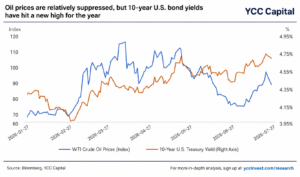
Markets rarely move for a single reason. Just as a pilot constantly adjusts for wind, altitude, and engine performance simultaneously, investors must recognize that today’s AI correction is not simply a technology story. It is the intersection of geopolitics, macroeconomics, and the evolution of the AI business model.
At YCC Capital, we believe recent weakness across AI-related equities reflects a transition from an investment environment that rewarded aggressive capital deployment toward one demanding tangible economic returns. While geopolitical tensions in the Middle East have injected fresh volatility into energy markets, and higher interest rates have increased the cost of capital, neither development fundamentally invalidates the long-term AI investment thesis. Rather, they raise the standard of proof.
The coming quarters are likely to be defined less by headline excitement surrounding larger models and more by measurable evidence that AI applications can generate sustainable revenue, justify unprecedented capital expenditures, and ultimately create durable shareholder value.
Three Drivers Are Now Steering AI Valuations
The recent repricing of AI assets has emerged from three interconnected developments:
First, geopolitical risks surrounding the United States and Iran continue to create uncertainty in energy
markets.
Second, monetary policy remains restrictive as the Federal Reserve keeps financial conditions tight.
Third, AI itself is entering an entirely different investment phase where profitability matters as much as innovation.
Individually, each force would likely have been manageable. Together, they have forced investors to reassess valuation multiples across the technology sector.
Geopolitics: Markets Continue to Expect Escalation Followed by De-escalation
The confrontation between Washington and Tehran remains capable of producing repeated episodes of market volatility. However, both sides also possess strong incentives to avoid a prolonged military conflict.
Iran views control over the Strait of Hormuz as one of its most important geopolitical and economic bargaining chips. For the United States, maintaining stability in this region remains essential for preserving broader strategic influence.
Yet financial markets ultimately impose their own discipline.
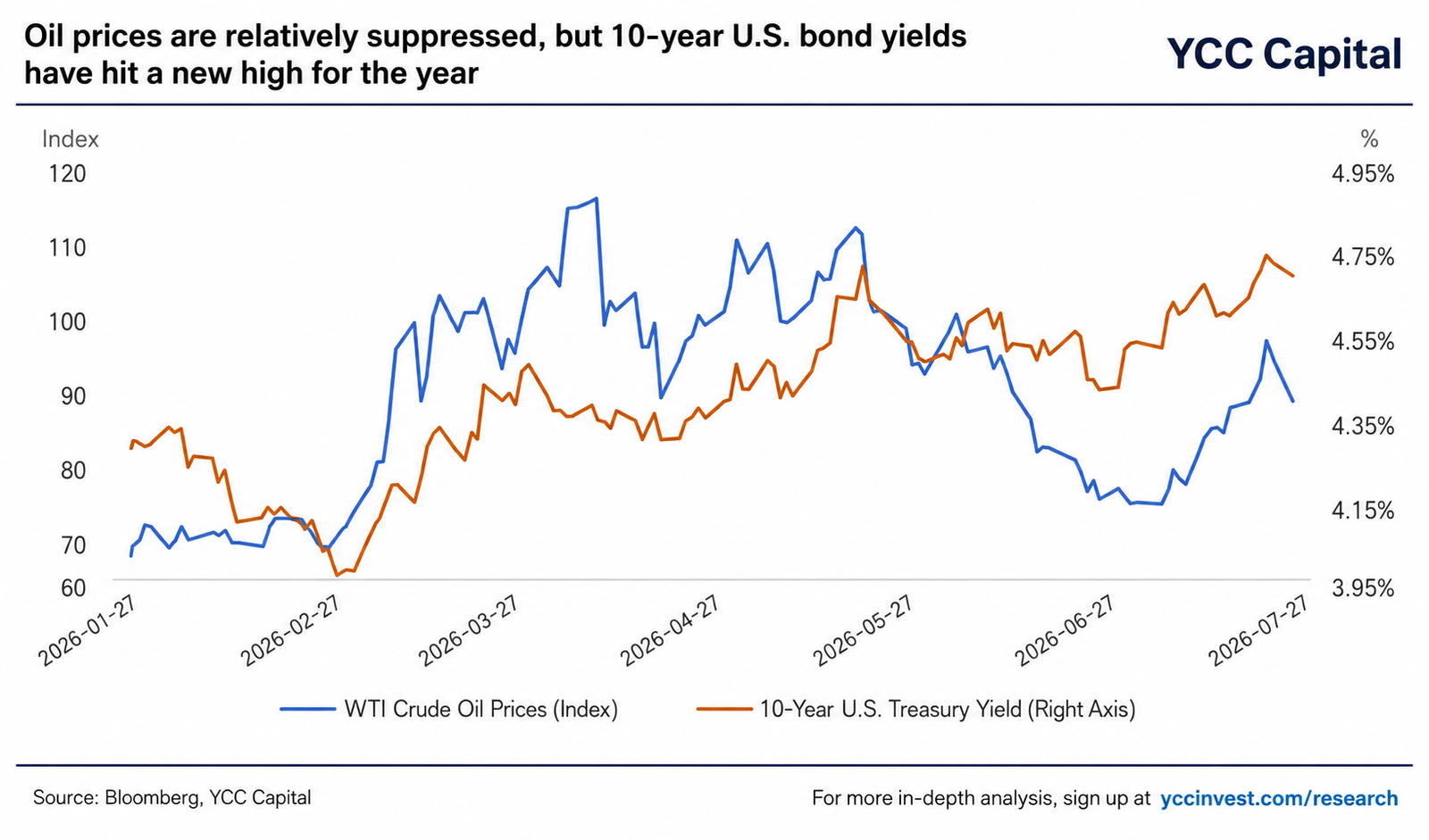
Higher oil prices, rising Treasury yields, and equity market weakness all increase the political costs associated with sustained military escalation.
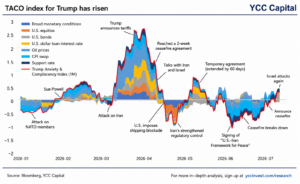
This creates what markets increasingly recognize as the “TACO” dynamic—Trump Always Chickens Out—where aggressive rhetoric is ultimately followed by compromise once financial conditions deteriorate sufficiently.
According to the source report, market participants have become noticeably more experienced in pricing geopolitical shocks. During the initial conflict earlier in the year, investors immediately rushed toward worst-case scenarios. The latest flare-up generated a far more measured response, with significant concern emerging only after crude oil approached the psychologically important $100 per barrel threshold and technology shares simultaneously entered a correction.
This evolution reflects an important behavioral shift. Markets learn. Investors who once feared every headline now demand confirmation before repricing risk.
Our base case therefore remains that geopolitical tensions will continue producing periodic volatility rather than a sustained global energy crisis.
The Federal Reserve: Holding Rates Steady Is Already Hawkish
Oil prices undoubtedly complicate the Federal Reserve’s policy decisions.
However, higher energy prices alone do not necessarily justify additional rate hikes.
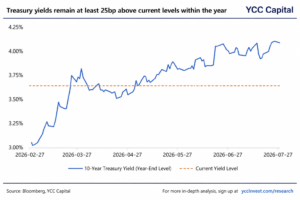
The report argues that maintaining current policy rates should itself be interpreted as a hawkish stance. Financial conditions remain sufficiently restrictive, and policymakers do not require another rate increase merely to reinforce credibility.
Current market pricing still reflects expectations for at least one additional 25-basis-point increase before year-end.
Nevertheless, for the Federal Reserve to actually tighten further, officials would need convincing evidence that existing interest rates are no longer restrictive enough to control inflation.
That threshold appears increasingly difficult to reach.
If higher oil prices primarily reflect geopolitical risk premiums rather than structural supply shortages, their inflationary impact is likely to prove temporary rather than persistent.
Absent accelerating core inflation, sustained wage growth, or deteriorating inflation expectations, the economic justification for further tightening remains limited.
From an investment perspective, monetary policy continues to influence valuation multiples primarily through the discount rate rather than through fundamental earnings deterioration.
AI Enters a New Phase: From Rewarding Investment to Demanding Returns
Perhaps the most significant shift occurring today lies within the AI industry itself.
For nearly two years, investors enthusiastically rewarded companies willing to spend aggressively on AI infrastructure.
That environment is changing.
Strong quarterly results from major cloud providers continue to demonstrate robust revenue growth, expanding operating margins, and healthy enterprise demand.
Yet investors increasingly focus on what comes after impressive revenue growth.
Capital expenditure guidance.
Free cash flow.
External financing requirements.
Return on invested capital.
Google’s latest results illustrate this transition particularly well.
Revenue growth remained strong, cloud demand continued expanding, and order backlogs suggested healthy future activity.
Nevertheless, investors concentrated on a different development: sharply rising capital expenditures and negative free cash flow.
The report notes that Google’s quarterly capital spending approached $45 billion, nearly doubling from the previous year, while free cash flow turned negative for the first time since becoming a public company.
Importantly, Google is not alone.
Amazon and Oracle had already entered negative free cash flow territory as AI infrastructure spending accelerated.
This represents a profound shift in investor psychology.
Historically, technology companies functioned as cash-generating businesses capable of funding buybacks, dividends, and continued innovation simultaneously.
Today, shareholders are effectively being asked to finance tomorrow’s opportunities before receiving yesterday’s rewards.
Like building an interstate highway system, enormous capital must be deployed years before traffic eventually generates meaningful economic returns.
The market is therefore beginning to distinguish between companies merely spending aggressively and those demonstrating a credible pathway toward monetization.
Rising Leverage Increases Sensitivity to Interest Rates
Another structural development deserves close attention.
The largest cloud providers are gradually transitioning from internally funded investment toward external financing.
The report estimates that AI-related bond issuance during 2026 has exceeded approximately $500 billion, while capital expenditures among leading cloud providers have surpassed $700 billion. Total AI-related investment across the United States is approaching $1 trillion.
Greater leverage naturally increases sensitivity to interest rates.
Although credit spreads among highly leveraged AI infrastructure firms have widened, broader technology credit markets remain relatively stable.
In other words, financing conditions have tightened without evolving into systemic financial stress.
For now, the denominator of valuation has weakened, but the numerator—future earnings potential—has not yet been fundamentally impaired.
The Real Test Has Only Just Begun: Can AI Generate Sustainable Revenue?
Ultimately, valuation will depend less on GPUs than on customers.
The next chapter of the AI investment cycle centers on commercialization.
Cloud spending, semiconductor purchases, storage expansion, and data center construction can only be justified if AI applications ultimately create meaningful revenue for businesses.
The report identifies Annual Recurring Revenue (ARR) as today’s most important operating metric.
Third-party estimates suggest leading U.S. foundation model companies collectively generated approximately $115 billion in ARR by mid-July, with continued acceleration driven partly by rising enterprise adoption and increasing usage of AI coding tools.
Continued growth in ARR remains essential because it validates the industry’s extraordinary investment cycle.
If enterprise AI adoption accelerates and autonomous AI agents become embedded within corporate workflows, current capital expenditures may ultimately prove justified.
However, several risks remain.
Technological progress could slow.
Corporate adoption could disappoint.
Model pricing power could weaken.
Depreciation expenses associated with enormous AI infrastructure investments could gradually erode profitability.
The report also highlights increasing competitive pressure from lower-cost Chinese models, including DeepSeek and Kimi. While these alternatives may compress pricing across portions of the market, we believe the United States retains substantial advantages in frontier model development, enterprise ecosystems, semiconductor leadership, and global software distribution. Competitive pressure may intensify, but it does not fundamentally alter America’s leadership position in advanced AI.
Investment Strategy: Reverse Conventional Market Psychology
One of the report’s most insightful observations concerns investor behavior.
Markets often become excessively optimistic during rallies and excessively pessimistic during corrections.
A more disciplined framework reverses this instinct.
When markets rise, investors should scrutinize valuations, leverage, positioning, and technical indicators.
When markets decline, attention should shift toward long-term industry fundamentals.
Temporary corrections frequently reveal more about investor psychology than about technological progress.
At present, near-term market performance will continue to depend on oil prices, monetary policy expectations, geopolitical developments surrounding the Strait of Hormuz, and broader global liquidity conditions.
Over the longer horizon, however, only one question truly matters:
Can AI generate enough recurring revenue to justify nearly unprecedented levels of investment?
If the answer remains yes, today’s correction may ultimately resemble previous periods of capital reallocation rather than the end of the AI cycle.
YCC Capital Strategic View
Markets are transitioning from an era of imagination to an era of verification.
Investors are no longer willing to reward capital spending simply because it carries the AI label. They increasingly demand measurable productivity gains, sustainable cash generation, and credible business models.
We view this evolution as healthy rather than bearish. History shows that transformative technologies—from railroads to the internet—often experience periods during which capital allocation becomes more disciplined before long-term winners emerge.
The next phase of AI leadership will likely belong not simply to companies building larger models, but to those proving they can consistently convert innovation into earnings.
Risks
Key risks include:
- Unexpected escalation of U.S.-Iran military conflict leading to a broader regional crisis.
- Sustained energy supply disruptions that generate persistent inflation and materially weaken global growth.
- A sharper-than-expected shift in global monetary policy resulting in renewed inflation pressures.
- Slower-than-expected commercialization of AI applications and enterprise agent adoption.
- Larger-than-anticipated deterioration in free cash flow across AI infrastructure providers, forcing more aggressive external financing.
Editorial Board
Ken Cao — Chief Strategist, Global Investment Strategy
Le Gao — Managing Analyst
Yui Nabeshima — Strategist
Mai Ikeda — Research Analyst
IMPORTANT DISCLAIMER
This research report is provided for informational and educational purposes only and does not constitute an offer to sell or a solicitation of an offer to buy any securities, financial instruments, or investment products. It is not intended as investment, legal, accounting, or tax advice and should not be relied upon as such. The views, opinions, and projections expressed herein are those of YCC Capital Management and its research personnel as of the date of publication and are subject to change without notice. Past performance is not indicative of future results.
YCC Capital Management, its affiliates, principals, and employees may hold long or short positions in securities or instruments discussed in this report and may trade for their own accounts or for client accounts in a manner inconsistent with the recommendations herein. This report is based on publicly available information and data believed to be reliable, but YCC Capital makes no representation or warranty, express or implied, as to the accuracy, completeness, or timeliness of such information. Forward-looking statements involve risks and uncertainties that could cause actual results to differ materially from those projected.
Recipients of this report should conduct their own independent due diligence and consult with their own financial, legal, and tax advisors before making any investment decisions. YCC Capital accepts no liability for any loss or damage arising from the use of or reliance on this report or its contents.
This report is intended solely for the use of the intended recipient(s) and may not be reproduced or redistributed for commercial purposes without the prior written consent of YCC Capital.
© 2026 YCC Capital. All rights reserved.
YCC Capital’s flagship vehicle, the YCC International Value Fund, LP, maintains a concentrated global macro value strategy with a focus on capital-flow-driven mispricings and asymmetric hedging opportunities. The Fund is registered in the State of Delaware, U.S. and structured as a Rule 506(c) fund. Performance data, where referenced, has been verified by independent third parties including NAV Consulting; however, individual investor results may vary.
Contact Us
YCC Capital Management
Email: ir@yccinvest.com
For institutional research, media inquiries, or partnership opportunities, please contact our investor relations team.
To receive our free daily macro and market intelligence, subscribe at:
Running Header (every page)
Left: YCC CAPITAL
Right: U.S. Themes & Strategy
A thin horizontal rule beneath the header.
YCC Capital Research | Sign up for free daily market insight at www.yccinvest.com
For more related research:
The AI Adoption Chasm: Why Smarter Models Alone Won’t Deliver the Productivity Revolution
The AI Gold Rush Is Far From Over—But the Margin for Error Is Shrinking
The Market’s Long Game: What Is a Fair Long-Term Return for Equities?
China’s Fiscal Engine Is Losing Power: Shrinking Policy Firepower Raises the Stakes for Growth
China’s Fiscal Mirage: Tax Revenues Rebound, But Growth Engines Continue to Stall