YCC CAPITAL
Global Fixed Income & Currency Strategy
June 30, 2026
Executive Perspective
Currencies rarely move for a single reason. At times they respond to interest rates, at others to capital flows, fiscal credibility, geopolitical shocks, or shifts in investor psychology. The recent appreciation of the U.S. dollar is a reminder that markets often evolve through changing narratives rather than changing data alone.
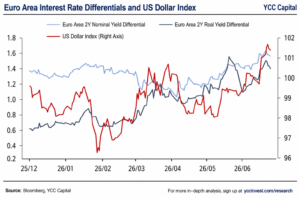
Over the past two months, investors have become increasingly focused on one question: why has the dollar strengthened despite Treasury yields easing? Under traditional macro relationships, lower long-term yields should weaken a currency by reducing its return advantage. Yet the opposite has occurred. This apparent contradiction has confused many investors but, in our view, reflects an important transition in what is driving global capital allocation.
Our assessment is that the dollar’s latest advance is no longer primarily a story of widening interest-rate differentials. Instead, it increasingly reflects an improvement in confidence surrounding U.S. financial assets and America’s institutional credibility. Markets are assigning a lower risk premium to holding dollars, allowing the currency to strengthen even as bond yields stabilize or drift lower.
For investors, this distinction matters enormously. A rate-driven dollar rally typically ends once monetary expectations change. A confidence-driven rally, however, can persist longer while simultaneously reshaping performance across equities, commodities, fixed income, and emerging markets.
Nevertheless, confidence is not the same as permanence. While the United States continues to enjoy structural advantages—including technological leadership, deep capital markets, and continued global demand for dollar assets—the foundations supporting the current rally remain vulnerable to political developments, fiscal outcomes, and geopolitical uncertainty. We therefore expect further near-term resilience but remain less convinced that an enduring multi-year dollar supercycle has begun.
Markets Enter a New Phase of Rotation
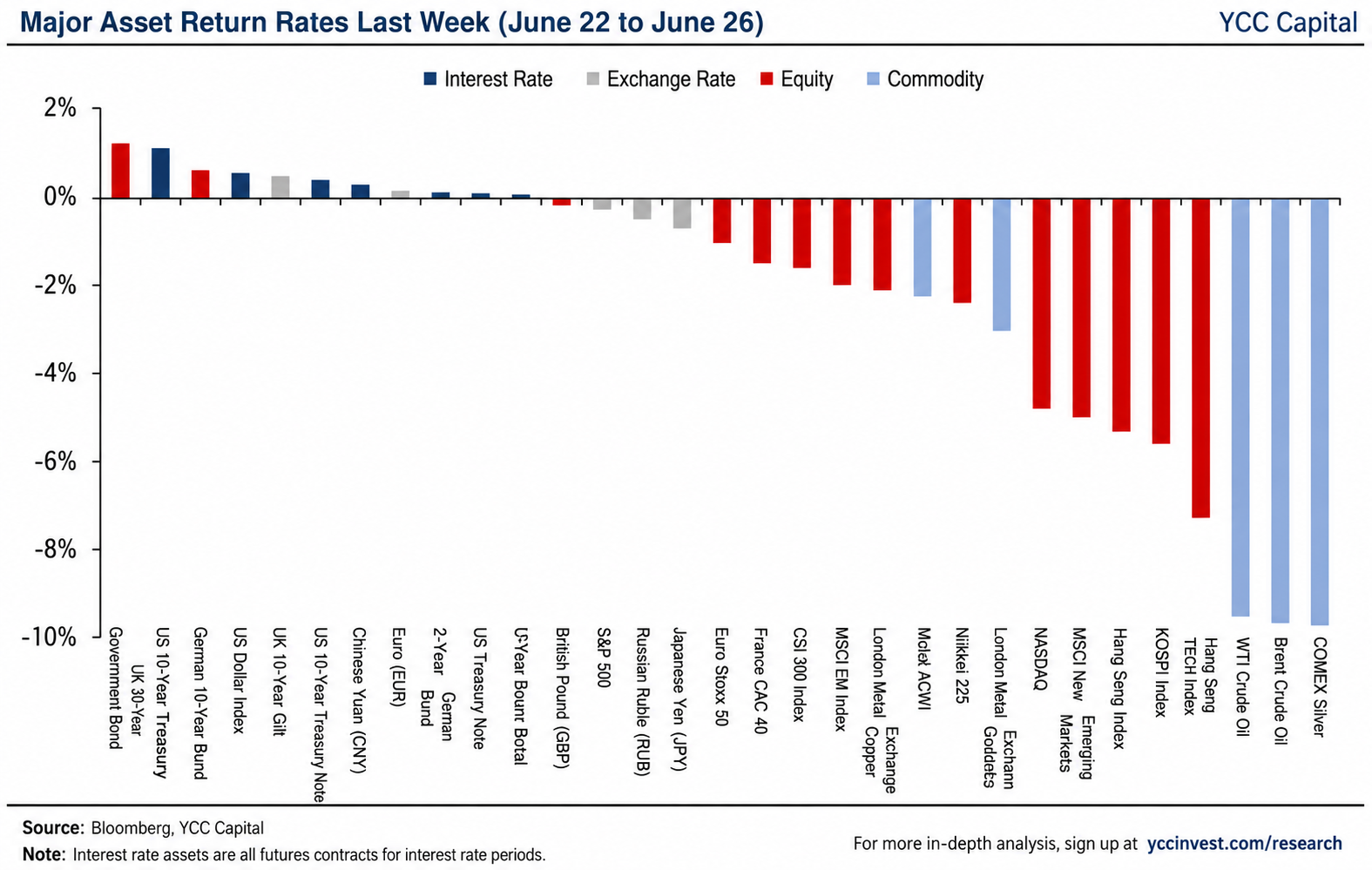
The final full trading week of June illustrated how quickly market leadership can change when investor narratives shift.
The advancement of U.S.–Iran diplomatic negotiations significantly reduced fears of immediate supply disruptions in global energy markets. Oil prices consequently declined sharply, removing one of the principal inflation risks that had dominated markets earlier in the month.
Ordinarily, cheaper oil would provide a broad tailwind for global equities. Instead, investors turned their attention elsewhere.
Growing caution surrounding artificial intelligence valuations triggered another wave of profit-taking across semiconductor manufacturers and mega-cap technology companies. South Korean technology shares experienced particularly heavy selling amid reports suggesting slower-than-expected production expansion for advanced memory chips, while leveraged ETF warnings further amplified market volatility.
The selling pressure subsequently spread into U.S. technology leaders. Even exceptionally strong earnings from Micron failed to reverse the broader rotation. Investors appeared increasingly willing to reduce exposure after one of the strongest AI-driven rallies in modern market history.
As a result, market leadership broadened considerably.
While the Nasdaq and the “Magnificent Seven” underperformed sharply, the Dow Jones Industrial Average generated positive weekly returns as capital rotated toward more cyclical and defensive sectors. Rather than exiting equities entirely, investors simply began redistributing risk across industries.
This distinction is important. Broad market corrections often signal deteriorating macroeconomic expectations. Sector rotation, by contrast, usually reflects changing preferences within an otherwise healthy investment environment. The recent episode appears much closer to the latter.
Across asset classes, precious metals and energy recorded the weakest performance. Silver and crude oil both suffered substantial declines, while gold extended its fourth consecutive weekly loss. Simultaneously, the U.S. Dollar Index climbed to its strongest level since May 2025.
These developments reveal a market increasingly rewarding confidence rather than pure inflation hedging.
Understanding the Dollar’s Two Distinct Rallies
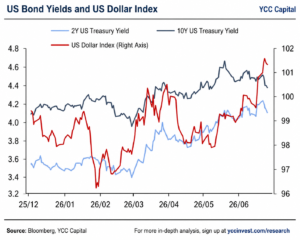
Although many observers describe the recent appreciation as one continuous move, we believe two separate phases have unfolded since May.
The first stage was relatively conventional.
Strong U.S. economic data consistently surprised to the upside, reinforcing expectations that the Federal Reserve would maintain restrictive monetary policy for longer than markets had previously anticipated. Following June’s Federal Open Market Committee meeting, policymakers delivered a more hawkish message than many investors expected, encouraging markets to push rate expectations further into the future.
As expectations for higher policy rates strengthened, real interest-rate differentials between the United States and Europe widened materially. Higher real returns naturally attracted additional global capital into dollar-denominated assets, supporting the currency.
This was the classic interest-rate story.
However, the second stage has been fundamentally different.
During the most recent week, Treasury yields drifted lower while the dollar continued strengthening. At the same time, gold prices fell decisively.
Such a combination does not fit traditional macro relationships.
Instead, it points toward falling dollar risk premiums rather than rising interest-rate advantages.
Markets appear increasingly comfortable owning dollar assets because confidence in the broader U.S. financial framework has improved.
That represents a subtle but important shift in investor psychology.
Confidence Has Become the New Catalyst
One of the principal catalysts emerged following public remarks from Treasury Secretary Scott Bessent emphasizing America’s commitment to maintaining dollar leadership within the international financial system.
His comments extended beyond monetary policy.
They addressed three broader themes:
First, renewed expectations that Middle Eastern energy exports could increasingly reconnect with dollar-based settlement mechanisms.
Second, confidence that U.S. economic growth could remain robust without generating a significant resurgence in inflation.
Third, a commitment toward improving America’s long-run fiscal trajectory.
Whether every objective ultimately materializes is less important than how markets interpreted the message.
Investors increasingly viewed U.S. institutions as demonstrating greater policy coherence than had been feared only months earlier.
When confidence improves, investors require less compensation for holding long-duration U.S. assets.
Consequently, long-term Treasury yields may fall while the dollar simultaneously strengthens.
Gold, meanwhile, typically struggles because part of its appeal derives from skepticism toward fiat currencies and sovereign credibility. As confidence in the dollar improves, that defensive demand naturally weakens.
This helps explain why both Treasury yields and gold declined together while the dollar appreciated.
Rather than contradicting one another, these asset movements collectively reflect declining systemic risk premiums.
America’s Economic Foundation Remains More Durable Than Many Expected
Recent macroeconomic releases continue to reinforce the picture of an economy that remains resilient despite elevated interest rates.
Final first-quarter GDP growth was revised higher, although the composition deserves careful attention.
Headline growth improved to an annualized 2.1%, yet household consumption was revised materially lower. Much of the improvement instead reflected stronger investment, particularly in technology-related sectors, alongside favorable trade adjustments.
This divergence illustrates an increasingly bifurcated economy.
Traditional consumer-oriented industries are losing momentum, while investment associated with artificial intelligence continues expanding rapidly.
Recent durable goods orders also surprised positively, suggesting businesses remain willing to invest despite restrictive financing conditions.
Meanwhile, both manufacturing and services purchasing manager indices improved during June, reinforcing the narrative of continued economic expansion.
Household income and spending also exceeded expectations.
Nevertheless, underlying trends reveal some emerging vulnerabilities.
Real disposable income continues running below its pre-pandemic trajectory, while the personal savings rate remains near multi-year lows. American consumers have maintained spending partly by drawing down accumulated savings rather than through accelerating real income growth.
This dynamic is sustainable for a period but becomes increasingly difficult to maintain indefinitely.
The result is what economists often describe as a “K-shaped economy”: one where technology-intensive sectors continue flourishing while more traditional segments experience slower growth.
That divergence is likely to remain one of the defining characteristics of the U.S. economy through the remainder of 2026.
Why We Expect the Dollar to Stay Firm in the Near Term
Our base case remains constructive for the U.S. dollar over the coming several weeks.
June’s economic data should continue reflecting the positive effects of earlier fiscal support, resilient business investment, and ongoing AI-related capital expenditure. Together, these factors are likely to prevent a meaningful decline in expectations for restrictive monetary policy.
Consequently, we expect the Dollar Index to remain broadly within the 101–102 range during July while maintaining a modest upward bias.
Equally important, international investors continue facing a relatively limited set of alternatives.
Europe’s recovery remains gradual, with growth still constrained by structural competitiveness challenges and uneven domestic demand.
China continues confronting persistent property-sector weakness, subdued household confidence, elevated local government debt burdens, and ongoing pressure on private-sector investment. Although policymakers possess policy tools to stabilize activity periodically, achieving a durable acceleration in growth remains challenging. From a global capital allocation perspective, these structural headwinds continue to limit the renminbi’s ability to emerge as a compelling reserve currency alternative over the medium term.
Japan’s outlook remains more balanced. Inflation dynamics have improved, corporate governance reforms continue attracting foreign capital, and shareholder returns have strengthened meaningfully over recent years. While cyclical challenges remain, Japan’s longer-term investment case continues to improve rather than deteriorate.
Against this backdrop, the United States still offers the deepest, most liquid capital markets supported by sustained technological leadership.
These advantages should continue supporting demand for dollar assets.
Looking Beyond the Summer
While the short-term outlook favors continued dollar resilience, the medium-term picture becomes considerably less certain.
As summer progresses, some of the temporary supports currently benefiting the economy are likely to diminish.
Higher interest rates continue weighing on housing activity, consumer demand may soften as excess savings become increasingly depleted, and labor-market momentum could gradually moderate.
Should inflation continue easing simultaneously, markets may begin bringing forward expectations for eventual Federal Reserve easing.
That would reduce one of the principal pillars supporting recent dollar strength.
Accordingly, we believe August and September could present a period during which the dollar temporarily weakens before a clearer longer-term trend emerges.
Why We Remain Cautious About a Multi-Year Dollar Supercycle
Some market participants increasingly argue that the dollar has entered another prolonged structural bull market.
We remain more measured.
Several developments have unquestionably improved America’s relative position.
Legal challenges surrounding tariff implementation have strengthened confidence in institutional governance.
Higher tariff revenues have provided modest fiscal support.
Strong AI-related equity performance continues attracting global capital.
Energy exports have also helped narrow external imbalances.
Each of these developments supports the dollar.
However, each also faces important uncertainties.
Fiscal consolidation remains politically difficult.
Improving trade balances partly reflect temporary geopolitical developments rather than permanent structural changes.
The assumption that additional oil producers will fully reintegrate into a dollar-centered energy settlement system remains speculative.
Moreover, if Middle Eastern tensions continue easing and energy prices normalize, non-U.S. economies could experience stronger cyclical recoveries, reducing the relative growth advantage currently enjoyed by the United States.
Looking toward 2027, three variables are likely to dominate the dollar’s longer-term trajectory.
The first is the outcome of the U.S. midterm elections and the resulting fiscal policy direction.
The second is the durability of the artificial intelligence investment cycle that has increasingly differentiated U.S. economic performance from the rest of the world.
The third is whether global growth outside the United States improves once current geopolitical disruptions fade.
These questions remain open.
For that reason, we believe investors should distinguish between tactical dollar strength and a structural dollar supercycle.
They are not necessarily the same phenomenon.
YCC Capital Strategic View
Markets often resemble long-distance hiking rather than sprinting. The steepest sections frequently occur just before the terrain flattens, tempting participants to mistake temporary momentum for permanent direction.
The recent dollar rally reflects genuine improvements in investor confidence and America’s relative economic position. Those developments deserve recognition.
However, history also reminds us that confidence is cyclical.
Periods of renewed optimism eventually encounter political uncertainty, changing monetary expectations, or shifting global capital flows.
For now, we continue to favor maintaining selective U.S. dollar exposure while remaining cautious toward precious metals and highly leveraged commodity trades over the near term. At the same time, investors should remain prepared for greater currency volatility later in the year as the balance between resilient U.S. growth and moderating domestic demand evolves.
Rather than chasing the latest move, disciplined investors should focus on identifying when today’s narrative begins changing into tomorrow’s consensus. That transition often creates the most compelling investment opportunities.
Editorial Board
Ken Cao
Chief Strategist, Global Investment Strategy
Le Gao
Managing Analyst
Yui Nabeshima
Strategist
Mai Ikeda
Research Analyst
IMPORTANT DISCLAIMER
This research report is provided for informational and educational purposes only and does not constitute an offer to sell or a solicitation of an offer to buy any securities, financial instruments, or investment products. It is not intended as investment, legal, accounting, or tax advice and should not be relied upon as such. The views, opinions, forecasts, and projections expressed herein represent the judgment of YCC Capital Management and its research personnel as of the publication date and are subject to change without prior notice as market conditions evolve. Past performance should not be viewed as an indication or guarantee of future results.
Financial markets are inherently uncertain. Asset prices, exchange rates, interest rates, commodities, and macroeconomic conditions may change rapidly in response to political developments, central bank decisions, geopolitical events, technological innovation, regulatory changes, or unforeseen external shocks. Forward-looking statements contained in this report are based upon assumptions that may ultimately prove incorrect. Actual outcomes may differ materially from those discussed herein.
This report has been prepared using information obtained from sources believed to be reliable, including Bloomberg and publicly available market data. While every reasonable effort has been made to ensure the accuracy and completeness of the information presented, YCC Capital Management makes no representation or warranty, express or implied, regarding its accuracy, completeness, reliability, or timeliness. Any opinions expressed reflect current market judgment and may be revised without notice.
Recipients should conduct their own independent due diligence and consult with qualified financial, legal, accounting, and tax professionals before making any investment decision. Nothing contained in this publication should be interpreted as personalized investment advice or as a recommendation regarding any specific security, investment strategy, sector, currency, or financial instrument.
YCC Capital Management, its affiliates, principals, portfolio managers, employees, contractors, and related parties may, from time to time, hold long or short positions in securities, currencies, commodities, derivatives, or other financial instruments referenced in this report. Such positions may change without notice and may be inconsistent with the views expressed herein. The firm and its affiliates may also provide advisory, research, trading, or other financial services to clients whose interests differ from those expressed in this publication.
Neither YCC Capital Management nor any of its affiliates accepts liability for any direct, indirect, incidental, consequential, or special loss arising from the use of or reliance upon this report or any information contained herein.
This report may not be reproduced, distributed, republished, or transmitted, in whole or in part, for commercial purposes without the prior written consent of YCC Capital Management.
© 2026 YCC Capital. All rights reserved.
YCC Capital’s flagship vehicle, the YCC International Value Fund, LP, maintains a concentrated global macro value strategy focused on capital-flow-driven market dislocations, valuation asymmetries, and asymmetric hedging opportunities across global asset classes. The Fund is registered in the State of Delaware, United States, and is structured as a Rule 506(c) private investment vehicle. Where performance data is referenced, such information has been independently verified by third-party fund administrator NAV Consulting; however, individual investor performance may differ depending on subscription timing, fee arrangements, and capital flows.
Contact Us
For institutional inquiries, media requests, or research subscriptions, please contact:
YCC Capital Research
Email: ir@yccinvest.com
Receive free daily global macro research, market commentary, and investment insights by subscribing at:
YCC Capital Research | Sign up for free daily market insight at www.yccinvest.com
For more related research:
After the Dollar: The Next Monetary Order and the Strategic Choices Facing China
When the Tide Recedes: Why the U.S. Dollar Is Entering a New Era of Two-Way Risk