YCC CAPITAL
Global Fixed Income & Currency Strategy
June 28, 2026
Executive Perspective
For much of the past three years, investors have become accustomed to viewing the U.S. dollar through a remarkably simple lens: stronger inflation leads to higher Federal Reserve rates, and higher rates translate into a stronger dollar. History, however, tells a far more nuanced story.
Financial markets rarely reward obvious narratives for long. By the time central banks finally act, markets have often spent months pricing those decisions. What ultimately drives currencies is not merely the direction of interest rates, but the evolution of expectations relative to what investors already believe.
Today, global markets once again stand at such an inflection point. Following a sharp resurgence in inflation driven primarily by Middle East energy disruptions, investors have rapidly shifted from expecting Federal Reserve easing to debating the possibility of renewed rate hikes. Yet just as markets have embraced a more hawkish consensus, the geopolitical backdrop is beginning to stabilize, energy prices are retreating, and the inflation impulse that fueled this policy repricing may already be fading.
At YCC Capital, we believe investors should resist extrapolating recent dollar strength into a new structural bull market. While tighter global monetary conditions support the dollar in the near term, history suggests that tightening cycles seldom produce sustained one-directional moves in the U.S. Dollar Index (DXY). Instead, periods of elevated uncertainty often evolve into prolonged episodes of broad trading ranges as competing macroeconomic forces offset one another.
Our base case is therefore that the second half of the year is likely to be characterized less by a decisive dollar trend and more by heightened volatility around a relatively stable equilibrium.
Global Liquidity Has Quietly Entered a New Tightening Phase
One of the least appreciated developments in today’s macro environment is that global liquidity conditions have shifted materially over recent months.
While investors remain heavily focused on the Federal Reserve, the broader monetary landscape has changed more dramatically than many appreciate. Inflation generated by geopolitical disruptions—particularly through higher energy prices—has increasingly forced central banks around the world to reconsider previously anticipated easing cycles.
This represents a meaningful departure from expectations earlier in the year.
Only a few months ago, consensus forecasts largely revolved around synchronized global monetary easing. Instead, policymakers now face imported inflation driven not by domestic overheating but by geopolitical supply shocks.
Across both developed and emerging economies, central banks have begun responding accordingly.
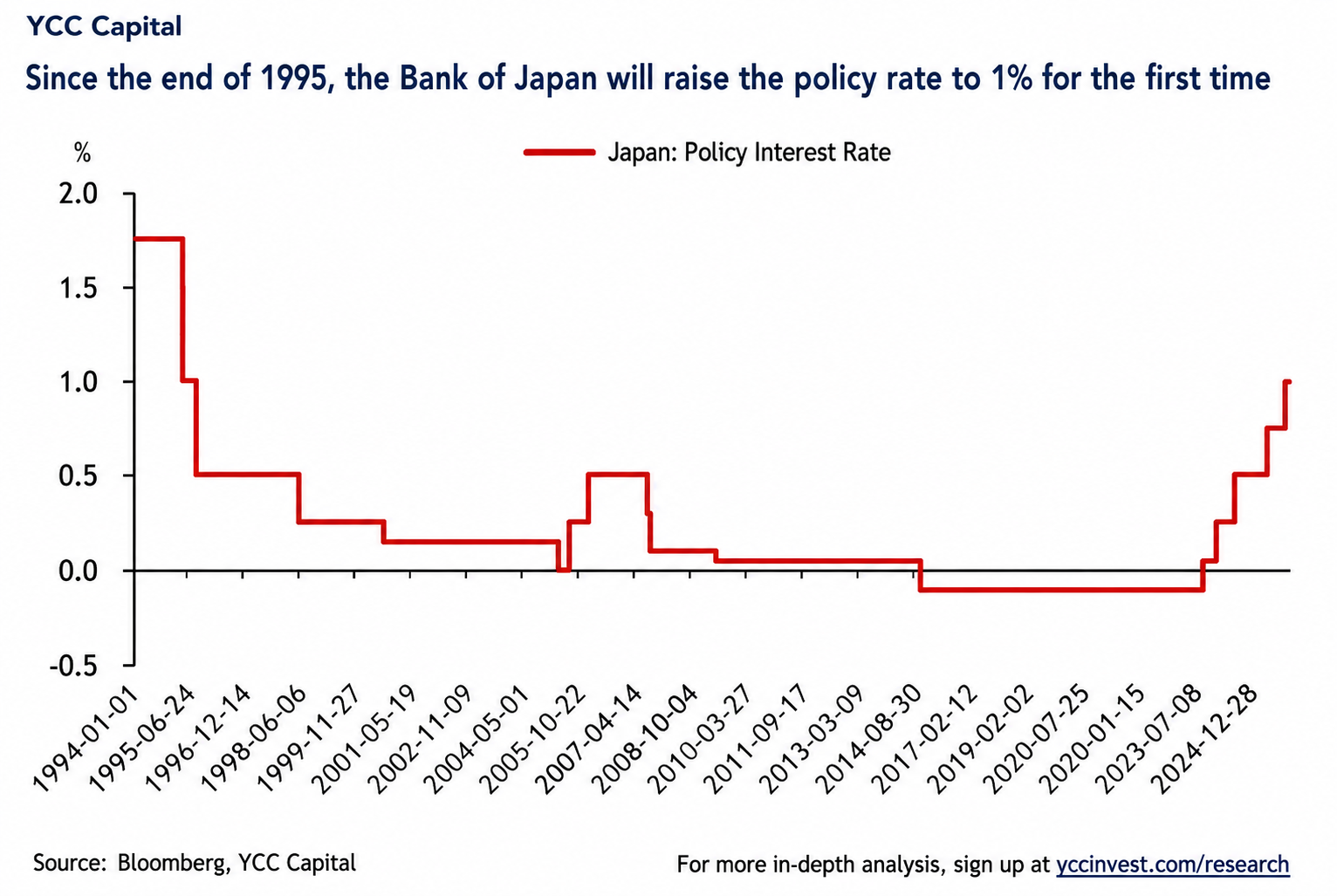
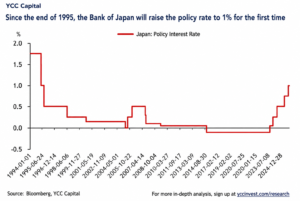
Japan’s Bank of Japan has continued its historic normalization process, raising its policy rate to 1%—the highest level since the mid-1990s—while also signaling a slower pace of government bond purchase reductions beginning next year. Meanwhile, the European Central Bank has also adopted a more restrictive stance after inflationary pressures intensified.
Several emerging market central banks have likewise shifted toward tightening.
Taken collectively, these developments suggest that the extraordinary era of abundant global liquidity is gradually giving way to a more restrictive monetary environment.
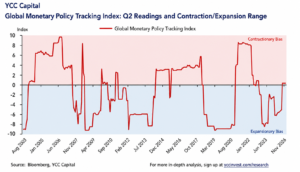
One useful gauge illustrating this transition is the Council on Foreign Relations’ Global Monetary Policy Tracker, which aggregates policy stances across 54 economies. During the second quarter, this indicator moved modestly into tightening territory for the first time in several quarters, reflecting that restrictive policy is no longer confined to the United States but is becoming increasingly global.
Markets often resemble ocean tides more than light switches. Liquidity rarely disappears overnight. Instead, it gradually recedes until investors suddenly realize the shoreline has moved much farther than expected.
That appears increasingly true today.
Sources: Bloomberg, YCC Capital.
Why Interest Rates Alone Rarely Determine the Dollar
Conventional wisdom often assumes that higher U.S. interest rates automatically translate into a stronger dollar.
Reality has been considerably more complicated.
The Dollar Index is not a measure of America’s economic strength in isolation. Rather, it reflects the value of the dollar against a basket of major developed-market currencies including the euro, yen, pound sterling, Canadian dollar, Swedish krona and Swiss franc.
Consequently, relative economic performance matters far more than absolute performance.
If U.S. growth merely slows less than Europe or Japan, the dollar can appreciate even if domestic conditions deteriorate.
Conversely, the dollar can weaken despite Fed tightening if overseas economies improve even faster.
Equally important is the role of expectations.
Modern monetary policy operates largely through forward guidance. Financial markets spend months—or even years—anticipating central bank decisions before those decisions actually occur.
When policy announcements merely confirm expectations, little incremental capital flows into the currency.
Instead, the largest currency moves occur when investors are surprised.
The difference between reality and expectations—the so-called “expectation gap”—often proves far more influential than the policy action itself.
Understanding this distinction helps explain why many tightening cycles have failed to generate sustained dollar appreciation.
Four Tightening Cycles, Four Very Different Dollar Outcomes
Looking back over the past three decades illustrates a remarkably consistent lesson: Federal Reserve tightening has rarely produced prolonged one-way appreciation in the Dollar Index.
The 1994–1995 Surprise Tightening
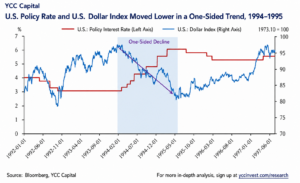
The 1994 tightening cycle remains unique in modern monetary history.
At the time, the U.S. economy was only beginning to recover from recession. Inflation remained relatively subdued while unemployment was still elevated.
Nevertheless, the Federal Reserve launched a rapid sequence of preventive rate hikes, lifting policy rates from 3% to 6%.
Unlike today’s Fed, policymakers then provided relatively little forward guidance.
Markets were caught off guard.
Rather than strengthening, the dollar entered a sustained decline.
Investors feared aggressive tightening would derail America’s recovery, triggering significant bond market volatility and capital outflows. Meanwhile, Europe’s comparatively stronger economic momentum attracted international investment away from the United States.
Ironically, higher interest rates failed to support the dollar because markets viewed the policy itself as a source of instability.
2004–2006: When Good News Was Already Priced In
The subsequent tightening cycle unfolded very differently.
By 2004, Federal Reserve communication had improved dramatically. Markets had ample opportunity to anticipate gradual rate increases.
When the first hike finally arrived, much of its positive impact had already been discounted.
The Dollar Index initially weakened as investors took profits and redirected capital toward rapidly expanding emerging markets, particularly China, whose industrial boom reshaped global trade and commodity markets. While China’s growth appeared impressive at the time, it also encouraged significant global capital misallocation and excessive leverage—imbalances that would become increasingly apparent in later years.
The picture shifted again in 2005.
Europe and Japan remained comparatively weak while U.S. economic momentum accelerated, restoring the dollar’s relative attractiveness.
Yet the rally proved temporary.
Surging commodity prices eventually forced both Europe and Japan toward tighter monetary policy, narrowing America’s interest-rate advantage and pushing the dollar lower once again.
The result was not a trend, but an extended inverted “N”-shaped trading pattern.
2015–2018: Expectations Led Reality
The post-financial crisis tightening cycle demonstrated perhaps the clearest example of expectations dominating actual policy.
The Dollar Index had already climbed dramatically before the first rate increase in December 2015.
By then, investors had spent more than a year positioning for normalization.
Once tightening officially began, the market entered a classic “buy the rumor, sell the news” phase.
When the Fed subsequently raised rates more slowly than anticipated, the dollar weakened.
Later, Donald Trump’s election reignited reflation expectations, attracting renewed capital inflows.
Then Europe surprised markets.
Economic growth accelerated across the euro area during 2017, prompting expectations that the European Central Bank would eventually follow the Fed toward policy normalization.
Capital rotated out of the dollar and into the euro.
Only after U.S. fiscal stimulus strengthened American growth in 2018 did the dollar recover once more.
Again, tightening produced volatility—not a straight line.
2022–2023: Inflation Shock and Peak Dollar
The most recent tightening cycle initially appeared to contradict history.
Confronted with the highest inflation in four decades, the Federal Reserve implemented its most aggressive hiking campaign since the early 1980s.
Simultaneously, Europe’s energy crisis sharply weakened the euro.
The combination of unexpectedly aggressive U.S. tightening and relative economic outperformance propelled the Dollar Index above 114—its highest level in decades.
Yet even this exceptional rally eventually reversed.
As European energy markets stabilized and the ECB accelerated its own tightening campaign, America’s relative advantage narrowed.
Once investors concluded that U.S. inflation had likely peaked, the expectation gap shifted.
The dollar entered a prolonged decline despite policy rates remaining historically elevated.
The lesson was once again unmistakable.
Currencies respond not simply to interest rates, but to how the future differs from what investors had already expected.
Why the Second Half Is Likely to Become a Trading Market
The principal catalyst behind today’s renewed tightening expectations has been geopolitical inflation.
Only a few months ago, markets largely anticipated Federal Reserve rate cuts.
Those expectations shifted rapidly following escalating tensions across the Middle East, which drove energy prices sharply higher and reignited inflation concerns.
The composition of inflation is particularly revealing.
Compared with conditions before the geopolitical escalation, Personal Consumption Expenditure (PCE) inflation has increased by roughly 1.2 percentage points, with more than four-fifths of that acceleration attributable to energy prices.
This distinction matters enormously.
Energy-driven inflation behaves very differently from demand-driven inflation.
Households confronted with higher gasoline prices feel poorer, not wealthier. Businesses experience higher input costs rather than stronger demand. Consequently, supply-driven inflation tends to weaken economic activity even as headline inflation rises.
It is therefore a far less durable source of price pressure.
Recent developments suggest that this inflation impulse may already be losing momentum.
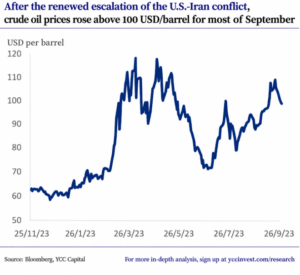
Diplomatic engagement has modestly reduced immediate geopolitical risks, while crude oil prices have retreated toward levels prevailing before the most acute phase of the Middle East conflict.
Should energy prices continue stabilizing, headline inflation is likely to moderate accordingly.
That, in turn, would reduce pressure on the Federal Reserve to resume aggressive tightening.
Markets currently appear positioned for a more hawkish outcome than fundamentals may ultimately justify.
Should inflation continue easing over coming months, expectations—not merely economic data—could once again shift in a less supportive direction for the dollar.
At YCC Capital, we therefore expect the Dollar Index to spend much of the second half oscillating within a broad range rather than establishing either a sustained bull market or a prolonged bear market.
For investors, this represents an important strategic distinction.
Trending markets reward directional conviction.
Range-bound markets reward disciplined risk management, tactical positioning, and patience.
Recognizing the transition between those regimes often proves more valuable than correctly forecasting every central bank meeting.
Investment Implications
The macro environment increasingly favors tactical currency allocation rather than aggressive directional positioning.
Dollar strength should become more selective and episodic rather than persistent.
Relative growth differentials between the United States and other developed economies will remain the dominant driver of exchange rates, while geopolitical developments are likely to generate intermittent bursts of volatility.
From a broader asset allocation perspective, the gradual normalization of global liquidity argues for maintaining portfolio flexibility rather than assuming a continuation of the exceptional dollar outperformance witnessed during previous inflation shocks.
Periods of elevated volatility frequently create attractive entry opportunities across global fixed income and currency markets, particularly when market expectations become overly concentrated around a single policy narrative.
YCC Capital Strategic View
Markets often spend too much time debating what central banks will do next and too little time considering what has already been priced into asset prices.
The current environment appears to fit that pattern.
Although renewed tightening remains possible, much of the hawkish narrative has already been incorporated into financial markets. As geopolitical inflation gradually fades and energy markets stabilize, investors are likely to shift their attention back toward relative growth, fiscal sustainability, and long-term capital flows.
Our central expectation is not for dramatic dollar weakness, nor for another structural dollar bull market.
Instead, we believe investors should prepare for a more balanced environment in which the Dollar Index repeatedly tests both optimism and pessimism without fully embracing either.
After several years dominated by powerful macro trends, the second half of the year may ultimately become a period in which patience proves more valuable than prediction.
Sources: Bloomberg, YCC Capital.
Editorial Board
Ken Cao
Chief Strategist, Global Investment Strategy
Le Gao
Managing Analyst
Yui Nabeshima
Strategist
Mai Ikeda
Research Analyst
IMPORTANT DISCLAIMER
This research report is provided for informational and educational purposes only and does not constitute an offer to sell or a solicitation of an offer to buy any securities, financial instruments, or investment products. It is not intended as investment, legal, accounting, or tax advice and should not be relied upon as such. The views, opinions, and projections expressed herein are those of YCC Capital Management and its research personnel as of the date of publication and are subject to change without notice. Past performance is not indicative of future results.
YCC Capital Management, its affiliates, principals, and employees may hold long or short positions in securities or instruments discussed in this report and may trade for their own accounts or for client accounts in a manner inconsistent with the recommendations herein. This report is based on publicly available information and data believed to be reliable, but YCC Capital makes no representation or warranty, express or implied, as to the accuracy, completeness, or timeliness of such information. Forward-looking statements involve risks and uncertainties that could cause actual results to differ materially from those projected.
Recipients of this report should conduct their own independent due diligence and consult with their own financial, legal, and tax advisors before making any investment decisions. YCC Capital accepts no liability for any loss or damage arising from the use of or reliance on this report or its contents.
This report is intended solely for the use of the intended recipient(s) and may not be reproduced or redistributed for commercial purposes without the prior written consent of YCC Capital.
© 2026 YCC Capital. All rights reserved.
YCC Capital’s flagship vehicle, the YCC International Value Fund, LP, maintains a concentrated global macro value strategy focused on identifying capital-flow-driven market mispricings and asymmetric hedging opportunities across global asset classes. The Fund is registered in the State of Delaware, United States, and is structured as a Rule 506(c) private investment vehicle.
Performance information referenced in this report has been independently verified where applicable, including by NAV Consulting. Individual investor outcomes may differ depending on investment timing, fees, liquidity conditions, and portfolio-specific circumstances.
Contact Us
YCC Capital Research
For institutional inquiries, media requests, partnership opportunities, or investor relations, please contact:
Email: ir@yccinvest.com
For complimentary daily macro research, investment strategy notes, and market commentary, subscribe at:
YCC Capital Research | Sign up for free daily market insight at www.yccinvest.com
For more related research:
After the Dollar: The Next Monetary Order and the Strategic Choices Facing China
The Warsh Shock: The Fed’s Hawkish Reset Forces a Full Market Repricing
Has Peak Hawkishness Arrived? Why the Fed’s Toughest Message May Also Mark the Turning Point
The Energy Shock Is Fading—Now Markets Must Price the Next Liquidity Cycle