YCC CAPITAL
Emerging Markets & China Strategy
June 30, 2026
Executive Summary
At first glance, China’s latest consumption figures appear disappointing. Retail sales contracted 0.6% year-over-year in May, reinforcing the widespread perception that household demand remains weak. Yet beneath the headline lies a more nuanced picture. After adjusting for last year’s exceptionally high comparison base—driven by aggressive government subsidy programs—and temporary weather disruptions that weighed on offline consumption, sequential momentum actually improved meaningfully.
The more important question, however, is not whether consumption stabilized in May. It is whether the recovery can endure.
Our assessment remains cautious. The recent improvement owes much to modest gains in employment, but the composition of that employment has shifted dramatically toward flexible and gig-based work. While these jobs reduce measured unemployment, they often provide lower incomes, fewer benefits, and considerably less financial security. As a result, China’s labor market is becoming quantitatively stronger while qualitatively weaker.
Anyone who has watched a city fill with food delivery riders during difficult economic times has seen this phenomenon firsthand. Streets appear busier and more people are working, yet many households remain reluctant to spend because income certainty has deteriorated. Employment exists—but confidence does not.
From YCC Capital’s perspective, this structural shift represents one of the most underappreciated constraints on China’s domestic demand outlook. Until stable employment opportunities expand meaningfully, consumer confidence is unlikely to experience a sustained recovery regardless of cyclical policy stimulus.
YCC Perspective
Financial markets often celebrate improving unemployment statistics as evidence that economic momentum is returning. History suggests investors should instead ask a more important question: what kinds of jobs are being created?
Employment quality frequently matters more than employment quantity.
China today increasingly resembles other economies that experienced rapid growth in gig employment following periods of structural slowdown. Headline labor statistics improve, yet wage growth remains subdued and precautionary savings continue rising.
That distinction will likely determine whether China’s long-awaited consumer recovery finally materializes—or remains another false dawn.
Consumption Is Improving at the Margin—but the Foundation Remains Fragile
Headline retail sales slowed to -0.6% year-over-year in May, seemingly indicating further deterioration in domestic demand. However, this figure deserves careful interpretation.
Last year’s nationwide consumer subsidy programs created unusually high comparison effects, particularly for household appliances and durable goods. In addition, unusually heavy rainfall disrupted brick-and-mortar consumption across several regions during May.
Sequential data therefore paint a considerably less pessimistic picture. Month-over-month retail activity outperformed historical seasonal averages and represented a noticeable improvement from April, suggesting consumer spending has begun to stabilize rather than deteriorate further.
Nevertheless, stabilization should not be mistaken for recovery.
Household confidence remains exceptionally sensitive to labor market conditions, property wealth, and future income expectations. While policymakers have succeeded in slowing the pace of deterioration, they have yet to generate convincing evidence of a self-sustaining consumption cycle.
Employment Is Improving—But the Wrong Kind of Employment
Labor market conditions continued to improve during May, with the surveyed unemployment rate declining once again.
Historical evidence demonstrates a meaningful inverse relationship between unemployment and household consumption propensity. Empirical analysis suggests that every 0.1 percentage point decline in unemployment has historically lifted household consumption willingness by roughly 0.8 percentage points.
Viewed narrowly, falling unemployment should therefore support stronger consumption.
Yet the composition of China’s labor market tells a more complicated story.
Over recent years, unemployment trends have increasingly diverged between local residents and migrant workers. While unemployment among migrant workers has declined, unemployment among locally registered residents has remained comparatively elevated.
This divergence reflects one of China’s most important structural labor market transformations: the rapid expansion of flexible employment.
Migrant workers have generally demonstrated greater willingness to participate in gig economy positions—including delivery services, ride-sharing, logistics, and platform-based work—whereas local residents continue to prioritize employment stability and traditional salaried positions.
Recent housing provident fund enrollment data from Chongqing provide additional confirmation of this trend, showing a steadily rising proportion of flexible workers entering the formal contribution system.
The implication is significant.
May’s employment improvement appears to have been driven disproportionately by growth in flexible employment rather than expansion of stable, higher-quality jobs.
That distinction matters enormously for the broader economy.
Why Flexible Employment Limits Consumption
Flexible employment carries two structural consequences that directly constrain household spending.
First, income levels are generally lower.
Gig workers often receive variable compensation based on completed tasks rather than fixed salaries. Their earnings fluctuate considerably across seasons and economic cycles, reducing aggregate wage growth even as total employment rises.
Second, income uncertainty encourages precautionary savings.
Households facing uncertain future earnings naturally become more conservative. Rather than increasing discretionary purchases, they prioritize liquidity and emergency savings.
The phenomenon is hardly unique to China.
Across numerous advanced economies, workers with unstable income streams consistently exhibit higher savings rates and lower discretionary consumption than households enjoying stable salaried employment.
China appears to be following the same pattern.
The country’s household consumption propensity has remained systematically subdued throughout 2024-2026 despite numerous policy initiatives designed to stimulate domestic demand.
In our view, labor market quality provides a compelling explanation for this disconnect.
Consumers do not spend confidently simply because they are employed.
They spend confidently because they believe they will remain employed.
Flexible Employment Cannot Become the Economy’s Final Demand
An important macroeconomic limitation often receives insufficient attention.
Flexible employment ultimately depends on demand generated elsewhere in the economy.
Delivery platforms require consumers to place orders.
Ride-hailing drivers require passengers.
Freelancers require corporate clients.
Platform economies cannot indefinitely create demand for themselves.
Without continued expansion of stable middle-income employment, flexible employment eventually reaches diminishing returns.
Current data already suggest this process may be emerging.
Local resident unemployment remained near its highest seasonal level in recent years during May. Meanwhile, improvements among migrant workers may become increasingly difficult to sustain if underlying domestic demand remains weak.
Recent official discussions addressing excessive competition within China’s consumer service industries further reinforce this concern. Intensifying price competition often reflects insufficient aggregate demand rather than excessive supply alone.
For investors, this represents an important warning signal.
Labor market stabilization should not automatically be interpreted as evidence of strengthening household fundamentals.
Industrial Production Continues to Recover Unevenly
Weekly high-frequency indicators suggest industrial activity continued improving through late June.
The recovery, however, remains highly uneven across sectors.
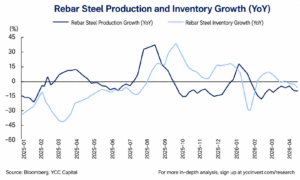
Real estate-related steel production weakened modestly, reflecting persistent softness in property investment despite numerous policy support measures.
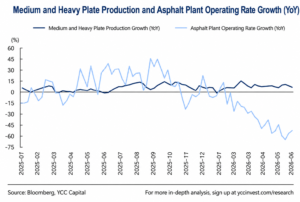
Infrastructure-related indicators remained comparatively resilient. Asphalt operating rates continued rising, indicating ongoing public investment activity even as other construction-related indicators softened.
Manufacturing sectors linked to machinery and electrical equipment maintained relatively stable production conditions, while inventories increased modestly, suggesting firms remain cautiously optimistic regarding future demand.
The strongest momentum emerged within textile, apparel, and packaging industries.
PTA operating rates and inventories both increased noticeably, pointing toward continued production expansion and greater willingness among firms to accumulate inventories.
Taken together, these indicators suggest China’s industrial sector continues experiencing gradual stabilization, although the recovery remains highly dependent upon selected industries rather than broad-based expansion.
Domestic Demand Continues Searching for a Bottom
Consumption-related high-frequency indicators remain considerably less encouraging.
Urban mobility weakened during the Dragon Boat Festival period, with subway passenger volumes across major cities declining compared with previous weeks.
Logistics activity also slowed noticeably.
Postal delivery volumes softened both sequentially and on a year-over-year basis, suggesting commercial activity remains subdued despite temporary seasonal distortions.
Automobile sales presented a similarly mixed picture.
Weekly passenger vehicle sales improved sequentially following holiday-related demand but remained nearly 30% below year-earlier levels, highlighting continued weakness in big-ticket household purchases.
Entertainment spending also disappointed.
Average daily box office receipts declined modestly despite record numbers of holiday film screenings, indicating that increased supply alone has proven insufficient to stimulate stronger consumer participation.
Collectively, these indicators reinforce a consistent message.
Chinese households remain cautious.
External Trade Faces Both Opportunity and Risk
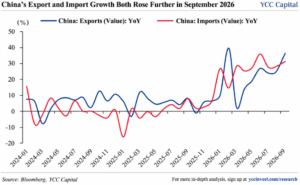
Trade activity remains comparatively resilient despite increasing geopolitical uncertainty.
Chinese port cargo throughput eased only marginally from elevated levels, while container volumes continued demonstrating remarkable resilience.
Shipping costs continued climbing sharply.
The China Containerized Freight Index rose nearly 7% during the latest week, extending a multi-week rally driven by robust shipping demand and constrained effective capacity.
Shipping companies have responded by expanding capacity across trans-Pacific and European routes, reflecting continued strength in external trade demand.
However, geopolitical developments introduce additional uncertainty.
Renewed tensions between the United States and Iran following recent military exchanges have yet to materially disrupt global energy markets, with crude oil prices remaining near manageable levels.
Nevertheless, escalation involving major shipping routes or energy infrastructure could rapidly increase transportation costs and further complicate global supply chains.
Fiscal Policy May Become More Supportive
China’s fiscal stance has remained relatively restrained during the first half of 2026.
Government bond issuance has generally lagged last year’s pace, suggesting fiscal support has been slower than policymakers initially anticipated.
This dynamic may change during the third quarter.
As domestic demand remains weak and fiscal revenues gradually improve, policymakers are increasingly likely to accelerate spending programs already authorized earlier in the year.
We expect the late-July Politburo meeting to provide greater clarity regarding implementation timelines.
While additional fiscal stimulus could improve short-term growth momentum, its long-term effectiveness will ultimately depend on whether policy supports household income growth rather than merely increasing infrastructure investment.
Monetary Conditions Have Stabilized
Financial conditions became noticeably more stable during the latest week.
Interbank funding pressures eased, while the People’s Bank of China expanded open market operations to maintain adequate liquidity.
The resulting improvement encouraged greater leverage within the domestic bond market as investors responded to more predictable funding conditions.
Monetary policy therefore continues functioning as a stabilizing force rather than a major growth catalyst.
Liquidity remains abundant.
Confidence does not.
Property Market Weakness Persists
China’s property market remains one of the economy’s largest structural headwinds.
Primary home sales experienced modest seasonal improvement but continued underperforming historical norms.
More concerning, secondary home transactions weakened meaningfully—a notable deterioration after previously demonstrating relative resilience.
Land sales also remained depressed, suggesting local government fiscal pressures are unlikely to ease substantially in the near term.
Meanwhile, price indicators across major cities continue drifting lower without convincing evidence of stabilization.
Until housing prices stop falling, households will likely remain reluctant to accelerate discretionary spending, limiting the effectiveness of broader stimulus measures.
Investment Implications
For global investors, China’s macroeconomic outlook remains characterized by stabilization rather than genuine reacceleration.
Industrial production is improving, exports continue providing support, and policymakers retain considerable fiscal and monetary flexibility.
Yet the structural drivers of domestic consumption remain unresolved.
The growing reliance on flexible employment, subdued household income growth, continued weakness in the property market, and elevated precautionary savings all suggest China’s consumer recovery will likely remain gradual and uneven.
YCC Capital therefore continues to maintain a cautious outlook toward China’s domestic demand sectors while favoring companies with stronger external revenue exposure, global supply chain integration, and resilient balance sheets.
The world’s second-largest economy is no longer defined primarily by cyclical fluctuations.
Increasingly, it is being shaped by structural transitions whose effects will unfold over years rather than quarters.
Editorial Board
Ken Cao
Chief Strategist, Global Investment Strategy
Le Gao
Managing Analyst
Yui Nabeshima
Strategist
Mai Ikeda
Research Analyst
IMPORTANT DISCLAIMER
This research report is provided for informational and educational purposes only and does not constitute an offer to sell or a solicitation of an offer to buy any securities, financial instruments, or investment products. It is not intended as investment, legal, accounting, or tax advice and should not be relied upon as such. The views, opinions, forecasts, estimates, and projections expressed herein are those of YCC Capital Management and its research personnel as of the publication date and are subject to change without notice. Economic conditions, financial markets, and geopolitical developments evolve rapidly, and future outcomes may differ materially from those discussed in this report. Past performance is not indicative of future results and should not be relied upon as a guarantee of future performance.
This publication has been prepared using information believed to be reliable and obtained from publicly available sources, market participants, and proprietary analysis. While every reasonable effort has been made to ensure the accuracy and completeness of the information presented, YCC Capital Management makes no representation or warranty, express or implied, regarding the accuracy, completeness, reliability, or timeliness of any information contained herein. Opinions expressed are based on conditions existing at the time of publication and may be revised without prior notice.
Forward-looking statements, including expectations regarding economic growth, inflation, interest rates, currencies, commodities, corporate earnings, or financial markets, inherently involve known and unknown risks, uncertainties, and assumptions that may cause actual outcomes to differ materially from those anticipated. Investors should recognize that macroeconomic forecasts are probabilistic rather than certain and should not be interpreted as guarantees of future market behavior.
YCC Capital Management, its affiliates, principals, employees, and related parties may from time to time hold long or short positions in securities, derivatives, currencies, commodities, exchange-traded funds, fixed-income instruments, or other financial products referenced in this report. Such positions may change without notice. The firm and its personnel may also provide advisory services or execute transactions for clients involving securities or instruments discussed herein, and such activities may be inconsistent with the views expressed in this publication.
Nothing contained in this report should be construed as personalized investment advice or a recommendation regarding any specific security, portfolio, investment strategy, or financial transaction. Each investor’s objectives, financial circumstances, risk tolerance, tax situation, and investment horizon are unique. Readers should conduct their own independent research and due diligence and consult with qualified financial, legal, accounting, and tax professionals before making any investment decision.
To the fullest extent permitted by applicable law, YCC Capital Management disclaims any liability for any direct, indirect, incidental, consequential, or other losses arising from the use of, or reliance upon, this report or any information contained herein.
No part of this publication may be reproduced, redistributed, republished, transmitted, or commercially exploited in any form without the prior written permission of YCC Capital Management, except where permitted by applicable copyright law.
© 2026 YCC Capital. All rights reserved.
YCC Capital’s flagship investment vehicle, the YCC International Value Fund, LP, maintains a concentrated global macro value strategy focused on identifying capital-flow-driven market dislocations, asymmetric investment opportunities, and long-term value creation across global asset classes. The Fund is organized in the State of Delaware, United States, and is structured as a Rule 506(c) private investment vehicle. Where referenced, performance information has been independently verified by third-party administrators, including NAV Consulting, although individual investor outcomes may differ depending on timing, subscriptions, redemptions, and other factors.
Contact Us
For institutional inquiries, media requests, partnership opportunities, or investor relations, please contact:
YCC Capital Management
Email: ir@yccinvest.com
For complimentary daily macro research, market commentary, and investment insights, please subscribe at:
YCC Capital Research | Sign up for free daily market insight at www.yccinvest.com
For more related research:
China’s Recovery Is Losing Altitude: Exports Mask a Deepening Domestic Slowdown
China’s Uneven Recovery: Exports Power Ahead While Domestic Demand Remains Stuck in Low Gear
After the Dollar: The Next Monetary Order and the Strategic Choices Facing China
The World Cup Jobs Boom: Reality, Hype, and What FIFA 2026 Means for the U.S. Labor Market