YCC CAPITAL
Emerging Markets & China Strategy
July 11, 2026
Executive Perspective
There are moments in economic history when the indicators investors have relied upon for decades suddenly lose their predictive power. It is much like driving with an old map after an entirely new highway has been built—the landmarks remain familiar, but they no longer determine the fastest route.
China may now be entering precisely such a phase.
For more than twenty years, investors viewed Chinese credit growth as the country’s master economic indicator. When loan creation accelerated, growth typically followed. When credit tightened, activity slowed. The relationship was sufficiently reliable that global investors came to treat China’s “credit impulse” as one of the world’s most important macro indicators.
That framework is becoming increasingly obsolete.
Our analysis suggests that China’s economy is undergoing a structural transition in which traditional bank lending no longer serves as the dominant engine of investment or growth. The country’s old debt-intensive sectors—particularly real estate and infrastructure—are steadily giving way to technology manufacturing, digital infrastructure, artificial intelligence, and advanced industrial production. These industries require significantly less leverage, rely more heavily on equity financing and retained earnings, and therefore weaken the historical relationship between credit expansion and economic activity.
The result could be an unfamiliar but increasingly plausible scenario: an economy capable of generating moderate growth without a corresponding acceleration in bank lending—a “creditless recovery.”
This does not imply that China’s structural challenges have disappeared. Quite the opposite. The country’s property correction, demographic headwinds, local government indebtedness, and declining private-sector confidence continue to constrain long-term potential. Nevertheless, investors should recognize that the transmission mechanism of China’s economy is changing. Credit data alone may no longer provide sufficient insight into future growth.
The End of China’s Credit-Led Growth Model
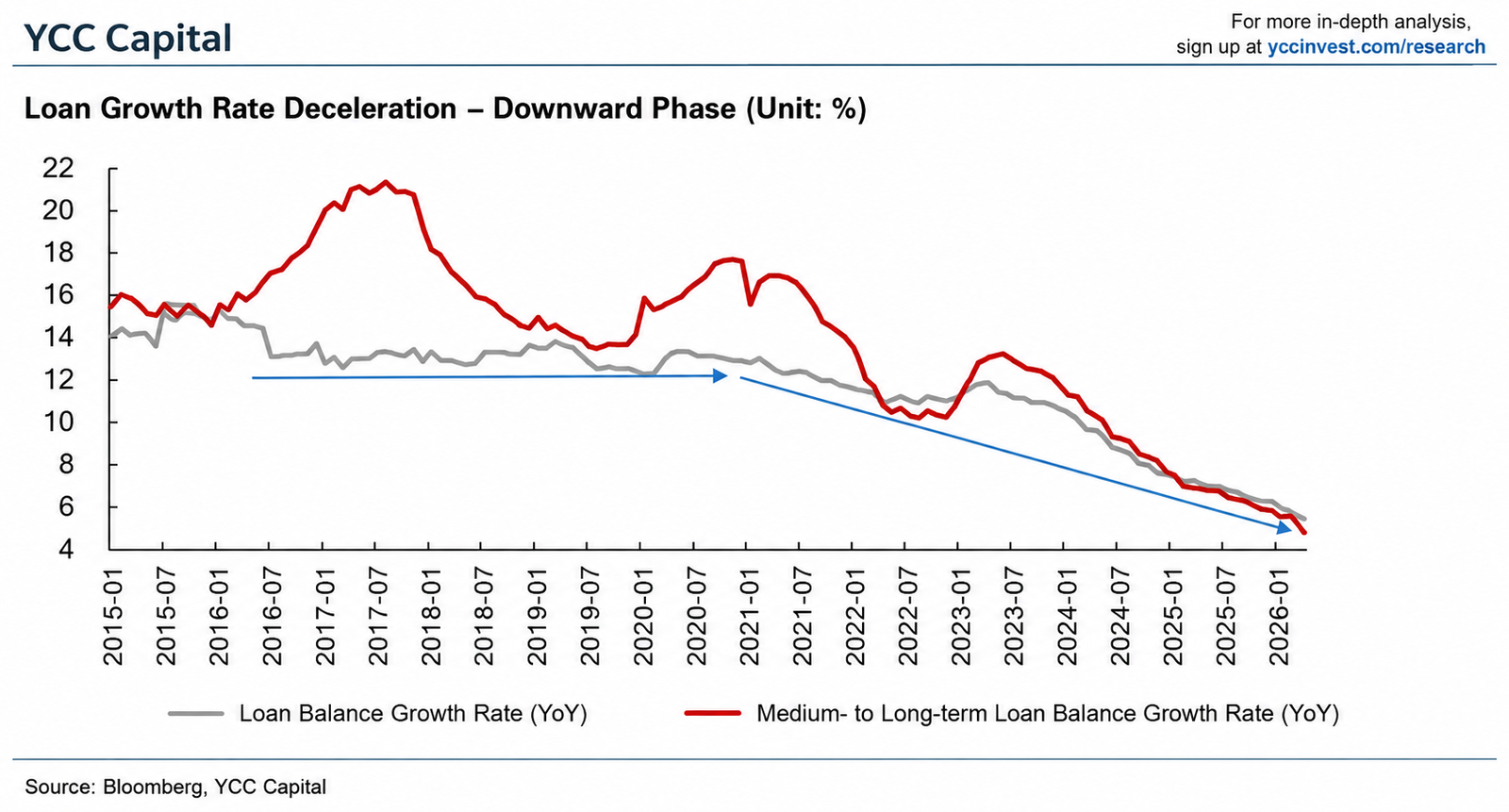
Since 2021, China’s banking system has experienced a pronounced deceleration in lending growth.
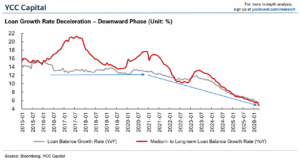
Outstanding medium- and long-term loans have slowed from annual growth exceeding 17% at the end of 2020 to below 5% by early 2026, the weakest pace in many years. New medium- and long-term lending has repeatedly surprised to the downside, while commercial bill yields have fallen toward historically low levels—clear evidence that underlying credit demand remains subdued.
At first glance, these numbers appear deeply recessionary.
Historically, such a collapse in loan growth would have signaled a sharp deterioration in economic momentum. Yet economic activity has proven considerably more resilient than traditional models would imply.
The explanation lies not simply in cyclical weakness but in structural transformation.
China’s economy is gradually replacing one financing model with another.
Property No Longer Dominates Capital Allocation
For much of the previous decade, property development and infrastructure investment absorbed the overwhelming majority of new credit creation.
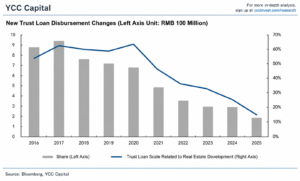
At their peak around 2017, these sectors accounted for roughly two-thirds of all new lending issued by Chinese banks, receiving well over RMB 8 trillion annually. The financial system effectively revolved around real estate, with developers, local governments, construction firms, and related industries serving as the principal borrowers.
That era has ended.
Following tighter regulatory oversight, the collapse of highly leveraged developers, and continued weakness in housing demand, real estate’s capacity to absorb credit has deteriorated dramatically.
By 2025, our estimates suggest that infrastructure and property together accounted for only around 12% of newly created bank credit.
Property-related lending alone has declined by approximately RMB 850 billion compared with previous years, becoming one of the largest drags on aggregate credit growth.
Rather than representing a temporary downturn, this reflects a permanent adjustment in China’s capital allocation.
The economy is no longer organized around building additional apartments.
Direct Financing Is Replacing Bank Loans
Another critical development is the rapid expansion of direct financing.
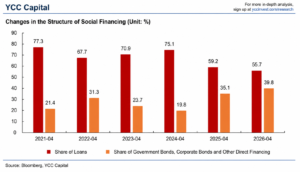
Historically, bank lending dominated China’s social financing system. Credit represented more than three-quarters of total financing as recently as 2021.
That share has steadily declined.
Meanwhile, government bond issuance, corporate bond markets, and domestic equity financing have become increasingly important sources of capital.
By early 2026, the proportion of total social financing represented by traditional bank credit had fallen to approximately 56%, while direct financing had nearly doubled its contribution to almost 40%.
This evolution reflects the financing preferences of China’s emerging industries.
Unlike property developers, technology companies rarely depend primarily on large bank loans.
Software firms, semiconductor designers, cloud infrastructure providers, internet platforms, and AI developers typically finance expansion through retained earnings, venture capital, equity issuance, strategic investors, and public markets.
Their balance sheets are fundamentally different.
Consequently, weaker loan growth no longer necessarily implies weaker investment.
AI Is Becoming Larger Than Real Estate
Perhaps the most significant structural shift is occurring within China’s industrial composition itself.
Using input-output analysis, we estimate that the combined AI ecosystem—including computing hardware, communications equipment, semiconductor components, software development, internet services, information technology services, power equipment supporting data centers, and related digital infrastructure—has expanded rapidly over recent years.
Its direct contribution to GDP has risen from approximately 5.3% in 2020 to around 6.6% by 2023.
Once upstream and downstream supply-chain effects are incorporated, AI-related industries may already account for nearly 15% of Chinese GDP by 2025.
That compares with an estimated 12.7% for the broader real estate ecosystem.
In other words, China’s new economy may now exceed its old economy in economic importance.
This crossover represents far more than a statistical milestone.
For decades, virtually every major cyclical upswing in China began with housing construction.
Today, the country’s largest growth engine increasingly consists of data centers, semiconductor fabrication, industrial automation, robotics, software services, cloud computing, and artificial intelligence infrastructure.
The nature of investment has fundamentally changed.
New Industries Need Less Debt
An equally important distinction lies in capital structure.
Property developers traditionally operated with asset-liability ratios exceeding 70%.
Many AI-related industries operate comfortably below 50%.
Manufacturing firms have certainly increased borrowing since 2020, supported by industrial policy initiatives, but overall financing needs remain substantially smaller than those associated with nationwide property expansion.
Likewise, information technology and software sectors continue to rely heavily on equity capital and internal cash generation.
This difference carries profound macroeconomic implications.
An economy dominated by low-leverage industries naturally requires less new credit to generate the same amount of output.
Consequently, declining loan growth does not automatically indicate weakening production.
Instead, it reflects changing financial architecture.
Households Are Deleveraging—But Consumption Has Not Collapsed
China’s household sector illustrates this transformation clearly.
Following years of aggressive mortgage borrowing during the housing boom, households have become increasingly cautious toward leverage.
Annual household borrowing has collapsed from approximately RMB 8 trillion during the peak years to almost zero in 2025.
The first four months of 2026 even recorded net declines in household borrowing.
Mortgage demand has weakened despite relatively stable housing transactions in major cities.
Many buyers continue purchasing homes while choosing substantially larger down payments.
Others are accelerating mortgage repayments to reduce financial risk rather than maximize leverage.
This behavioral shift resembles what many developed economies experienced following previous housing cycles.
Families increasingly prioritize balance-sheet repair over debt accumulation.
Anyone who has watched relatives pay down mortgages ahead of schedule instead of purchasing larger homes will recognize this phenomenon immediately.
Economic activity continues—but financial behavior changes.
That distinction matters enormously for interpreting macroeconomic data.
GDP Is Becoming Less Credit Intensive
The weakening relationship between credit and output is visible in national data.
The amount of new lending required to generate one unit of GDP has fallen steadily over recent years.
Both total new loans relative to GDP and medium-term lending relative to GDP have declined materially since 2023.
This suggests that China is producing incremental output with considerably less financial leverage.
Such developments are not unprecedented.
Several mature economies experienced similar transitions as their industrial structures shifted toward technology, services, and knowledge-intensive production.
China’s path differs because the adjustment is occurring while the property sector remains under significant structural pressure.
That creates unusual macroeconomic signals.
Traditional indicators increasingly point toward weakness, while parts of the real economy continue expanding.
Implications for Monetary Policy
These developments also complicate monetary policy.
Historically, lower credit demand would have encouraged increasingly aggressive monetary easing.
Today, additional liquidity may not translate into proportionally stronger borrowing because structural demand for leverage has permanently declined.
Instead, policy transmission is likely to become more dependent upon capital markets, fiscal spending, industrial policy, and targeted financing mechanisms.
The People’s Bank of China may therefore find itself operating within a fundamentally different monetary framework than existed during previous decades.
Rather than stimulating another property cycle, policymakers appear increasingly focused on maintaining liquidity while directing capital toward strategic industries.
Whether this approach can offset persistent weakness in private-sector confidence remains uncertain.
Strategic Investment Implications
For global investors, the implications are nuanced.
China’s traditional property-led growth model continues to deteriorate, and we remain cautious regarding sectors dependent upon residential construction, highly leveraged local government financing vehicles, and businesses closely tied to land sales.
Structural headwinds—including demographics, declining productivity growth, and elevated debt burdens within legacy sectors—remain significant constraints on long-term economic performance.
At the same time, investors should avoid assuming that weak credit data necessarily signals an imminent economic collapse.
The economy is becoming more heterogeneous.
Technology manufacturing, automation, AI infrastructure, advanced electronics, renewable equipment, and selected export-oriented industries increasingly operate according to different financing dynamics than legacy real estate.
For global asset allocators, understanding these internal divergences is becoming more important than interpreting aggregate credit statistics alone.
YCC Capital Strategic View
The transition now underway represents one of the most important macroeconomic developments in China since the property boom began two decades ago.
The old China was built through leverage.
The emerging China is attempting to grow through innovation.
Whether that transition ultimately succeeds remains an open question. We remain cautious regarding China’s longer-term structural outlook given persistent demographic deterioration, declining returns on capital, and ongoing pressure within the property market. Nevertheless, investors should recognize that macroeconomic relationships developed during the previous property cycle may no longer apply with the same reliability.
The era in which rising credit automatically implied stronger growth—and falling credit guaranteed weaker activity—is gradually fading.
Markets that continue relying exclusively on yesterday’s indicators risk misunderstanding tomorrow’s economy.
Risk Assessment
While the structural transition described above offers a compelling explanation for why credit growth and economic activity are becoming less synchronized, investors should avoid interpreting this evolution as evidence that China’s economy has entered a risk-free phase. In many respects, the opposite is true. A system in transition often experiences periods where traditional indicators lose explanatory power before new equilibrium relationships become fully established.
Three risks deserve particular attention.
First, AI Investment May Eventually Follow the Law of Diminishing Returns
The current expansion of AI infrastructure has become one of China’s principal investment engines. Semiconductor fabrication, cloud computing capacity, industrial robotics, advanced manufacturing equipment, data centers, and digital infrastructure have together replaced much of the investment once generated by residential property.
However, every investment cycle eventually reaches a point where marginal returns begin to decline.
History offers numerous examples. During the late 1990s, fiber-optic networks were built far faster than traffic demand justified. The railway booms of the nineteenth century produced extraordinary productivity gains but also periods of severe overcapacity. More recently, parts of the global renewable energy industry have periodically experienced similar investment cycles.
China’s AI buildout could eventually encounter comparable challenges.
Should enterprise adoption fail to match infrastructure investment, or should profitability disappoint expectations, capital expenditure could slow materially. Because AI-related industries have become an increasingly important source of investment and employment, any moderation would have broader macroeconomic implications.
Unlike the property sector, however, AI investment is generally supported by healthier corporate balance sheets and greater equity financing. That makes the sector less vulnerable to systemic financial stress, although cyclical corrections remain entirely possible.
Second, Geopolitical Fragmentation Could Alter the Investment Landscape
China’s technology ambitions remain closely intertwined with an increasingly fragmented global geopolitical environment.
Export controls, semiconductor restrictions, supply-chain diversification, and strategic competition between major powers all introduce uncertainty into the long-term development of China’s technology ecosystem.
For investors, this creates a paradox.
On one hand, external restrictions may accelerate domestic investment in indigenous technology, automation, and semiconductor capacity.
On the other hand, prolonged limitations on access to advanced equipment, software, intellectual property, and international markets could reduce productivity gains and slow returns on investment.
The outcome will depend not only on domestic policy execution but also on the evolution of global strategic competition.
Markets should therefore treat geopolitical developments as macroeconomic variables rather than purely diplomatic events.
Third, The Property Adjustment Is Far From Complete
Although the economy’s center of gravity is shifting toward new industries, real estate continues to represent an enormous stock of existing wealth.
Residential property remains the largest household asset class, local governments remain heavily dependent upon land-related revenues, and the banking system still carries substantial exposure to property-linked borrowers.
Consequently, stabilization should not be confused with recovery.
Housing activity has shown intermittent improvements, particularly within major cities, yet nationwide demand continues to face structural headwinds from demographics, urbanization maturity, and weaker household confidence.
Moreover, household deleveraging remains a defining feature of the current cycle.
Many families now approach home purchases differently than they did a decade ago. Rather than maximizing leverage because mortgage rates are attractive, buyers increasingly seek larger down payments and faster repayment schedules. The emphasis has shifted from maximizing financial returns toward preserving financial resilience.
That behavioral change may prove long lasting.
Broader Implications for Global Investors
The implications extend well beyond China.
For nearly two decades, global commodity producers, industrial manufacturers, luxury brands, financial institutions, and emerging-market investors all relied—directly or indirectly—on China’s debt-fueled property expansion.
As that engine fades, global capital markets will likely assign greater importance to different sectors of the Chinese economy.
Instead of asking whether property sales are recovering, investors may increasingly focus on questions such as:
- Is enterprise software spending accelerating?
- Are semiconductor capital expenditures continuing to expand?
- Is industrial automation adoption increasing?
- Are AI applications generating measurable productivity gains?
- Are advanced manufacturing exports maintaining competitiveness?
These represent fundamentally different investment questions from those that dominated the previous cycle.
For portfolio managers, this transition argues for greater selectivity rather than broad directional exposure to China.
Blanket optimism toward Chinese equities appears difficult to justify given persistent structural challenges. Equally, blanket pessimism risks overlooking industries that continue to benefit from policy support, technological upgrading, and export competitiveness.
The opportunity increasingly lies beneath the aggregate data.
Conclusion
China’s economic transition should be viewed not as a conventional cyclical recovery but as a structural reallocation of capital.
The old model was built upon expanding leverage, rapidly rising property prices, and continuous credit creation.
The emerging model is increasingly driven by advanced manufacturing, digital infrastructure, software, artificial intelligence, automation, and strategic industrial upgrading.
These sectors demand less debt, rely more heavily on direct financing, and consequently weaken the historical relationship between bank lending and GDP growth.
For investors, this means traditional macro frameworks require updating.
Credit growth remains an important indicator, but it is no longer sufficient on its own to explain the trajectory of the world’s second-largest economy.
At YCC Capital, we believe investors should resist interpreting every disappointing loan report as evidence of imminent economic contraction. Equally, they should avoid assuming that technological investment alone can fully offset China’s deep-seated structural challenges. The property downturn, demographic pressures, elevated local government debt, and weaker private-sector confidence continue to weigh on the country’s long-term outlook.
Our baseline expectation remains one of moderate growth accompanied by continued structural divergence: persistent weakness in legacy sectors alongside selective strength in industries aligned with national strategic priorities. Such an environment is likely to produce a more uneven investment landscape, rewarding discrimination over broad market exposure.
The next chapter of China’s economy is unlikely to resemble the last. The transition from a debt-driven model to one increasingly centered on innovation will not be linear, nor will it be free of setbacks. Yet understanding this shift—and recognizing where traditional indicators are losing explanatory power—may prove one of the most important macro advantages for investors over the coming decade.
Editorial Board
Ken Cao
Chief Strategist, Global Investment Strategy
Le Gao
Managing Analyst
Yui Nabeshima
Strategist
Mai Ikeda
Research Analyst
IMPORTANT DISCLAIMER
This research report is provided for informational and educational purposes only and does not constitute an offer to sell or a solicitation of an offer to buy any securities, financial instruments, or investment products. It is not intended as investment, legal, accounting, or tax advice and should not be relied upon as such. The views, opinions, and projections expressed herein are those of YCC Capital Management and its research personnel as of the date of publication and are subject to change without notice. Past performance is not indicative of future results.
YCC Capital Management, its affiliates, principals, and employees may hold long or short positions in securities or instruments discussed in this report and may trade for their own accounts or for client accounts in a manner inconsistent with the recommendations herein. This report is based on publicly available information and data believed to be reliable, but YCC Capital makes no representation or warranty, express or implied, as to the accuracy, completeness, or timeliness of such information. Forward-looking statements involve risks and uncertainties that could cause actual results to differ materially from those projected.
Recipients of this report should conduct their own independent due diligence and consult with their own financial, legal, and tax advisors before making any investment decisions. YCC Capital accepts no liability for any loss or damage arising from the use of or reliance on this report or its contents.
This report is intended solely for the use of the intended recipient(s) and may not be reproduced or redistributed for commercial purposes without the prior written consent of YCC Capital.
© 2026 YCC Capital. All rights reserved.
YCC Capital’s flagship vehicle, the YCC International Value Fund, LP, maintains a concentrated global macro value strategy with a focus on capital-flow-driven mispricings and asymmetric hedging opportunities. The Fund is registered in the State of Delaware, U.S. and structured as a Rule 506(c) private fund. Performance data, where referenced, has been verified by independent third parties including NAV Consulting; however, individual investor results may vary.
Contact Us
YCC Capital Research
Email: ir@yccinvest.com
Sign up for our free daily market insights and research updates at:
For more related research:
China’s Uneven Recovery: Exports Power Ahead While Domestic Demand Remains Stuck in Low Gear
China’s Recovery Is Losing Altitude: Exports Mask a Deepening Domestic Slowdown