YCC CAPITAL
Emerging Markets & China Strategy
July 19, 2026
Executive Perspective
Credit is often described as the lifeblood of an economy. When businesses are confident, households optimistic, and governments investing aggressively, financing flows naturally through the financial system. When confidence fades, however, even abundant liquidity struggles to find productive borrowers.
China’s June financial data illustrates precisely this dilemma.
Headline liquidity remains plentiful, yet the transmission mechanism from policy easing to real economic activity continues to weaken. Aggregate Social Financing (ASF) growth slowed again, corporate borrowing remained subdued, household leverage failed to recover meaningfully, and monetary aggregates softened after temporary strength earlier this year.
The numbers do not point toward an imminent financial crisis. Rather, they reinforce a longer-running structural transition in which China is gradually moving away from the debt-intensive growth model that powered its economy for nearly two decades. The challenge is that no equally powerful replacement engine has fully emerged.
For global investors, this distinction matters enormously. Slower credit expansion does not necessarily imply an abrupt collapse, but it does suggest that expectations for a broad-based Chinese economic reacceleration should remain restrained. While fiscal policy may cushion downside risks during the second half of the year, the underlying issues—property weakness, cautious private investment, and local government deleveraging—remain far from resolved.
Just as an experienced sailor recognizes that calm seas can conceal strong undercurrents, investors should look beyond China’s headline liquidity figures to examine the quality and direction of credit creation itself. The June data suggest those undercurrents remain considerably weaker than headline policy rhetoric would imply.
Aggregate Financing Continues to Lose Momentum
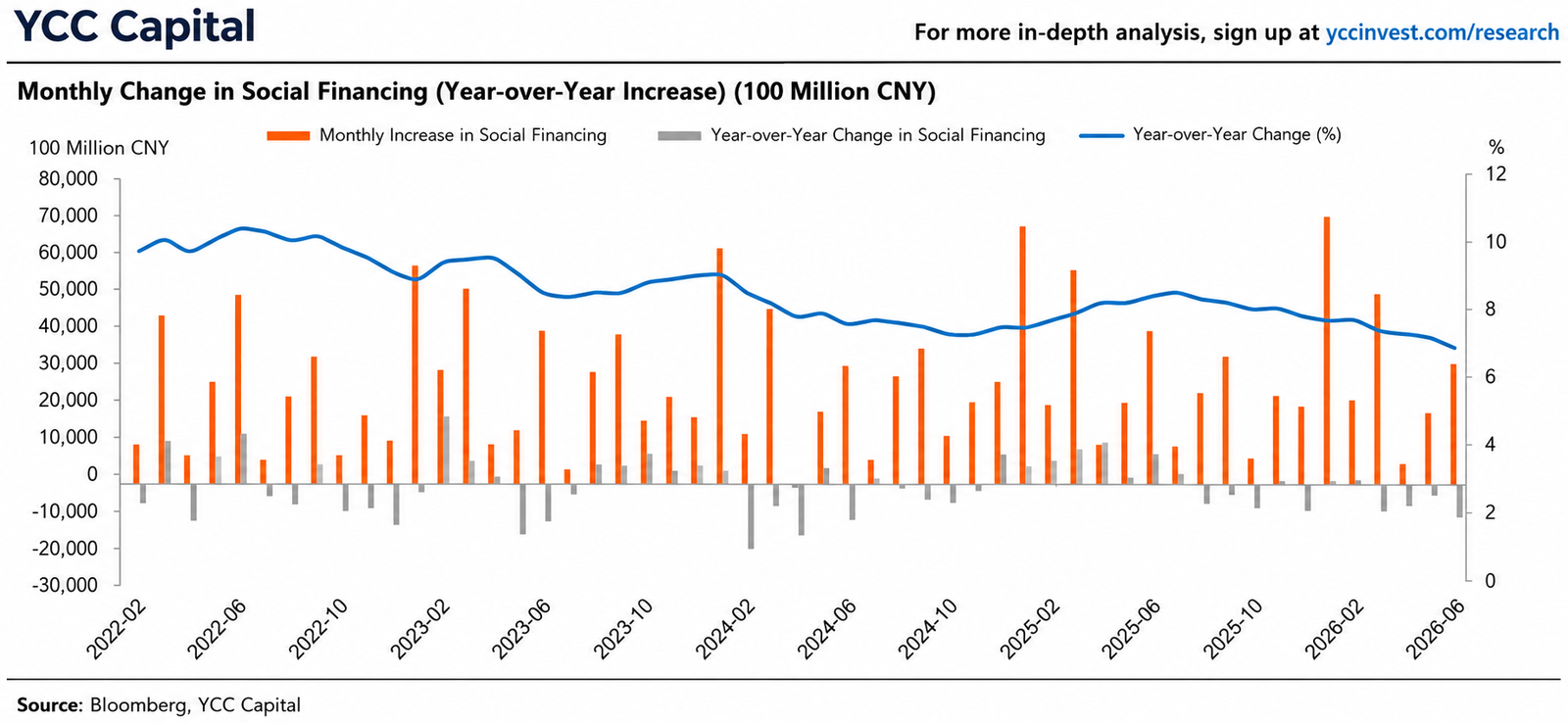
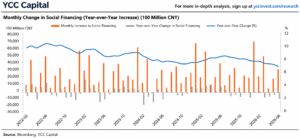
China’s Aggregate Social Financing (ASF)—the broadest measure of credit supplied to the real economy—expanded by RMB 3.4 trillion in June, representing a decline of approximately RMB 861 billion compared with the same month last year. Outstanding ASF growth slowed further to 7.4% year-over-year, extending the gradual deceleration seen throughout recent quarters.
The deterioration was not driven by a single category but reflected weakness across several major financing channels.
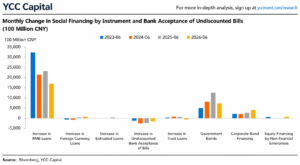
Lower bank lending, slower government bond issuance and weaker trust lending collectively weighed on overall financing growth. Offsetting these declines only partially were stronger corporate bond issuance and increased use of bankers’ acceptances.
The composition of financing is becoming increasingly important.
Historically, China’s credit expansion depended overwhelmingly upon commercial bank lending. Today, direct financing through bond issuance is gradually assuming a larger role. Policymakers have repeatedly emphasized improving financing efficiency rather than simply expanding credit volumes, suggesting that slower loan growth is becoming an accepted feature of China’s evolving financial architecture.
Nevertheless, structural improvement should not be confused with cyclical strength.
The underlying demand for credit remains soft, indicating that both businesses and households continue to approach new borrowing with considerable caution.
Corporate Credit Demand Remains Constrained
Perhaps the clearest message from June’s data is that corporate confidence has yet to recover convincingly.
Short-term corporate loans increased by RMB 820 billion, representing a year-over-year decline of roughly RMB 340 billion.
At first glance, this may appear alarming. However, part of the decline reflects changing financing preferences rather than outright deterioration. Banks have continued aggressively purchasing commercial bills amid persistently low bill discount rates, encouraging companies to substitute traditional short-term loans with bill financing.
Still, substitution explains only part of the picture.
Medium- and long-term corporate loans increased just RMB 560 billion, falling approximately RMB 450 billion from the previous year.
These longer-duration loans typically finance factory construction, infrastructure, equipment investment and capacity expansion. Their continued weakness therefore signals restrained corporate investment rather than temporary financing adjustments.
Several structural forces continue suppressing borrowing appetite.
First, local governments have adopted more conservative project approval standards under stricter accountability requirements. Infrastructure investment has consequently proceeded at a measured pace rather than serving as the aggressive growth engine seen during previous economic slowdowns.
Second, China’s ongoing local government debt restructuring continues to absorb financial resources. Existing debt replacement programs have reduced immediate financial stress but simultaneously limit fresh credit creation.
Third, corporate bond financing has become increasingly attractive amid relatively favorable funding costs. Many higher-quality borrowers now prefer issuing bonds directly instead of relying exclusively on bank loans.
Taken together, these developments suggest that credit weakness increasingly reflects muted investment intentions rather than supply constraints.
Banks remain willing to lend.
Borrowers simply remain hesitant to borrow.
Households Continue to Prioritize Balance Sheet Repair
If corporate credit reflects business confidence, household borrowing provides perhaps an even clearer window into consumer sentiment.
Here too, June’s data offered little encouragement.
Household short-term loans increased by only RMB 106 billion, declining approximately RMB 156 billion year-over-year.
Consumer credit demand has weakened despite multiple rounds of government stimulus.
Trade-in subsidy programs for automobiles, home appliances and consumer electronics generated an initial burst of spending after their introduction. Much of that pent-up demand, however, now appears to have been exhausted.
Employment conditions continue improving only gradually, while income expectations remain subdued. Under such circumstances, households naturally become more cautious about discretionary borrowing.
This behavior mirrors what many families experience after purchasing a home or navigating a period of financial uncertainty. Rather than immediately taking on additional debt, households typically rebuild savings before expanding consumption once again.
China appears to be experiencing this balance-sheet adjustment on a national scale.
Property Market Stabilization Remains Fragile
Longer-term household borrowing—which is dominated by residential mortgage lending—continued weakening as well.
New medium- and long-term household loans reached RMB 158 billion, approximately RMB 177 billion lower than one year earlier.
The weakness remains closely linked to China’s still-fragile housing market.
Transaction volumes across thirty major Chinese cities declined 6.7% year-over-year during June.
Breaking the figures down further reveals declines across virtually every tier of city:
- Tier-one cities: -2.2%
- Tier-two cities: -8.7%
- Tier-three cities: -8.2%
While policymakers have introduced numerous measures to stabilize real estate markets, much of the initial recovery appears to have represented the release of previously delayed demand rather than the beginning of a sustained expansion.
Earlier policy easing successfully encouraged first-time buyers and purchasers seeking relatively affordable homes to re-enter the market. Yet demand from upgrade buyers remains considerably weaker.
Without a meaningful recovery in household confidence and income expectations, housing transactions are unlikely to generate the powerful credit expansion that characterized previous Chinese economic cycles.
This represents an important structural shift.
For nearly two decades, property acted as China’s principal mechanism for household wealth accumulation and credit creation. That relationship has weakened substantially, leaving policymakers searching for alternative engines capable of generating comparable economic momentum.
Monetary Growth Moderates Again
Broad monetary aggregates also softened during June.
M1 growth slowed to 4.0% year-over-year, declining 1.5 percentage points from May.
Part of the slowdown reflected statistical base effects. Corporate deposits strengthened unusually sharply during June last year, creating a difficult comparison.
Nevertheless, softer M1 growth also reflects weaker transaction activity and slower creation of demand deposits associated with new lending.
Meanwhile, M2 growth eased to 8.0%, down 0.6 percentage points from the previous month.
Two factors contributed.
First, slower loan growth naturally reduced money creation.
Second, banks increasingly relied upon wholesale funding instruments—including negotiable certificates of deposit—to stabilize their liability structures as traditional deposit growth moderated.
The decline in non-bank financial institution deposits also weighed on overall money supply growth.
Viewed together, M1 and M2 indicate that monetary conditions remain accommodative but are becoming progressively less effective at stimulating private-sector activity.
Liquidity, in other words, is abundant.
Confidence remains scarce.
Fiscal Policy Will Likely Become the Primary Growth Support
While private-sector borrowing remains subdued, fiscal policy is positioned to assume greater responsibility during the second half of the year.
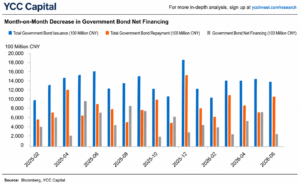
Government bond issuance represented one of the principal drags on June financing growth because net Treasury issuance remained below last year’s pace.
However, this weakness appears largely temporary.
With annual fiscal deficits and bond issuance quotas already approved, Treasury issuance is expected to accelerate during coming months, reversing part of the first-half shortfall.
Special local government bonds have already shown modest improvement.
As infrastructure projects gradually move from approval into execution, financing demand should strengthen modestly.
Nevertheless, investors should avoid assuming that additional fiscal spending will recreate the investment booms witnessed after previous economic downturns.
Today’s China differs fundamentally from the China of a decade ago.
Local governments operate under tighter borrowing constraints.
Infrastructure returns are generally lower.
Demographic trends have become less supportive.
Property no longer generates the same multiplier effects across construction, household spending and local fiscal revenues.
Consequently, fiscal policy is more likely to stabilize growth than to ignite another powerful credit expansion.
Structural Transformation Comes With Long-Term Trade-Offs
The broader story behind June’s financial data extends beyond monthly fluctuations.
China is intentionally attempting to reduce dependence upon debt-driven growth while redirecting capital toward advanced manufacturing, strategic technologies and innovation-intensive industries.
From a long-term resource allocation perspective, this objective is understandable.
Yet transitions of this magnitude rarely proceed smoothly.
Traditional sectors—including property development and infrastructure construction—historically absorbed enormous quantities of financing. Emerging industries typically require significantly less leverage.
As a result, even successful industrial upgrading naturally produces slower aggregate credit growth.
This implies that investors should not expect financing data to return to the double-digit expansion rates that characterized previous decades.
Instead, China’s financial system appears to be entering an environment where credit quality matters more than credit quantity.
Whether this transition ultimately succeeds will depend less upon regulatory guidance and more upon private-sector confidence returning sustainably.
At present, that confidence remains incomplete.
Investment Implications
For global investors, June’s financing figures reinforce several broader themes.
Chinese equities may continue facing periodic headwinds as domestic demand remains subdued and earnings recovery proves uneven. Sectors tied closely to residential property and highly leveraged local government investment are likely to remain under structural pressure.
Government-led infrastructure spending should provide selective support to industrial activity, though the magnitude is unlikely to replicate previous stimulus cycles.
High-quality exporters, advanced manufacturing companies and technology firms remain relatively better positioned than sectors dependent upon domestic credit expansion.
From a broader asset allocation perspective, China’s macro backdrop continues to argue for selective rather than broad exposure.
Meanwhile, the United States retains comparatively stronger structural fundamentals despite ongoing cyclical moderation, supporting continued international portfolio diversification.
YCC Capital Strategic View
June’s financial data reinforce our long-held view that China’s economy is navigating a prolonged adjustment rather than preparing for a rapid cyclical rebound.
Credit expansion remains constrained not because liquidity is unavailable, but because confidence has yet to recover across households, private businesses and local governments. Fiscal policy will likely prevent a sharper slowdown, yet it cannot fully substitute for durable private-sector demand.
For investors, this argues against extrapolating isolated policy announcements into expectations of broad-based economic acceleration. Instead, we continue to favor a disciplined approach that differentiates between sectors benefiting from structural upgrading and those still burdened by legacy debt dynamics.
China’s transition remains investable—but increasingly selective. The era when rising aggregate credit alone could lift nearly every asset class appears firmly behind us.
Editorial Board
Ken Cao
Chief Strategist, Global Investment Strategy
Le Gao
Managing Analyst
Yui Nabeshima
Strategist
Mai Ikeda
Research Analyst
IMPORTANT DISCLAIMER
This research report is provided for informational and educational purposes only and does not constitute an offer to sell or a solicitation of an offer to buy any securities, financial instruments, or investment products. It is not intended as investment, legal, accounting, or tax advice and should not be relied upon as such. The views, opinions, and projections expressed herein are those of YCC Capital Management and its research personnel as of the date of publication and are subject to change without notice. Past performance is not indicative of future results.
YCC Capital Management, its affiliates, principals, and employees may hold long or short positions in securities or instruments discussed in this report and may trade for their own accounts or for client accounts in a manner inconsistent with the recommendations herein. This report is based on publicly available information and data believed to be reliable, but YCC Capital makes no representation or warranty, express or implied, as to the accuracy, completeness, or timeliness of such information. Forward-looking statements involve risks and uncertainties that could cause actual results to differ materially from those projected.
Recipients of this report should conduct their own independent due diligence and consult with their own financial, legal, and tax advisors before making any investment decisions. YCC Capital accepts no liability for any loss or damage arising from the use of or reliance on this report or its contents.
This report is intended solely for the use of the intended recipient(s) and may not be reproduced or redistributed for commercial purposes without the prior written consent of YCC Capital. © 2026 YCC Capital. All rights reserved.
YCC Capital’s flagship vehicle, the YCC International Value Fund, LP, maintains a concentrated global macro value strategy with a focus on capital-flow-driven mispricings and asymmetric hedging opportunities. The Fund is registered in the State of Delaware, United States, and is structured as a Rule 506(c) private investment fund. Performance data, where referenced, has been independently verified by third-party administrators including NAV Consulting; however, individual investor returns may vary depending on subscription timing, fees and other factors.
Contact Us
YCC Capital Research
For complimentary daily macro, market and investment research, sign up at:
YCC Capital publishes institutional-quality analysis covering global macroeconomics, equities, fixed income, commodities, geopolitics, innovation, and long-term investment themes. Our research seeks to identify structural shifts before they become consensus, helping investors navigate an increasingly complex global investment landscape.
YCC Capital Research | Sign up for free daily market insight at www.yccinvest.com
For more related research:
The Era of the Creditless Recovery: Why China’s New Economy Is Breaking the Old Financial Cycle
China’s Uneven Recovery: Exports Power Ahead While Domestic Demand Remains Stuck in Low Gear
China’s Growth Engine Loses Momentum: Why the Q2 GDP Miss Signals a Longer Road to Recovery