YCC CAPITAL
Emerging Markets & China Strategy
July 10, 2026
Executive Perspective
Inflation is often described as the economy’s pulse. Sometimes it races, sometimes it slows, but what matters most is understanding why it changes. China’s June inflation report presents precisely this challenge. On the surface, the data appear mixed: consumer inflation eased while producer prices accelerated further. Yet beneath the headline numbers lies a more nuanced story—one shaped less by a resurgence in domestic demand than by fluctuations in global commodity markets and technological investment.
For investors, this distinction is critical. A healthy inflation cycle is typically driven by improving household income, stronger consumption, and broad-based pricing power. China’s latest figures instead suggest that external commodity shocks and selective industrial upgrading continue to dominate price formation, while consumer demand remains subdued.
At YCC Capital, we believe the June inflation report reinforces our broader macro view: China’s industrial sector is benefiting from pockets of technological upgrading and higher commodity costs, but the broader economy continues to struggle with insufficient domestic demand, weak property-related wealth effects, and cautious consumer behavior. Producer inflation may remain elevated for longer, yet consumer inflation is unlikely to develop into a sustained inflationary cycle.
Key Takeaways
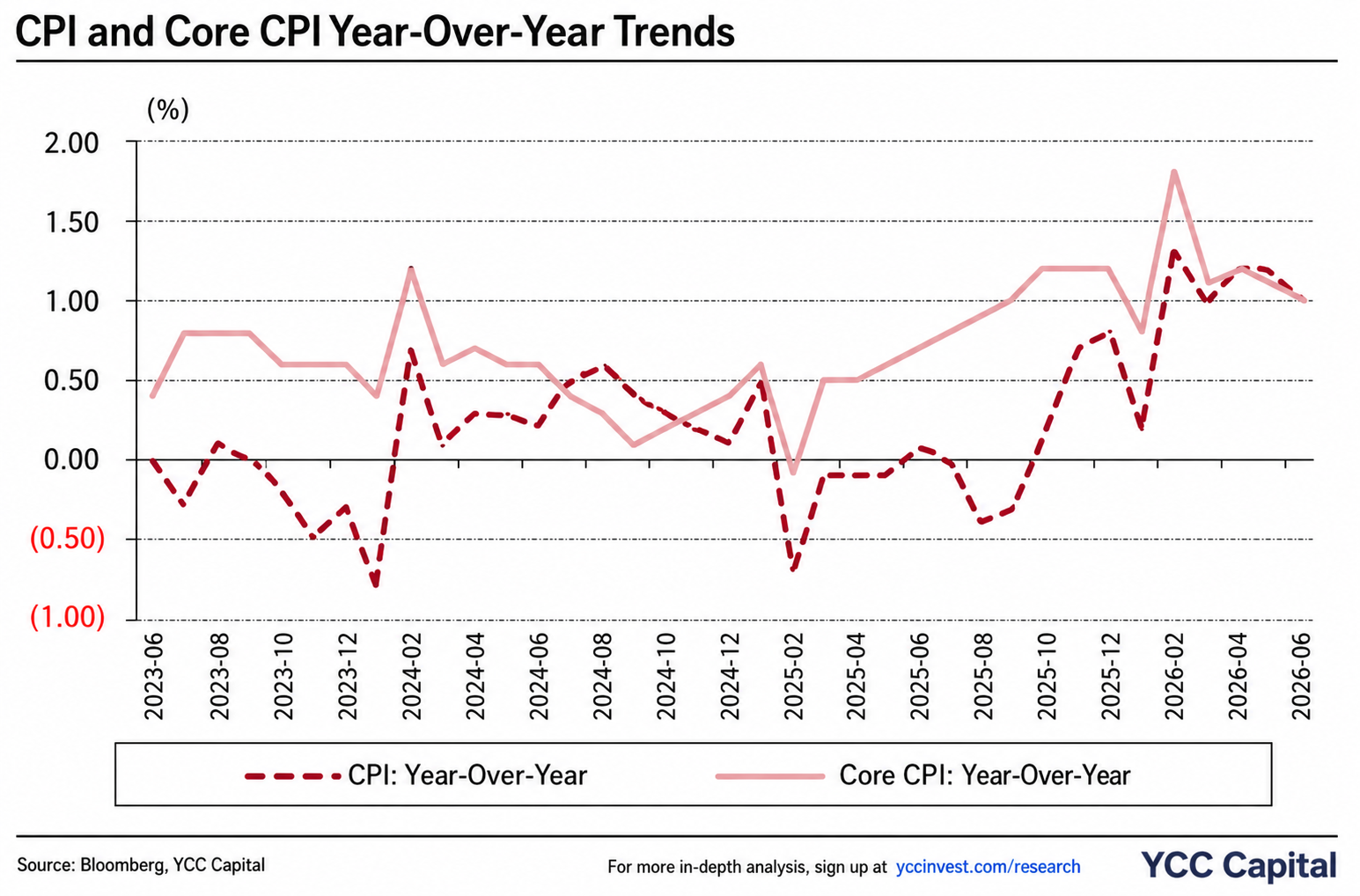
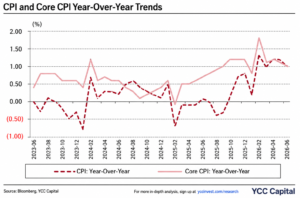
June CPI declined 0.3% month-over-month while rising 1.0% year-over-year, slightly below market expectations. Core CPI also increased 1.0%, suggesting that underlying demand remains relatively stable but far from robust.
Producer prices continued their upward trend. PPI increased 4.1% year-over-year, surpassing the 4% threshold for the first time in the current cycle, reflecting stronger industrial pricing driven by commodities, artificial intelligence investment, and manufacturing upgrades.
The divergence between CPI and PPI illustrates a familiar pattern in China’s economy: industrial producers are benefiting from external pricing dynamics and policy-supported investment, while households remain considerably more cautious.
Source: Bloomberg, YCC Capital
Consumer Inflation: Imported Factors Dominate
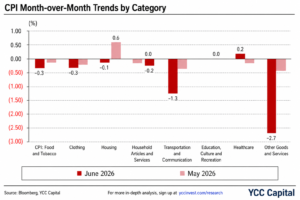
Headline CPI slowed modestly during June, but the underlying drivers reveal that domestic demand was not the principal cause.
Instead, imported price movements accounted for much of the fluctuation.
International gold prices corrected during the month, causing domestic jewelry prices to decline sharply. At the same time, lower international crude oil prices reduced gasoline prices across China. Together, these two categories alone reduced monthly CPI by approximately 0.22 percentage points, accounting for the majority of June’s decline.
By contrast, services inflation remained remarkably steady.
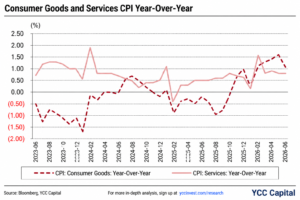
Service prices rose 0.8% year-over-year, essentially unchanged from May, suggesting that domestic consumption has stabilized but has not meaningfully accelerated.
This is consistent with broader evidence seen across China’s retail sales, consumer confidence, and household savings behavior. Chinese households continue to prioritize balance sheet repair over discretionary spending, reflecting ongoing uncertainty surrounding employment, income growth, and the property market.
Walking through many Chinese shopping districts today illustrates this reality. Restaurants remain open, shopping malls remain busy during weekends, yet spending per customer remains restrained. Consumers browse carefully, compare prices, and increasingly seek promotions rather than premium products. The economy is moving—but not with the confidence typically associated with a strong inflationary cycle.
Food Inflation Remains Highly Uneven
Food prices continued to provide a modest drag on headline inflation.
Overall food prices declined 1.6% year-over-year, although the pace of decline narrowed slightly compared with May.
Within the category, however, significant divergence emerged.
Seasonal supply remained abundant for fresh vegetables and fruits, leading to further price declines as harvests entered the market. Pork prices also continued falling, although the rate of decline moderated compared with previous months.
Egg prices moved in the opposite direction.
Reduced laying capacity combined with unusually high summer temperatures constrained supply, pushing egg prices sharply higher during June.
Such divergence highlights an increasingly important feature of China’s inflation dynamics: rather than broad demand-driven inflation, individual supply-side factors continue to dominate specific categories.
Looking ahead, weather may become a more important variable than monetary policy.
The Politburo has warned that El Niño conditions may increase the frequency of floods and droughts during the peak summer season. Extreme weather could temporarily disrupt fruit and vegetable production, creating short-term food inflation even as underlying consumer demand remains weak.
Energy Markets Continue to Drive Inflation Volatility
Geopolitical developments remain an increasingly important source of inflation uncertainty.
Although oil prices softened during much of June, developments in the Middle East have once again increased supply risks.
Recent military escalation involving Iran has renewed concerns regarding tanker traffic through the Strait of Hormuz, one of the world’s most strategically important energy corridors.
Any prolonged disruption could rapidly reverse recent declines in crude oil prices.
For China, which remains heavily dependent on imported energy, such developments directly affect transportation costs, industrial production, and consumer inflation.
Unlike demand-driven inflation, imported inflation leaves policymakers with limited tools. Interest rate adjustments cannot increase oil production or reopen disrupted shipping routes.
This explains why inflation forecasting has become increasingly dependent on geopolitical analysis alongside traditional macroeconomic indicators.
Producer Prices Continue to Strengthen
While consumer inflation softened, producer prices continued strengthening.
June PPI increased 4.1% year-over-year, rising from 3.9% in May.
Production materials increased 5.5%, while consumer goods prices remained slightly negative at -0.9%, reinforcing the divide between industrial activity and household demand.
After eight consecutive months of positive monthly increases, producer prices declined modestly on a month-over-month basis during June as lower oil prices weighed on energy-related industries.
However, the broader annual trend remained firmly positive.
Several sectors experienced particularly strong pricing gains.
Coal mining, electrical equipment manufacturing, electronics production, and steel processing all recorded stronger year-over-year price growth than in May.
Meanwhile, energy-intensive industries linked to oil refining and chemicals experienced some moderation as crude prices retreated during the month.
Overall, producer inflation increasingly reflects structural industrial transformation rather than broad cyclical recovery.
Artificial Intelligence Is Beginning to Influence Factory Prices
One of the more notable developments within China’s producer price data is the growing influence of artificial intelligence and advanced manufacturing.
Demand for industrial robots, intelligent wearable devices, industrial control systems, specialized electronic materials, virtual reality equipment, and advanced carbon-based materials continued pushing factory prices higher.
This represents an important evolution within China’s manufacturing sector.
Unlike previous cycles driven primarily by real estate construction or heavy infrastructure spending, portions of industrial demand are increasingly tied to technology upgrading.
Nevertheless, investors should avoid interpreting this as evidence of broad economic strength.
The technology sector represents a relatively concentrated share of China’s industrial base. Strong pricing among AI-related manufacturers cannot fully offset ongoing weakness across construction, traditional consumer industries, or property-linked sectors.
The broader macro picture therefore remains uneven.
China continues producing world-class technology, yet household confidence has not recovered at the same pace.
Domestic Demand Remains the Missing Piece
The divergence between CPI and PPI ultimately points toward the same conclusion.
Industrial production is recovering faster than household consumption.
This imbalance has characterized China’s post-pandemic recovery and remains unresolved.
Several structural challenges continue to restrain domestic demand:
- Weak property prices continue to reduce household wealth.
- Youth unemployment remains elevated relative to historical norms.
- Consumers continue favoring precautionary savings over discretionary spending.
- Local government fiscal constraints limit the scale of consumption-oriented stimulus.
As a result, inflation generated by stronger household spending remains elusive.
Producer inflation can continue rising for some time without translating into sustained consumer inflation if firms absorb higher costs through lower margins or if weak demand prevents full price pass-through.
YCC Capital Strategic View
At YCC Capital, we expect producer inflation to remain close to 4% over coming months, supported by three principal forces.
First, favorable base effects from the second half of last year continue to lift annual comparisons.
Second, geopolitical uncertainty surrounding global energy markets remains elevated, particularly given persistent Middle East tensions.
Third, investment in artificial intelligence infrastructure and advanced manufacturing should continue supporting selected industrial sectors.
Consumer inflation presents a different outlook.
We expect CPI to remain above 1% during the second half of 2026 but anticipate only gradual acceleration. Domestic demand remains too soft to generate broad inflationary pressure without substantially stronger income growth and renewed consumer confidence.
For global investors, this divergence has several implications.
Commodity-linked exporters may continue benefiting from resilient industrial demand, while companies dependent upon Chinese household consumption are likely to experience a more challenging operating environment.
Meanwhile, policymakers will probably continue balancing modest monetary easing with selective fiscal support rather than launching another large-scale credit expansion similar to previous decades.
From a global allocation perspective, we remain more constructive on developed markets—particularly the United States—where consumption remains healthier and private-sector innovation continues driving productivity growth. China, by contrast, still faces persistent structural headwinds including demographics, property adjustment, and weaker private-sector confidence, which are likely to constrain long-term growth despite isolated areas of technological leadership.
Markets often celebrate improving headline numbers. Experienced investors, however, ask a deeper question: what is actually driving them? June’s inflation report reminds us that not all price increases signal economic strength. Some merely reflect higher import costs, geopolitical uncertainty, or sector-specific investment booms. Sustainable recoveries ultimately require confident consumers—not simply more expensive commodities.
Sources: Bloomberg, YCC Capital
Editorial Board
Ken Cao
Chief Strategist, Global Investment Strategy
Le Gao
Managing Analyst
Yui Nabeshima
Strategist
Mai Ikeda
Research Analyst
IMPORTANT DISCLAIMER
*”This research report is provided for informational and educational purposes only and does not constitute an offer to sell or a solicitation of an offer to buy any securities, financial instruments, or investment products. It is not intended as investment, legal, accounting, or tax advice and should not be relied upon as such. The views, opinions, and projections expressed herein are those of YCC Capital Management and its research personnel as of the date of publication and are subject to change without notice. Past performance is not indicative of future results.
YCC Capital Management, its affiliates, principals, and employees may hold long or short positions in securities or instruments discussed in this report and may trade for their own accounts or for client accounts in a manner inconsistent with the recommendations herein. This report is based on publicly available information and data believed to be reliable, but YCC Capital makes no representation or warranty, express or implied, as to the accuracy, completeness, or timeliness of such information. Forward-looking statements involve risks and uncertainties that could cause actual results to differ materially from those projected.
Recipients of this report should conduct their own independent due diligence and consult with their own financial, legal, and tax advisors before making any investment decisions. YCC Capital accepts no liability for any loss or damage arising from the use of or reliance on this report or its contents.
This report is intended solely for the use of the intended recipient(s) and may not be reproduced or redistributed for commercial purposes without the prior written consent of YCC Capital. © 2026 YCC Capital. All rights reserved. YCC Capital’s flagship vehicle, the YCC International Value Fund, LP, maintains a concentrated global macro value strategy with a focus on capital-flow-driven mispricings and asymmetric hedging opportunities. The Fund is registered in the State of Delaware, U.S and structured as a 506(c) fund. Performance data, where referenced, has been verified by independent third parties including NAV Consulting; however, individual investor results may vary.”*
Contact Us
YCC Capital Research
Email: ir@yccinvest.com
Sign up for our free daily macro and market insights at www.yccinvest.com.
For more related research:
China’s Uneven Recovery: Exports Power Ahead While Domestic Demand Remains Stuck in Low Gear
Peace Priced In, Pain Still Ahead: Why the U.S.–Iran Accord Does Not End the Economic Aftershocks
China’s Consumer Mirage: Why Better Employment Data Is Hiding a More Fragile Recovery
Trump’s Political Playbook: Winning Abroad to Stabilize at Home