YCC CAPITAL
U.S. Bond Strategy
August 25, 2026
YCC Capital Research
Long-duration U.S. Treasuries have become the pressure gauge for a market wrestling with fiscal supply, inflation uncertainty and increasingly complicated liquidity mechanics. The latest rise in yields is not simply another repricing of the Federal Reserve. It looks more like a chronic fiscal concern suddenly becoming acute.
That distinction matters. A central bank can move overnight rates with one decision. It cannot erase a $40 trillion public-debt stock, change the maturity profile of Treasury issuance overnight, or instantly restore confidence in the long end. Yet we remain cautiously constructive on the United States. The Treasury market is under strain, not fundamentally broken, and policymakers still possess several tools capable of cooling yields—although nearly every tool comes with a cost somewhere else in the system.
Market Pulse: The Long End Takes Control
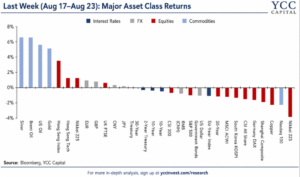
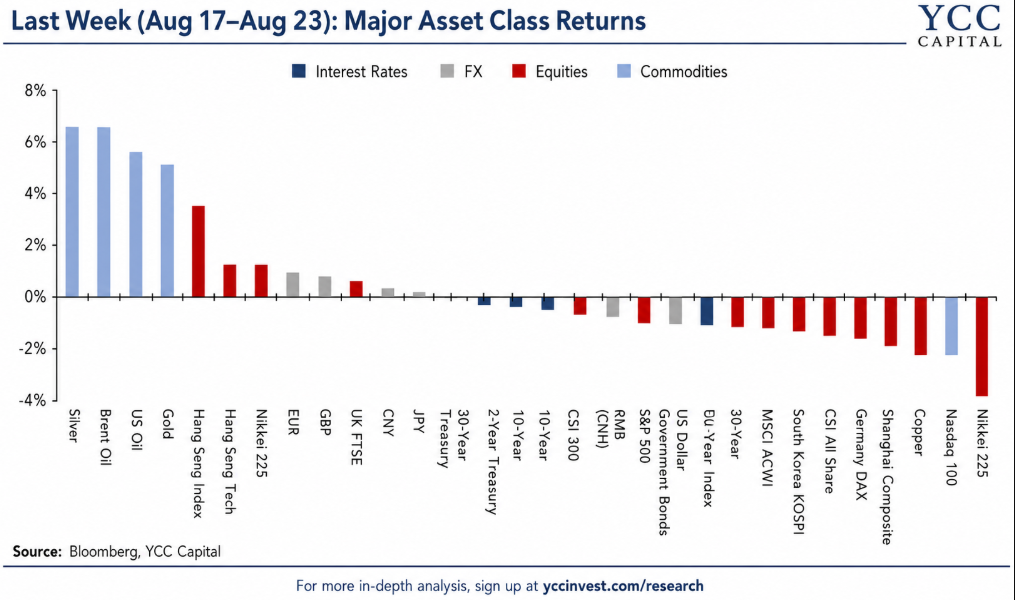
During August 17–23, long-dated Treasury yields drove global markets. The 10-year yield traded in a broad 4.63%–4.74% range, while the 30-year yield pushed above 5.33%, its highest level in roughly two decades. The dollar index fell below 98, its weakest level since May, while precious metals and crude oil outperformed and most major equity indices declined.
Several forces converged. Oil remained elevated as negotiations around the Strait of Hormuz stalled and the U.S. position toward Iran hardened. At the same time, concerns intensified around large U.S. fiscal deficits, Japanese reductions in Treasury holdings and expanding bond issuance by major AI technology companies. Semiconductor stocks led the equity decline.
Midweek brought temporary relief when the U.S. Treasury unexpectedly expanded its long-duration debt-buyback program. Yields dropped quickly and equities bounced, but the relief proved short-lived. Strong U.S. composite PMI data and better-than-expected jobless claims subsequently reinforced the economy’s resilience and pushed yields higher again.
For investors, this is an important distinction: economic strength is still a positive feature of the U.S. story, but in the current bond-market regime, strong data can temporarily work against duration.
Why Long-Term Yields Are Rising
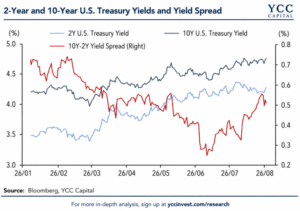
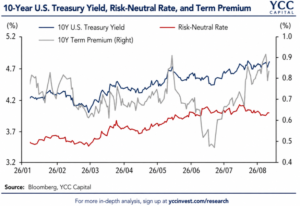
Since July, widening term spreads and rising term premium have been the dominant drivers of long-end yields. Earlier in the move, inflation uncertainty played a substantial role, particularly after questions emerged around the Federal Reserve’s inflation framework and oil prices lifted inflation expectations.
More recently, however, liquidity and fiscal-risk premia have become more important.
One pressure point is Japan. Treasury International Capital data showed Japanese Treasury holdings declining from roughly $1.24 trillion in February to $1.14 trillion in May and $1.12 trillion in June. Japan remains the largest foreign holder of Treasuries, so even a gradual reduction attracts attention. The market became especially sensitive following the July U.S.-Japan intervention in the yen.
We do not view this as evidence of a structural Japanese retreat from U.S. assets. Japan’s portfolio decisions are being shaped by near-term currency-management and domestic-rate considerations. But when the largest foreign Treasury holder reduces exposure while Washington is issuing heavily, markets naturally demand a larger cushion.
Fiscal arithmetic is the second pressure point. July’s U.S. federal deficit reached a record for the month, while public debt crossed $40 trillion, approaching the stated $41.1 trillion debt limit. Investors are therefore asking for greater compensation to hold duration.
The third factor is corporate supply. Major U.S. technology companies have materially expanded issuance to finance AI investment. Apple, Amazon, Alphabet, Meta, Microsoft, Oracle and Nvidia are among the companies shaping this new supply environment. The peak issuance pace came earlier in the year, but the larger point remains: investors increasingly have attractive corporate alternatives competing with government bonds for balance-sheet capacity.
In everyday terms, the Treasury market is no longer the only restaurant on a crowded street. When high-quality corporate borrowers open next door and offer an appealing spread, the government may have to offer a better price to fill every seat.
Treasury Buybacks: Useful, but Not a Cure
On August 19, the Treasury announced that buybacks of securities with maturities of 10 years and longer would be expanded by at least 100%, increasing the maximum size of an individual operation from $2 billion to $4 billion. Treasury Secretary Scott Bessent subsequently suggested individual operations could exceed $4 billion.
The scheduled August–November buyback ceiling had originally been $63 billion. Seven long-end operations between September 10 and November 4 imply at least $14 billion of additional purchases, lifting the estimated total toward $77 billion.
That sounds meaningful until it is compared with financing needs. Treasury estimates put third-quarter privately held net marketable borrowing near $739 billion. Buybacks therefore represent only about one-tenth of net issuance.
The market understood the mathematics quickly. Long yields initially fell, but returned close to pre-announcement levels within days. Buybacks improve market functioning and can remove poorly traded securities, but they do not eliminate the underlying supply problem.
The Bessent Option: Shorten the Government’s Funding Mix
Treasury can further reassure markets by limiting increases in long-bond issuance and relying more heavily on bills. Mechanically, this reduces the amount of duration the private sector must absorb.
But the strategy is not free.
Bills already represent roughly 22% of marketable debt, around the level considered appropriate by the Treasury Borrowing Advisory Committee. A further shift toward short-term borrowing would make federal interest expense more sensitive to volatile short rates and require more frequent refinancing.
It would also affect system liquidity. The Treasury General Account has effectively migrated from a roughly $600 billion center of gravity in the earlier period to around $1 trillion since 2024. Larger and more frequent bill issuance can pull cash toward the TGA, reducing bank reserves and Federal Reserve net liquidity.
In other words, Treasury can shorten duration risk, but it may squeeze liquidity in the process. Push down one side of the mattress and another side rises.
The Political Route: Fiscal Discipline Could Do More Than Buybacks
The cleanest medium-term way to reduce Treasury term premium is tighter fiscal policy.
The midterm elections could therefore become a major bond-market event. In our base case, a modest loss of House seats by Republicans could produce a somewhat tighter fiscal configuration in 2027. That would restrain Treasury supply and allow the 10-year term premium to compress.
A more disruptive electoral result could produce something closer to the fiscal confrontation seen in 2011. That outcome would carry recession and policy risks, but it could also impose greater fiscal discipline and increase expectations of eventual Fed easing, driving long-duration yields materially lower.
The bond market does not necessarily need austerity. It needs evidence that the trajectory of deficits will not accelerate indefinitely.
Jackson Hole: Credibility Matters as Much as the Rate Signal
The Jackson Hole symposium runs August 27–29, with this year’s theme focused on financial innovation and its implications for payments and policy.
We expect Kevin Warsh’s message to revolve around two objectives: longer-term institutional reform and restoring near-term confidence in the Fed.
Markets may interpret some reform themes dovishly—particularly discussion of the inflation framework or the possibility that AI-driven productivity could support both strong employment and lower inflation. Yet after communication around the July FOMC contributed to greater inflation uncertainty, Warsh also has an incentive to emphasize commitment to price stability.
A theoretical option would be to signal a front-loaded rate increase, potentially even in September. Bringing future tightening into the present could flatten the curve: short rates rise immediately, while the resulting restraint on future growth and inflation could pull long yields lower.
The practical problem is communication. If markets interpret such a message as the beginning of a fresh hiking cycle rather than a one-off credibility measure, long yields could rise rather than fall. Higher policy rates could also intensify concern about federal interest expense.
For that reason, we do not expect Jackson Hole to deliver a dramatic new policy roadmap. The larger test will be credibility, clarity and professional execution.
YCC Strategic View
We remain cautiously optimistic on U.S. risk assets while selective on duration. The present Treasury selloff reflects a genuine fiscal premium, but it is also creating the conditions for a policy response. Lower oil prices, greater fiscal restraint, a more duration-conscious Treasury issuance strategy or clearer Fed communication could each cool the long end.
The key risk is that investors increasingly demand compensation for holding U.S. duration faster than policymakers can respond. Yet the U.S. retains substantial institutional, economic and market-depth advantages. This is a repricing of the cost of capital, not a rejection of the U.S. financial system.
For investors, the message is simple: watch the long end. It is currently telling us more about fiscal credibility, liquidity and policy coordination than the fed-funds rate alone.
Sources: Bloomberg, YCC Capital
Key Risks
An unexpectedly severe escalation in U.S.-Iran tensions could lift oil prices and inflation risk premia. A faster deterioration in U.S. fiscal conditions could drive Treasury term premia materially higher. Conversely, unexpectedly strong U.S. economic data or a substantial shift in Federal Reserve policy expectations could produce further volatility across rates, equities and the dollar.
Editorial Board
Ken Cao, Chief Strategist, Global Investment Strategy
Le Gao, Managing Analyst
Yui Nabeshima, Strategist
Mai Ikeda, Research Analyst
IMPORTANT DISCLAIMER
This research report is provided for informational and educational purposes only and does not constitute an offer to sell or a solicitation of an offer to buy any securities, financial instruments, or investment products. It is not intended as investment, legal, accounting, or tax advice and should not be relied upon as such. The views, opinions, and projections expressed herein are those of YCC Capital Management and its research personnel as of the date of publication and are subject to change without notice. Past performance is not indicative of future results.
YCC Capital Management, its affiliates, principals, and employees may hold long or short positions in securities or instruments discussed in this report and may trade for their own accounts or for client accounts in a manner inconsistent with the recommendations herein. This report is based on publicly available information and data believed to be reliable, but YCC Capital makes no representation or warranty, express or implied, as to the accuracy, completeness, or timeliness of such information. Forward-looking statements involve risks and uncertainties that could cause actual results to differ materially from those projected.
Recipients of this report should conduct their own independent due diligence and consult with their own financial, legal, and tax advisors before making any investment decisions. YCC Capital accepts no liability for any loss or damage arising from the use of or reliance on this report or its contents.
This report is intended solely for the use of the intended recipient(s) and may not be reproduced or redistributed for commercial purposes without the prior written consent of YCC Capital. © 2026 YCC Capital. All rights reserved. YCC Capital’s flagship vehicle, the YCC International Value Fund, LP, maintains a concentrated global macro value strategy with a focus on capital-flow-driven mispricings and asymmetric hedging opportunities. The Fund is registered in the State of Delaware, U.S and structured as a 506(c) fund. Performance data, where referenced, has been verified by independent third parties including NAV Consulting; however, individual investor results may vary.
Contact Us
For research inquiries, contact ir@yccinvest.com.
For free daily market insight and YCC Capital’s latest macro research, sign up at yccinvest.com.
YCC Capital Research | Sign up for free daily market insight at www.yccinvest.com
For more related research:
Treasury’s Duration Pivot: What Bigger Buybacks Can—and Can’t—Do for the Long End
The Dual Nature of Interest Rates: Why U.S. Treasury Yields Are Entering a Higher-for-Longer Regime
Oil, Rates, and Risk: Why the Middle East Shock Is Repricing Global Fixed Income
The Fed’s Hawkish Pause Raises the Bar: Why Real Yields Now Hold the Key to Global Markets