YCC CAPITAL
Global Fixed Income & Currency Strategy
July 31, 2026
Executive Perspective
There are moments when central banks move markets by changing interest rates. Then there are moments—arguably more consequential—when they move markets without touching rates at all.
The Federal Reserve’s July 2026 meeting belonged firmly in the second category. By leaving the federal funds rate unchanged while revealing an unusually divided Committee, Chair Kevin Warsh delivered perhaps the strongest hawkish message possible without actually raising rates. Rather than surprising markets with another hike, the Fed chose to signal that inflation remains an unfinished battle and that further tightening remains firmly on the table.
For investors, the implication extends well beyond one FOMC meeting. The next phase of the cycle is unlikely to be determined simply by whether the Fed hikes again. Instead, the interaction between geopolitical risks, energy prices, inflation expectations, technology-driven productivity, and—above all—the trajectory of U.S. real interest rates—is becoming the central macro variable for virtually every major asset class.
At YCC Capital, we believe investors should increasingly focus on the resistance to further increases in U.S. real yields, as this may ultimately determine whether markets transition toward recovery or experience another wave of de-risking.
A Hawkish Hold Instead of a Hike
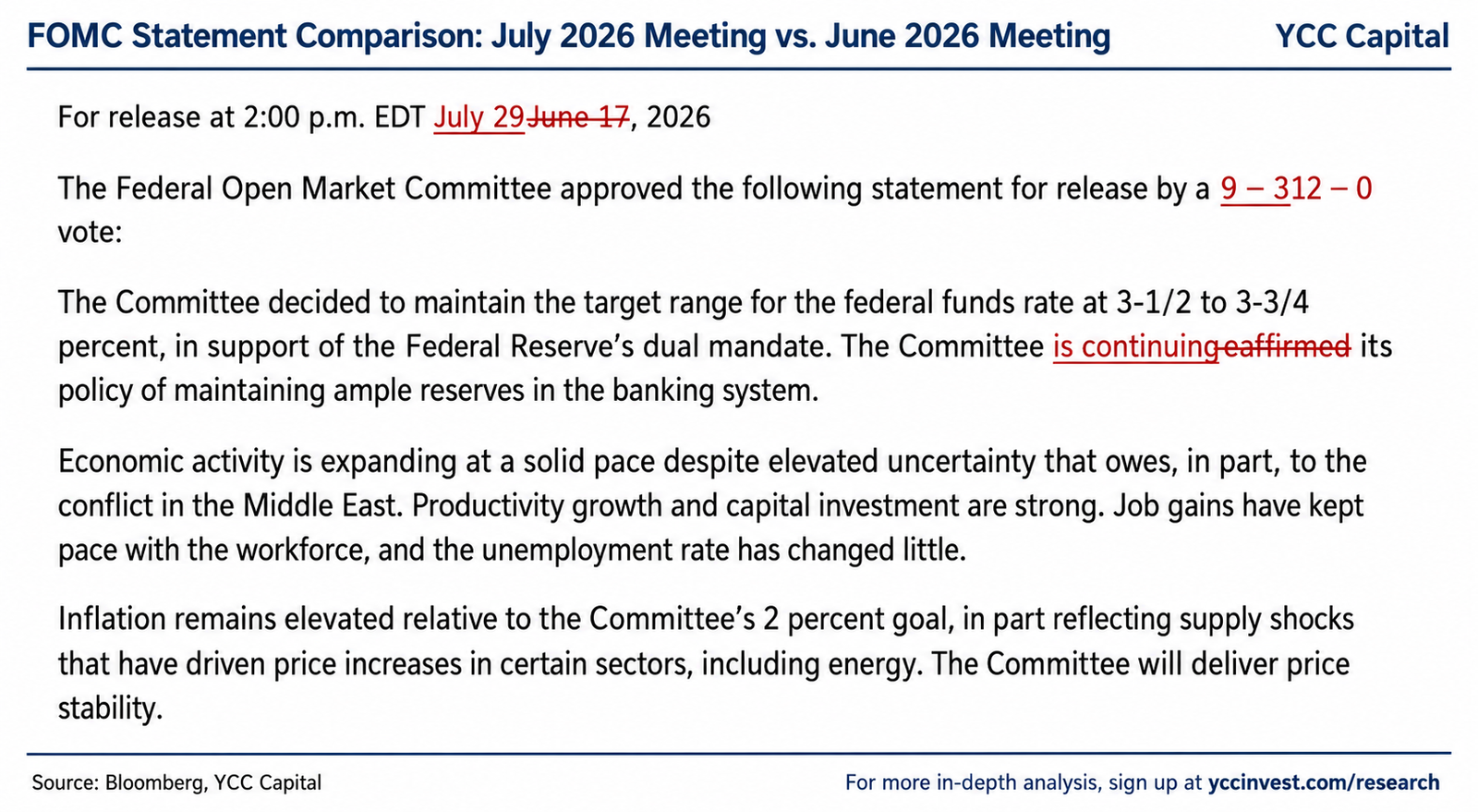
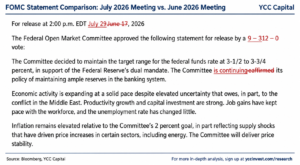
The Federal Reserve voted 9-3 to keep the federal funds target range unchanged at 3.50%-3.75%, marking the first significant internal division within the voting committee in recent meetings. Rather than representing policy uncertainty, the split vote served as a deliberate communication tool, highlighting growing hawkish sentiment inside the Federal Open Market Committee.
Compared with the June meeting, the official statement changed very little. Policymakers continued to describe the U.S. economy as expanding at a solid pace despite elevated uncertainty stemming from Middle East tensions. Strong productivity growth, resilient capital investment, and stable labor market conditions remained central elements of the Fed’s assessment.
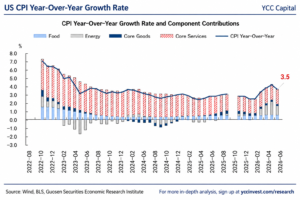
Inflation language likewise remained largely unchanged. The Committee reiterated that inflation continues to exceed its 2% objective, partly reflecting supply disruptions that have pushed prices higher in several industries, particularly energy.
The most meaningful shift therefore came not from the wording of the statement, but from the voting pattern itself. Three dissenting votes against holding rates effectively communicated that a meaningful bloc within the Committee believes additional tightening may soon become necessary.
This represents a notably different signaling strategy than a conventional rate increase. Instead of immediately tightening financial conditions through higher policy rates, the Fed tightened expectations while preserving optionality.
Warsh Sends an Unmistakably Hawkish Message
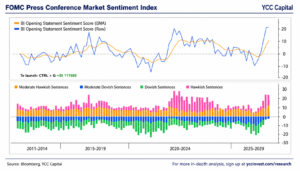
Chair Kevin Warsh reinforced this message during the post-meeting press conference.
First, he repeatedly emphasized that the Federal Reserve’s 2% inflation target leaves no room for flexibility. Temporary improvements in monthly inflation data are insufficient to alter the Committee’s broader assessment. According to Warsh, inflation has remained above target for more than five years, making a durable return to price stability the overwhelming priority.
Second, Warsh continued reducing the importance of forward guidance. He argued that outside crisis periods, the Federal Reserve should refrain from excessively steering market expectations and instead allow financial markets to interpret incoming economic information independently. This represents an important philosophical shift toward a more market-driven pricing environment.
Third, he forcefully defended the Fed’s institutional independence, reiterating that monetary policy would not be influenced by political pressure, financial market volatility, or external commentary.
Finally, Warsh highlighted an emerging source of uncertainty rarely emphasized in previous meetings: artificial intelligence investment. Massive corporate spending on memory chips, logic semiconductors, and AI infrastructure could eventually reshape aggregate supply. At the same time, policymakers remain uncertain whether this investment boom will alleviate inflation through productivity gains or instead create new inflationary pressures across broader sectors of the economy.
Markets Receive Mixed Signals
Financial markets reacted in a nuanced fashion following the announcement.
Short-term Treasury yields retreated modestly as investors concluded that an immediate rate hike had been avoided. Longer-dated Treasury yields, however, moved higher, reflecting persistent inflation concerns and uncertainty regarding the longer-term policy outlook.
Gold prices strengthened despite the hawkish rhetoric, suggesting investors increasingly view geopolitical uncertainty and inflation risks as offsetting forces against higher interest rates.
U.S. equities remained under pressure, while the U.S. dollar weakened noticeably following the meeting.
At first glance, these moves appear contradictory. Yet they reveal a market attempting to reconcile two competing narratives.
On one hand, the Federal Reserve remains committed to restrictive monetary policy. On the other hand, persistent geopolitical risks and higher energy prices may eventually slow economic activity enough to limit how far real interest rates can continue rising.
Much like a driver climbing a steep mountain road, the Fed continues pressing the accelerator, but investors are increasingly questioning how much further the engine can realistically go before gravity begins working in the opposite direction.
Three Macro Variables Will Shape the Next Two Months
1. Middle East Geopolitics Remains the Primary Inflation Wildcard
The evolution of U.S.-Iran negotiations and the security of shipping through the Strait of Hormuz remain critical.
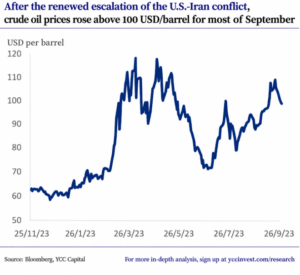
Oil prices rebounded sharply during July following renewed disruptions and heightened uncertainty surrounding regional maritime security. Although President Trump later signaled renewed willingness to return to negotiations, the durability of any ceasefire remains uncertain.
Should shipping disruptions persist while global inventories remain relatively tight, energy prices could transmit inflationary pressure much more aggressively than during the second quarter.
For the Federal Reserve, this creates a difficult policy dilemma. Higher inflation expectations driven by oil may prevent real yields from rising substantially further while simultaneously delaying any eventual policy easing.
2. Real Interest Rates Have Become the Market’s Most Important Indicator
Since May and June, the Fed’s increasingly hawkish framework has supported a stronger U.S. dollar and tighter global financial conditions.
Looking ahead, however, sustained increases in oil prices may begin lifting inflation expectations faster than nominal yields can rise.
If that occurs, real interest rates could face increasing upward resistance.
This distinction matters enormously because real yields—not nominal rates—represent the true discount rate for financial assets.
A stabilization or decline in real yields would significantly improve conditions for equities, precious metals, and other duration-sensitive assets, even if nominal policy rates remain elevated.
3. China’s Policy Response Remains an Important External Variable
China’s second-quarter GDP growth slowed to approximately 4.3%, falling below the lower end of the government’s annual target range.
While authorities have focused primarily on incremental policy optimization and longer-term structural adjustments, markets are increasingly looking for more meaningful fiscal support entering August.
At YCC Capital, we remain cautious on China’s medium-term outlook. Structural headwinds—including weak domestic demand, property-sector adjustment, and uneven private-sector confidence—continue to constrain sustainable growth. Even if additional policy easing emerges, it is likely to cushion the slowdown rather than fundamentally alter the underlying trajectory.
Consequently, improvements in Chinese risk sentiment remain highly dependent on stabilization in the external geopolitical environment.
Two Possible Market Paths
The coming months are likely to be defined by the interaction between geopolitical shocks and technology-driven productivity improvements.
We see two broad scenarios.
Scenario One: Geopolitical Risks Ease
If tensions in the Middle East gradually subside, oil prices stabilize, and inflation expectations moderate, markets could begin pricing the peak of the Fed’s tightening cycle.
Under this outcome, real yields would gradually decline, supporting a transition toward broader risk-on positioning.
Equities, particularly cyclical sectors, would likely benefit alongside improving liquidity conditions.
Scenario Two: Geopolitical Risks Persist
If shipping disruptions continue and energy prices remain elevated, markets may first experience another phase of deleveraging.
Technology-related optimism alone would struggle to offset tightening financial conditions, while risk assets could experience another meaningful correction before eventual stabilization.
Only after economic weakness becomes sufficiently evident would markets begin anticipating a less restrictive Federal Reserve.
This represents the more volatile—and arguably more challenging—path.
Investment Implications
Precious Metals
Downside risk for precious metals appears increasingly limited. Although additional Fed hawkishness could temporarily pressure gold if nominal yields continue rising, slowing increases in real yields create a more constructive medium-term backdrop.
Option-based bull call spreads or long positions protected with downside puts offer attractive asymmetric exposure.
Energy
Oil prices are likely to remain elevated even if volatility increases.
While governments have incentives to prevent a full-scale energy crisis, shipping disruptions and unresolved geopolitical tensions suggest that significant downside in crude prices may remain limited over the near term.
China-Linked Assets
Domestic Chinese assets continue trading within narrow ranges, supported by higher energy costs but constrained by weak underlying economic fundamentals.
More decisive policy support would likely be required before a sustained improvement in investor sentiment can develop.
Global Equities
Technology remains the market’s long-term structural growth engine, but investors should avoid assuming that every AI-related correction automatically presents a buying opportunity.
Until liquidity conditions improve and cost pressures begin easing simultaneously, a balanced allocation between quality growth and defensive value remains preferable.
Patience is often an underrated investment strategy. Just as experienced sailors wait for favorable tides instead of fighting the current, investors may benefit from allowing macro conditions to align before aggressively increasing risk exposure.
YCC Capital Strategic View
The July FOMC meeting demonstrated that monetary policy has entered a more sophisticated stage. The Federal Reserve is no longer relying solely on interest-rate adjustments to tighten financial conditions; communication, voting dynamics, and policy philosophy have become equally powerful instruments.
Our central focus therefore shifts from asking whether the Fed will hike again toward asking whether U.S. real interest rates can continue climbing meaningfully from current levels.
That single variable increasingly sits at the intersection of inflation, energy markets, geopolitics, technology investment, and global capital allocation.
For now, the Fed remains hawkish—but the market’s ability to absorb tighter financial conditions may prove to be the more important story.
Sources: Bloomberg, YCC Capital.
Editorial Board
Ken Cao — Chief Strategist, Global Investment Strategy
Le Gao — Managing Analyst
Yui Nabeshima — Strategist
Mai Ikeda — Research Analyst
IMPORTANT DISCLAIMER
This research report is provided for informational and educational purposes only and does not constitute an offer to sell or a solicitation of an offer to buy any securities, financial instruments, or investment products. It is not intended as investment, legal, accounting, or tax advice and should not be relied upon as such. The views, opinions, and projections expressed herein are those of YCC Capital Management and its research personnel as of the date of publication and are subject to change without notice. Past performance is not indicative of future results.
YCC Capital Management, its affiliates, principals, and employees may hold long or short positions in securities or instruments discussed in this report and may trade for their own accounts or for client accounts in a manner inconsistent with the recommendations herein. This report is based on publicly available information and data believed to be reliable, but YCC Capital makes no representation or warranty, express or implied, as to the accuracy, completeness, or timeliness of such information. Forward-looking statements involve risks and uncertainties that could cause actual results to differ materially from those projected.
Recipients of this report should conduct their own independent due diligence and consult with their own financial, legal, and tax advisors before making any investment decisions. YCC Capital accepts no liability for any loss or damage arising from the use of or reliance on this report or its contents.
This report is intended solely for the use of the intended recipient(s) and may not be reproduced or redistributed for commercial purposes without the prior written consent of YCC Capital. © 2026 YCC Capital. All rights reserved. YCC Capital’s flagship vehicle, the YCC International Value Fund, LP, maintains a concentrated global macro value strategy with a focus on capital-flow-driven mispricings and asymmetric hedging opportunities. The Fund is registered in the State of Delaware, U.S. and structured as a 506(c) fund. Performance data, where referenced, has been verified by independent third parties including NAV Consulting; however, individual investor results may vary.
Contact Us
YCC Capital Research
Email: ir@yccinvest.com
Sign up for our free daily market insights at www.yccinvest.com.
YCC Capital Research | Sign up for free daily market insight at www.yccinvest.com
For more related research:
Oil, Rates, and Risk: Why the Middle East Shock Is Repricing Global Fixed Income
Trump’s Political Playbook: Winning Abroad to Stabilize at Home
The Dual Nature of Interest Rates: Why U.S. Treasury Yields Are Entering a Higher-for-Longer Regime