YCC CAPITAL
U.S. Bond Strategy
July 16, 2026
Executive Perspective
Financial markets often resemble a crowded theater wh
ere
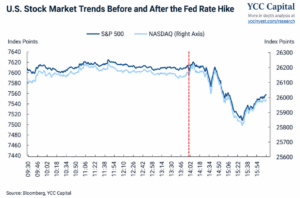
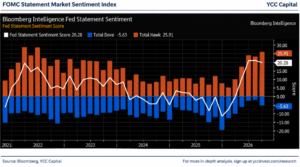
the greatest danger emerges not when the fire starts, but when everyone rushes toward the same exit simultaneously. Over the past month, investors collectively sprinted toward one conclusion: the Federal Reserve might be forced to resume tightening in 2026. Hawkish messaging following the June FOMC meeting, coupled with persistent geopolitical uncertainty and resilient economic growth, reignited concerns that inflation would once again escape policymakers’ control.
June’s CPI report tells a different story.
While inflation remains well above the Federal Reserve’s
long-term objective, the latest data suggest that the underlying inflation engine is gradually losing momentum. Headline inflation surprised to the downside, core inflation softened more meaningfully than expected, and perhaps most importantly, the broad-based moderation across goods and services points to weakening domestic pricing pressure rather than a one-off statistical anomaly.
For investors, this distinction matters enormously. Temporary disinflation driven solely by falling gasoline prices rarely changes monetary policy. Broad-based cooling across multiple inflation categories often does.
Our base case therefore remains that the Federal Reserve is increasingly likely to remain on hold throughout 2026, with any further rate increases more likely postponed until 2027 should economic growth continue outperforming expectations. Markets may gradually begin unwinding the aggressive tightening expectations that developed after June’s FOMC meeting, allowing Treasury markets to stabi
lize despite ongoing geopolitical volatility.
Inflation Cools More Than Expected
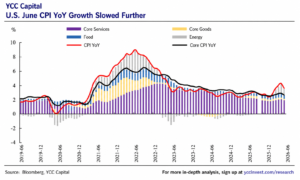
The June inflation report delivered a welcome surprise.
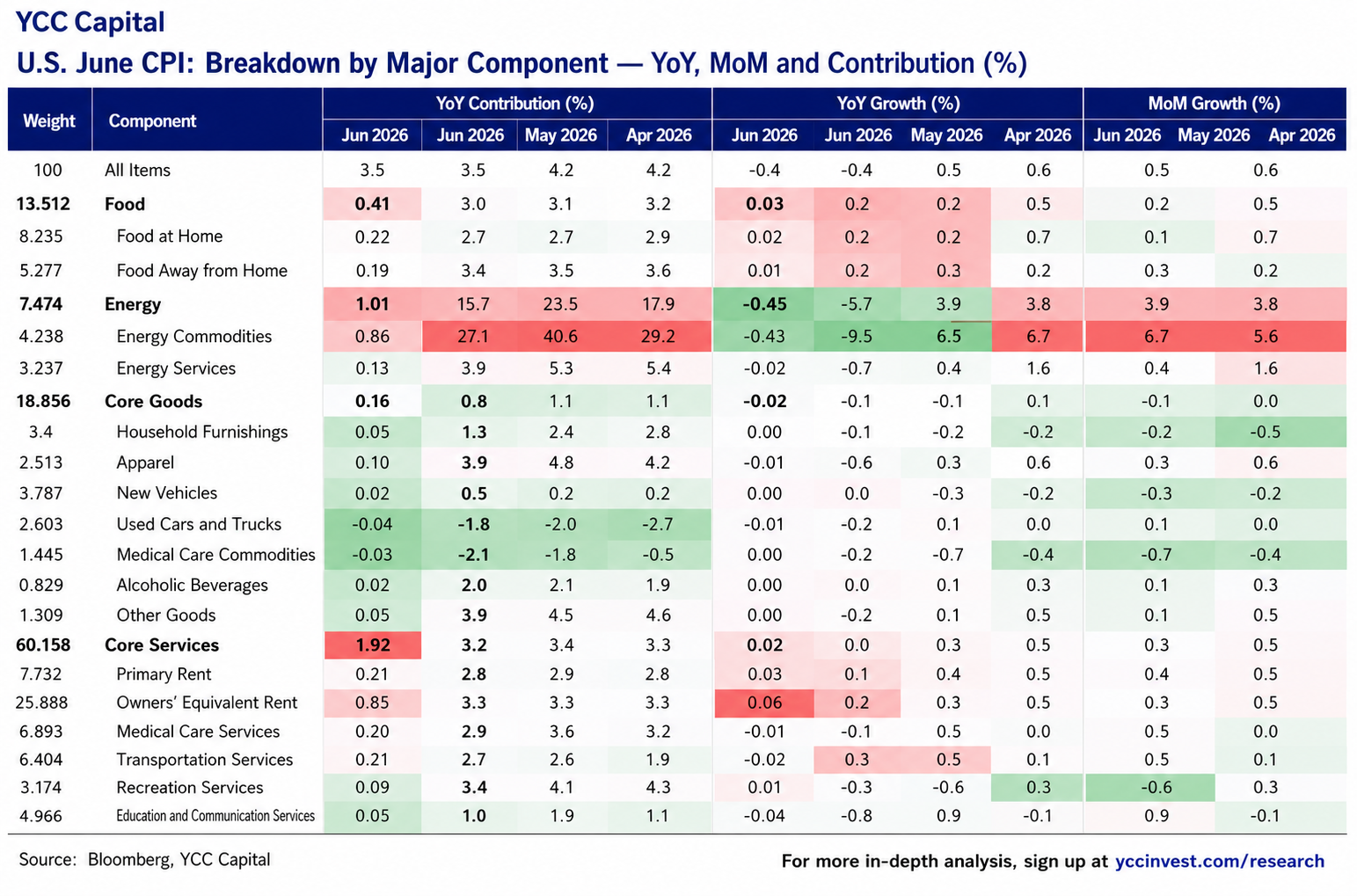
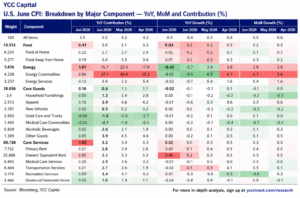
Headline Consumer Price Index inflation slowed to 3.5% year-over-year, substantially below market expectations and down from 4.2% in May. On a monthly basis, CPI declined 0.4%, reversing the positive monthly increases recorded in previous months.
Even more encouraging was the behavior of core inflation. Core CPI eased to 2.6% year-over-year, down from 2.9%, while monthly core inflation was essentially flat.
This represents the first meaningful moderation in both headline and core inflation since March, suggesting that inflationary pressures are becoming increasingly less entrenched.
Several factors contributed to the improvement.
First, favorable base effects from mid-2025 mechanically reduced year-over-year inflation readings. While statistical effects alone should never be interpreted as genuine disinflation, they nevertheless create a more favorable backdrop over the coming months.
Second, and more importantly, energy prices fell sharply throughout June. Gasoline prices declined by more than 10% during the month, exerting substantial downward pressure on headline inflation.
Finally—and arguably most significant—the underlying momentum of core inflation weakened noticeably, indicating that domestic inflation pressures are gradually losing steam independent of energy markets.
Inflation is no longer cooling solely because oil prices temporarily declined. It is cooling because pricing power across large portions of the U.S. economy is becoming increasingly constrained.
That distinction fundamentally changes the monetary policy outlook.
Energy Remains the Largest Swing Factor
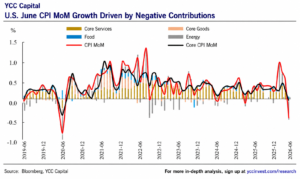
Energy provided the largest contribution to June’s disinflation.
Energy inflation slowed to 15.7% year-over-year, nearly eight percentage points lower than May’s pace. Gasoline inflation decelerated particularly sharply, while fuel oil prices also moderated significantly.
Retail gasoline prices fell from approximately $4.14 per gallon at the beginning of June to roughly $3.70 by month-end, creating an unusually powerful drag on monthly CPI.
Food inflation, meanwhile, continued its gradual moderation.
Overall food prices increased 3.0% year-over-year, only slightly below May’s reading, while grocery inflation remained relatively stable.
Looking ahead, however, this favorable energy story may not persist indefinitely.
Geopolitical developments surrounding Iran and the Strait of Hormuz continue introducing considerable upside risks to global oil markets. Renewed military confrontations have already disrupted shipping activity through one of the world’s most strategically important energy corridors.
Even if outright military escalation is avoided, elevated geopolitical risk premiums are likely to keep crude oil prices trading near higher equilibrium levels than markets anticipated only weeks ago.
Agricultural commodities also deserve attention. USDA projections continue pointing toward tighter grain markets due to stronger global demand alongside softer production for several major crops.
Consequently, food and energy are likely to become sources of inflation resilience rather than outright disinflation over coming quarters.
Core Inflation Is Quietly Improving
If headline inflation attracted most of the media attention, core inflation deserves far greater attention from policymakers.
Core goods inflation softened meaningfully across several major categories.
Used vehicle prices resumed declining despite temporary fluctuations in wholesale auction prices. New vehicle prices remained broadly stable as easing supply chain pressures limited manufacturers’ pricing power.
Medical goods inflation also weakened, while household furnishings and apparel showed slower price increases than earlier in the year.
Perhaps even more encouraging was the moderation in core services.
Core services inflation eased to approximately 3.2%, with housing inflation continuing its slow but persistent descent.
Shelter remains the single largest contributor to overall inflation, yet rental indicators suggest further moderation is likely during the second half of the year. Forward-looking private-sector measures such as Zillow rental indices continue pointing toward softer rent growth, implying additional downside pressure on official shelter inflation over coming months.
Transportation services, medical services, recreation, and communications all contributed to broader cooling across the services sector.
Taken together, June’s report demonstrates that inflation moderation is becoming increasingly broad-based rather than narrowly concentrated.
This is precisely the pattern Federal Reserve officials have been waiting to observe.
The Super Core Measure Sends an Even Stronger Signal
Federal Reserve officials increasingly emphasize “super core” inflation—core services excluding housing—as one of the best gauges of domestically generated inflation pressure.
June’s data showed particularly encouraging progress.
Super core inflation slowed to approximately 3.17% year-over-year, while monthly increases turned negative.
Unlike gasoline prices, which can fluctuate dramatically because of geopolitical events, super core inflation largely reflects domestic labor costs, service-sector demand, and wage-driven pricing behavior.
Its moderation therefore carries considerably greater policy significance.
The weakening of super core inflation suggests that demand across the U.S. economy is gradually becoming more balanced without requiring a significant deterioration in employment conditions.
This represents something policymakers have been attempting to engineer for several years—a gradual cooling of inflation without triggering recession.
While success is far from guaranteed, June’s report offers evidence that progress continues.
Inflation Is Falling—But the Journey Will Not Be Smooth
Disinflation rarely follows a straight line.
Although underlying inflation momentum is weakening, several structural forces continue preventing inflation from returning rapidly to the Federal Reserve’s 2% objective.
The first challenge remains geopolitics.
Renewed instability involving Iran continues threatening maritime traffic through the Strait of Hormuz. Shipping volumes have already fallen sharply following renewed military confrontations.
Should disruptions persist, global energy prices could once again rise toward $80 per barrel, reversing part of June’s energy-driven disinflation.
The second challenge is investment-led demand.
America’s largest technology companies continue deploying hundreds of billions of dollars toward artificial intelligence infrastructure, cloud computing facilities, semiconductor manufacturing, and electricity generation.
Unlike previous investment cycles driven primarily by financial engineering, today’s capital spending directly expands productive capacity while simultaneously generating strong labor demand.
Construction workers, electrical engineers, data center specialists, equipment manufacturers, and semiconductor suppliers all experience sustained demand growth.
The result is an economy that remains remarkably resilient despite restrictive monetary policy.
In many respects, this resembles renovating a house while simultaneously trying to lower the indoor temperature. Even if the air conditioning improves, the construction activity itself continues generating heat.
Investment strength therefore remains one of the most important reasons inflation may decline only gradually rather than collapse rapidly.
Why Markets May Be Overestimating 2026 Tightening Risks
Following the June FOMC meeting, markets increasingly priced the possibility of multiple rate hikes during 2026.
Those concerns were understandable.
The Federal Reserve’s updated dot plot appeared more hawkish, while Chair Kevin Warsh emphasized a policy of “zero tolerance” toward persistently elevated inflation.
However, June’s CPI report substantially weakens the case for imminent tightening.
Headline inflation surprised lower.
Core inflation surprised lower.
Super core inflation surprised lower.
When viewed collectively, these developments reinforce the argument for policy patience rather than renewed tightening.
Federal Reserve officials have repeatedly indicated that sustainable progress in core inflation carries greater weight than temporary fluctuations in headline prices.
June’s report moves policy in exactly that direction.
Furthermore, institutional developments inside the Federal Reserve deserve equal attention.
Several internal policy review working groups remain engaged in evaluating aspects of monetary policy strategy, communications, and framework design. Until these reviews conclude, policymakers are likely to prefer maintaining policy stability unless inflation unexpectedly accelerates again.
Accordingly, our central scenario remains unchanged.
The Federal Reserve is likely to leave policy rates unchanged throughout most, if not all, of 2026.
Should additional tightening eventually become necessary, 2027 appears considerably more plausible than late 2026.
Market Implications
For fixed income investors, June’s CPI report provides an important shift in the macro narrative.
Treasury yields may continue experiencing short-term volatility as oil prices fluctuate with geopolitical headlines.
However, the probability of a sustained repricing toward significantly higher terminal policy rates has diminished.
Intermediate-duration Treasuries appear increasingly attractive should incoming inflation data continue confirming broad-based moderation.
Credit markets should also benefit from a prolonged pause, provided economic growth remains sufficiently resilient to prevent a meaningful deterioration in corporate earnings.
Equity markets face a more nuanced outlook.
Persistent investment in artificial intelligence infrastructure continues supporting U.S. earnings growth, particularly among technology and industrial leaders. At the same time, a less aggressive Federal Reserve reduces valuation pressure across growth sectors.
The result is an environment where macro uncertainty remains elevated but systemic tightening risks gradually diminish.
YCC Capital Strategic View
Markets frequently confuse slower inflation with defeated inflation.
They are not the same.
Inflation remains above target, geopolitical risks remain elevated, and structural investment trends continue supporting nominal growth. Investors should therefore avoid assuming that interest rates will quickly return to the ultra-low environment that characterized much of the previous decade.
Nevertheless, June’s CPI report marks an important psychological turning point.
The dominant question is no longer whether inflation is accelerating once again.
Instead, investors are increasingly asking how quickly inflation can continue slowing without materially damaging economic growth.
That is a far healthier debate.
Our base case continues to favor a prolonged Federal Reserve pause throughout 2026, with policy remaining restrictive but increasingly predictable. Unless inflation unexpectedly reaccelerates or geopolitical shocks produce sustained commodity price spikes, fears of imminent Fed tightening are likely to fade over coming months.
For investors, the era of constant upward revisions to rate expectations may finally be giving way to a period of greater policy stability—a development that should ultimately prove supportive for both fixed income markets and broader financial conditions.
Key Risks to Our View
No macroeconomic outlook should be interpreted as a deterministic forecast. While the June inflation report materially improves the outlook for price stability, several risks could still derail the disinflation process and force the Federal Reserve to reconsider its policy stance.
The most immediate threat remains geopolitical. Escalation in the Middle East has already demonstrated how quickly global energy markets can reprice when supply routes are disrupted. Should military conflict broaden or shipping through the Strait of Hormuz remain impaired for an extended period, crude oil prices could move decisively above current assumptions, spilling over into transportation costs, manufacturing inputs, and ultimately consumer prices.
A second risk is that the U.S. economy continues to outperform expectations. Household balance sheets remain comparatively healthy, corporate investment—particularly in artificial intelligence infrastructure—shows little sign of slowing, and labor demand has proven remarkably resilient despite restrictive monetary policy. If productivity gains fail to keep pace with investment-driven demand, wage growth could stabilize at levels inconsistent with achieving the Federal Reserve’s inflation objective.
There is also the possibility that shelter inflation proves stickier than expected. Although private-sector rental indicators continue pointing toward moderation, official CPI shelter measures historically adjust with considerable lag. If housing inflation declines more slowly than anticipated, progress in overall core inflation could stall even as other categories continue improving.
Finally, financial markets themselves represent an important transmission mechanism. A premature easing in financial conditions—through lower bond yields, tighter credit spreads, or renewed speculative activity—could stimulate demand sufficiently to slow the disinflation process, forcing policymakers to maintain restrictive policy for longer than investors currently anticipate.
While these risks deserve careful monitoring, none presently appear sufficiently large to overturn our central expectation that inflation is gradually moving onto a more sustainable downward trajectory.
Investment Implications
Fixed Income
For Treasury investors, the June CPI report strengthens the case for extending duration selectively. The probability of an immediate policy tightening cycle has declined meaningfully, reducing upside risks to intermediate and long-term yields. While geopolitical developments are likely to produce periodic volatility, we believe such episodes increasingly represent tactical opportunities rather than structural threats.
Investment-grade credit should also remain supported by resilient corporate fundamentals and a stable monetary policy environment. Credit spreads may experience temporary widening during periods of geopolitical stress, but the absence of renewed Fed tightening reduces the probability of a broad deterioration in financial conditions.
U.S. Equities
For equity investors, a prolonged policy pause creates a constructive backdrop, particularly for sectors benefiting from secular investment trends rather than cyclical leverage.
Artificial intelligence infrastructure, semiconductor capital expenditure, power generation, industrial automation, cybersecurity, and software remain beneficiaries of one of the largest corporate investment cycles in decades. These industries continue enjoying structural demand that appears largely independent of short-term fluctuations in interest rates.
At the same time, lower policy uncertainty should provide modest support for equity valuations, especially among companies whose cash flows extend well into the future.
This does not imply that equity markets are without risk. Valuations remain elevated across portions of the technology sector, requiring continued earnings delivery to justify current pricing. Nevertheless, an extended Federal Reserve pause materially improves the macro backdrop compared with scenarios involving additional tightening.
U.S. Dollar
The U.S. dollar may gradually relinquish some of the extraordinary strength generated by aggressive monetary tightening over recent years. However, expectations of a sharp structural depreciation appear premature.
Relative economic performance continues favor the United States over most developed economies. Europe faces weak productivity growth and structural fiscal constraints, while China’s economy continues grappling with persistent property-sector weakness, subdued private-sector confidence, and increasingly limited policy effectiveness. Against this global backdrop, the U.S. dollar should remain supported by comparatively stronger growth, deep capital markets, and continued global demand for dollar-denominated assets.
Global Asset Allocation
From a broader asset allocation perspective, investors should distinguish between peak inflation and low inflation.
June’s CPI report strongly suggests that inflation has already peaked for this cycle. It does not suggest that inflation is returning to the exceptionally subdued environment that characterized much of the 2010s.
Accordingly, portfolios should continue emphasizing high-quality fixed income, globally competitive U.S. equities, and selective real assets capable of providing resilience against periodic commodity price shocks.
Conclusion
The June CPI report is unlikely to be remembered simply because inflation declined.
Rather, it may ultimately prove significant because it changed the direction of the policy conversation.
Only weeks ago, financial markets were debating how many times the Federal Reserve might need to raise interest rates in 2026. Following the latest inflation data, the discussion has shifted toward how long policymakers can comfortably remain on hold.
That is a meaningful transition.
The broad-based moderation across headline inflation, core inflation, and super core services suggests that price pressures are gradually becoming less embedded within the U.S. economy. While geopolitical tensions and sustained investment activity will likely prevent inflation from falling in a straight line, the overall trajectory increasingly points toward moderation rather than renewed acceleration.
For policymakers, patience is becoming a more credible strategy than preemptive tightening.
For investors, this implies a macro environment characterized by fewer policy surprises, greater interest-rate stability, and a more favorable backdrop for high-quality fixed income assets.
At YCC Capital, we continue to believe that the Federal Reserve’s most likely course through the remainder of 2026 is to maintain current policy settings while monitoring incoming inflation data and labor market conditions. Unless inflation unexpectedly reaccelerates or a major geopolitical shock materially alters the inflation outlook, the market’s fears of another tightening cycle should continue to recede.
History often shows that markets spend more time preparing for the last inflation scare than recognizing the next disinflation trend. June’s CPI report may ultimately represent one of those pivotal moments where the prevailing narrative begins to shift—not dramatically overnight, but steadily enough that investors who recognize the change early are positioned to benefit before consensus catches up.
Editorial Board
Ken Cao
Chief Strategist, Global Investment Strategy
Le Gao
Managing Analyst
Yui Nabeshima
Strategist
Mai Ikeda
Research Analyst
IMPORTANT DISCLAIMER
This research report is provided for informational and educational purposes only and does not constitute an offer to sell or a solicitation of an offer to buy any securities, financial instruments, or investment products. It is not intended as investment, legal, accounting, or tax advice and should not be relied upon as such. The views, opinions, and projections expressed herein are those of YCC Capital Management and its research personnel as of the date of publication and are subject to change without notice. Past performance is not indicative of future results.
YCC Capital Management, its affiliates, principals, and employees may hold long or short positions in securities or instruments discussed in this report and may trade for their own accounts or for client accounts in a manner inconsistent with the recommendations herein. This report is based on publicly available information and data believed to be reliable, but YCC Capital makes no representation or warranty, express or implied, as to the accuracy, completeness, or timeliness of such information. Forward-looking statements involve risks and uncertainties that could cause actual results to differ materially from those projected.
Recipients of this report should conduct their own independent due diligence and consult with their own financial, legal, and tax advisors before making any investment decisions. YCC Capital accepts no liability for any loss or damage arising from the use of or reliance on this report or its contents.
This report is intended solely for the use of the intended recipient(s) and may not be reproduced or redistributed for commercial purposes without the prior written consent of YCC Capital. © 2026 YCC Capital. All rights reserved. YCC Capital’s flagship vehicle, the YCC International Value Fund, LP, maintains a concentrated global macro value strategy with a focus on capital-flow-driven mispricings and asymmetric hedging opportunities. The Fund is registered in the State of Delaware, U.S. and structured as a 506(c) fund. Performance data, where referenced, has been verified by independent third parties including NAV Consulting; however, individual investor results may vary.
Contact Us
YCC Capital Research
Email: ir@yccinvest.com
Sign up for our free daily macro and market insights at:
YCC Capital Research | Sign up for free daily market insight at www.yccinvest.com
For more related research:
Trump’s Political Playbook: Winning Abroad to Stabilize at Home
Oil, Rates, and Risk: Why the Middle East Shock Is Repricing Global Fixed Income
When the Tide Recedes: Why the U.S. Dollar Is Entering a New Era of Two-Way Risk
Has Peak Hawkishness Arrived? Why the Fed’s Toughest Message May Also Mark the Turning Point