YCC CAPITAL
U.S. Bond Strategy
July 21, 2026
Executive Summary
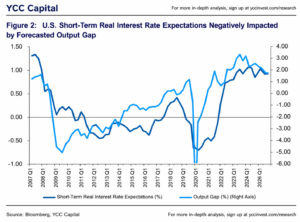
For decades, investors have searched for a single variable capable of explaining the direction of U.S. Treasury yields. Inflation expectations, Federal Reserve policy, fiscal deficits, demographic shifts, productivity growth, and global savings have each taken turns occupying center stage. Yet each framework eventually proves incomplete because interest rates themselves possess two distinct dimensions. They respond not only to the level of economic activity but also to the speed at which that activity is changing.
This report introduces what we describe as the Duality of Interest Rates—a framework that distinguishes between the economy’s position within the business cycle and the economy’s underlying momentum. The interaction between these two forces explains why Treasury yields often behave in ways that appear contradictory under conventional models.
At YCC Capital, we believe investors frequently make the mistake of comparing variables that belong to different economic dimensions. Economic growth is compared with unemployment, GDP with equity prices, or inflation with market returns, even though these variables evolve on different orders of change. Once this distinction is recognized, much of the apparent inconsistency in bond markets becomes considerably easier to understand.
Our framework decomposes long-term Treasury yields into four underlying components:
- Expected future real short-term interest rates
- Inflation expectations
- Real term premium
- Inflation risk premium
The first two are primarily determined by the output gap—the economy’s position relative to potential output—while the latter two are influenced simultaneously by both the output gap and changes in economic momentum. This distinction helps explain why long-term Treasury yields can continue rising even when inflation moderates or why yields sometimes decline despite surprisingly resilient economic data.
Looking ahead, we believe the United States remains in an expansionary phase characterized by positive output gaps, resilient economic momentum, persistent fiscal support, and structurally higher capital investment driven by artificial intelligence. Under these conditions, short-term rates are likely to remain elevated while long-term yields continue to face upward pressure through higher term premiums.
Our base case therefore remains one of higher-for-longer Treasury yields, accompanied by a steeper yield curve as markets gradually reprice structural inflation risks and fiscal sustainability.
For investors, this environment requires a shift in mindset. The era when every growth slowdown automatically translated into collapsing bond yields is likely ending. Instead, long-duration government bonds increasingly resemble assets whose pricing depends as much on fiscal credibility and macro uncertainty as on monetary policy alone.
YCC Perspective
Anyone who has driven through mountain roads understands that two factors determine the journey. One is altitude. The other is the steepness of the road. A car climbing a gentle incline behaves very differently from one racing uphill even if both are technically at the same elevation.
Financial markets work much the same way.
The output gap represents the economy’s altitude—its structural position relative to potential output. Economic momentum measures how quickly conditions are changing. Markets respond to both simultaneously.
Much of today’s confusion surrounding Treasury yields stems from focusing exclusively on one dimension while ignoring the other. Investors debate whether inflation is cooling or whether growth remains resilient, when the more important question is how both variables interact over time.
This interaction lies at the heart of today’s bond market.
Understanding the Dual Nature of Interest Rates
The conventional approach assumes that long-term interest rates simply reflect inflation expectations and Federal Reserve policy. While intuitive, this explanation fails to capture why Treasury yields often move independently of near-term inflation data or policy expectations.
Instead, we view long-term nominal Treasury yields as consisting of four distinct building blocks:
Long-Term Treasury Yield =
Expected Future Real Short-Term Rates
Expected Inflation
Real Term Premium
Inflation Risk Premium
Each component responds differently to changing macroeconomic conditions.
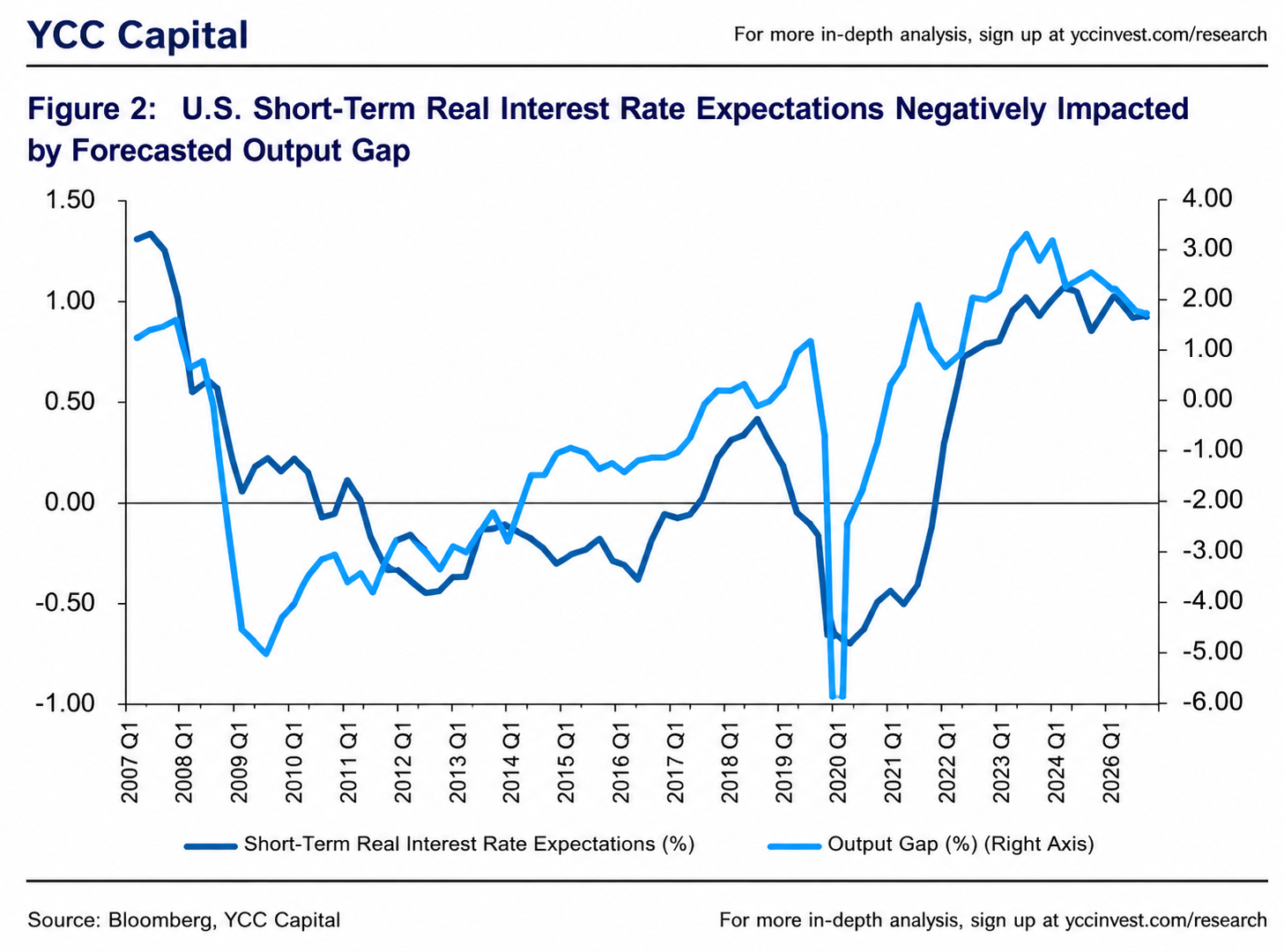
Expected real policy rates largely depend on the business cycle. Inflation expectations also respond primarily to the output gap, although supply shocks can temporarily dominate cyclical forces.
Term premiums, however, behave differently.
Unlike policy expectations, term premiums compensate investors for uncertainty. They reflect changing perceptions regarding fiscal sustainability, liquidity conditions, monetary policy credibility, geopolitical risks, and future macroeconomic volatility.
Consequently, term premiums fluctuate not only because the economy expands or contracts but also because investors become more or less uncertain about the future.
This distinction is central to understanding why Treasury yields sometimes rise during periods when inflation itself appears to be easing.
First-Order and Second-Order Economics
The output gap and economic growth describe different dimensions of the economy.
The output gap is fundamentally a level variable. It determines unemployment, inflation pressure, and monetary policy stance.
Growth, by contrast, measures acceleration or deceleration. It explains corporate earnings growth, equity performance, credit expansion, and shifts in investor sentiment.
Confusing these variables often produces misleading conclusions.
For example, investors frequently compare GDP growth directly with unemployment. Yet unemployment responds primarily to the output gap rather than growth itself.
Similarly, equity prices generally react not to GDP levels but to changes in growth momentum and earnings acceleration.
Interest rates occupy a unique position because they respond to both dimensions simultaneously.
They therefore possess what we call first-order and second-order characteristics.
The first-order component reflects where the economy currently stands.
The second-order component reflects where investors believe the economy is heading.
Both matter.
The Four Drivers of Treasury Yields
Expected Real Short-Term Interest Rates
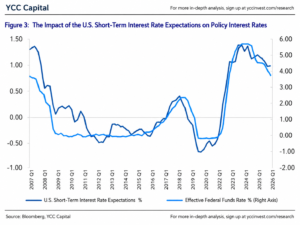
The first component of Treasury yields reflects expected future Federal Reserve policy.
In the long run, equilibrium real interest rates depend on demographics, productivity, labor-force growth, technological progress, and global savings behavior.
Over shorter horizons, however, policy expectations dominate.
Importantly, Federal Reserve decisions respond primarily to the output gap rather than quarterly fluctuations in GDP growth.
During the early stages of recovery, growth may accelerate sharply while spare capacity remains abundant. Under such conditions, monetary policy generally remains accommodative.
Conversely, late-cycle expansions often feature slowing GDP growth but persistently tight labor markets. Even though momentum weakens, positive output gaps require policy rates to remain restrictive.
Understanding this distinction explains why slowing growth does not necessarily imply imminent rate cuts.
Inflation Expectations
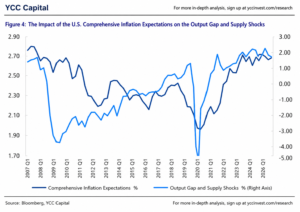
Inflation expectations also depend primarily on the output gap.
As long as actual growth exceeds potential growth, excess demand gradually accumulates throughout the economy, pushing inflation expectations higher.
Supply shocks complicate this relationship.
The disinflationary effects of globalization before the pandemic allowed inflation expectations to remain subdued despite a gradually closing output gap.
Today the opposite dynamic dominates.
Deglobalization, geopolitical fragmentation, reshoring, and supply-chain restructuring have effectively reduced productive capacity while increasing production costs.
These developments resemble a decline in potential output, widening the effective output gap even without exceptionally strong demand.
Consequently, inflation expectations remain more resilient than traditional demand-based models would predict.
Real Term Premium
The real term premium compensates investors for uncertainty extending beyond expected inflation.
Its behavior depends heavily upon fiscal credibility, monetary policy uncertainty, liquidity conditions, and macroeconomic tail risks.
When output gaps remain deeply negative, investors generally expect accommodative policy, reducing uncertainty and compressing term premiums.
As output gaps approach positive territory, however, investors begin reassessing future monetary policy.
This transition often produces significant increases in long-term bond volatility.
Markets simultaneously debate whether central banks will tighten sufficiently, whether inflation has truly stabilized, and whether fiscal authorities can maintain sustainable debt trajectories.
As uncertainty rises, investors demand higher compensation for holding longer-duration assets.
This is one reason why term premiums often increase even before policy rates change.
Interest Rates Across the Business Cycle
One of the strengths of the Duality of Interest Rates framework is that it explains why Treasury yields behave differently even when economic growth appears similar on the surface. Identical GDP growth rates can produce very different yield environments depending on whether the economy is moving toward expansion or toward recession.
The interaction between the output gap and economic momentum creates four distinct phases of the business cycle, each associated with a characteristic pattern across the four interest-rate components.
Phase One: Early Recovery
Recoveries begin long before economies return to full capacity.
Growth accelerates sharply from depressed levels, yet unemployment remains elevated and considerable slack still exists throughout the economy. Businesses begin rehiring, consumers regain confidence, and credit conditions improve, but inflationary pressures remain limited because productive capacity still exceeds demand.
During this phase, inflation expectations gradually recover but remain subdued. The Federal Reserve generally maintains accommodative policy, keeping expected short-term real rates low. Real term premiums also remain compressed because investors view monetary policy as predictable and supportive.
Long-term Treasury yields rise modestly, but the increase is driven primarily by improving growth expectations rather than aggressive policy tightening.
This is often the most favorable environment for risk assets, as improving economic momentum coincides with still-accommodative financial conditions.
Phase Two: Mature Expansion
Eventually, growth remains above potential long enough for spare capacity to disappear.
The output gap turns decisively positive.
Labor markets tighten, wage pressures broaden, and inflation becomes increasingly persistent rather than temporary.
At this stage monetary policy becomes restrictive. Expected real short-term interest rates rise as investors anticipate higher policy rates.
Inflation expectations also remain elevated because demand consistently exceeds productive capacity.
More importantly, uncertainty begins to increase.
Investors must assess not only whether the Federal Reserve will tighten further but also whether policymakers can engineer a soft landing without triggering recession.
This uncertainty pushes both the real term premium and inflation risk premium higher.
Initially, all four components reinforce one another, producing rising Treasury yields across the curve.
Later in the expansion, however, economic momentum begins slowing even though the output gap remains positive.
Corporate executives often experience this before economists recognize it.
Orders continue arriving, factories remain busy, and consumers continue spending, but the pace of improvement gradually slows.
This is similar to climbing a long mountain road. The vehicle is still ascending, yet acceleration begins fading as the incline steepens.
Markets start pricing slower future growth even while inflation remains elevated.
Term premiums frequently stabilize or decline before policy expectations do, producing more complex yield dynamics than conventional models anticipate.
Phase Three: Recession
Recessions begin when growth falls below potential output.
Initially, inflation often remains stubbornly high because positive output gaps have not yet fully disappeared.
This creates one of the most difficult environments for monetary policymakers.
Growth deteriorates while inflation remains uncomfortable.
Eventually unemployment rises, excess demand fades, and inflation pressures begin easing.
Once markets become convinced that monetary tightening has ended, expectations for future policy rates decline rapidly.
At the same time, reduced policy uncertainty compresses term premiums.
Provided the financial system remains stable, long-term Treasury yields fall as both expected real rates and inflation expectations decline simultaneously.
Historically, this phase has generated the strongest returns for duration-sensitive fixed income portfolios.
Phase Four: Economic Contraction
Deep contractions represent the mirror image of mature expansions.
Output gaps become significantly negative.
Inflation risks largely disappear.
Central banks adopt aggressively accommodative policies.
Expected real policy rates decline toward equilibrium while inflation expectations remain subdued.
Initially, term premiums also remain compressed because markets expect prolonged monetary accommodation.
Toward the end of the downturn, however, growth momentum gradually improves even while output gaps remain negative.
Investors begin anticipating recovery.
Term premiums start increasing before policy rates move.
Long-term Treasury yields therefore often bottom well before economic data visibly improve.
Bond markets typically lead economic recoveries rather than follow them.
A Framework for Understanding Treasury Volatility
Traditional macroeconomic models often assume that Treasury yields respond smoothly to changing economic conditions.
Reality is considerably less orderly.
The most volatile periods usually occur not when the economy is clearly expanding or clearly contracting but when markets struggle to determine which regime lies ahead.
Transitions matter more than destinations.
Whenever the output gap approaches zero, investors must reassess the future path of monetary policy.
Small changes in incoming economic data suddenly carry disproportionate importance because they influence expectations regarding future Federal Reserve decisions.
Consequently, revisions to expected policy rates become larger.
Term premiums also rise because uncertainty regarding inflation, fiscal sustainability, and liquidity conditions simultaneously increases.
These transition periods often generate outsized movements in long-duration Treasuries even when macroeconomic data appear relatively stable.
Understanding these inflection points is critical for institutional portfolio construction.
Outlook for U.S. Treasury Yields
Applying the Duality of Interest Rates framework to today’s U.S. economy produces a relatively clear conclusion.
The United States remains firmly positioned within the expansionary quadrant of the business cycle.
Economic momentum has moderated from the extraordinary post-pandemic rebound but continues to exceed long-term potential growth.
Unlike previous cycles driven primarily by consumer leverage or housing, the current expansion increasingly reflects structural investment.
Fiscal spending remains historically elevated.
Private-sector capital expenditures continue expanding.
Artificial intelligence infrastructure has emerged as one of the largest investment cycles since the commercialization of the internet.
Meanwhile, household balance sheets remain comparatively healthy and credit conditions have stabilized following earlier monetary tightening.
Taken together, these forces continue supporting positive output gaps.
Our base case therefore assumes U.S. real GDP growth remains modestly above potential over the coming 12 to 18 months.
Such an environment naturally produces persistent inflation pressures even if headline inflation gradually moderates.
This distinction is important.
Inflation does not need to accelerate for Treasury yields to remain elevated.
It merely needs to remain sufficiently sticky to prevent a rapid normalization of monetary policy.
From an investment perspective, this creates an environment where front-end Treasury yields are likely to fluctuate around relatively high levels while longer maturities face additional upward pressure from rising term premiums.
Rather than expecting a repeat of the ultra-low-rate era that characterized much of the decade following the Global Financial Crisis, investors should increasingly view nominal Treasury yields as settling into a structurally higher equilibrium.
At YCC Capital, our central scenario therefore remains one of range-bound short-end yields accompanied by gradual steepening at the long end of the Treasury curve.
The driver is not an imminent acceleration in inflation.
Rather, it is the steady repricing of fiscal, policy, and duration risks that investors have historically underappreciated.
Monetary Policy Reform and the Repricing of Term Premiums
While the business cycle remains the dominant force shaping short-term interest-rate expectations, structural changes in the Federal Reserve’s operating framework could increasingly influence the long end of the Treasury market.
In recent decades, quantitative easing, explicit forward guidance, and large-scale asset purchases compressed long-term yields beyond what macroeconomic fundamentals alone would have implied. By becoming one of the largest buyers of Treasury securities, the Federal Reserve effectively reduced the amount of duration risk that private investors needed to absorb.
That era is gradually ending.
The debate surrounding future Federal Reserve leadership increasingly centers on restoring market-based price discovery rather than actively managing long-term interest rates. Policymakers advocating a rules-based framework—including ideas associated with Kevin Warsh—argue that central banks should focus primarily on price stability while allowing markets to determine the appropriate long-term cost of capital.
Whether or not these proposals are adopted in full, the direction of travel matters.
Reduced reliance on forward guidance increases uncertainty surrounding the future policy path. Investors receive fewer explicit signals from policymakers and must instead infer the trajectory of interest rates directly from incoming economic data.
That uncertainty naturally commands compensation.
Likewise, a continued reduction in the Federal Reserve’s balance sheet shifts a greater share of Treasury issuance back to private investors. As official demand declines, the market must absorb additional duration risk without the same degree of central bank support.
The result is not necessarily higher policy rates.
Rather, it is a structurally higher real term premium.
This distinction is frequently overlooked.
A Federal Reserve that intervenes less aggressively in long-duration markets does not automatically become more hawkish. Instead, it simply allows long-term bond yields to reflect fiscal realities, macroeconomic uncertainty, and private-sector risk preferences more accurately.
At YCC Capital, we view this as one of the defining structural changes likely to shape Treasury markets over the remainder of the decade.
Fiscal Policy: The Structural Driver Investors Cannot Ignore
If monetary policy determines the direction of short-term interest rates, fiscal policy increasingly determines the level of long-term yields.
The United States continues operating with historically elevated fiscal deficits despite an economy that remains close to full employment. Traditionally, large deficits were associated with recessions or financial crises. Today they have become a structural feature of the economic landscape.
This matters because Treasury yields reflect not only today’s borrowing needs but also investors’ confidence in future fiscal discipline.
Every additional dollar of government borrowing ultimately requires financing.
When issuance expands persistently, private investors demand greater compensation for absorbing increased duration exposure, particularly if inflation remains above target or if debt sustainability becomes more uncertain.
Unlike cyclical inflation, fiscal risk accumulates gradually.
It resembles rust rather than fire.
A single year’s deficit rarely changes investor psychology, but persistent deficits over many years slowly alter perceptions regarding sovereign creditworthiness, debt sustainability, and the long-run purchasing power of fixed-income assets.
History demonstrates that sovereign bond markets generally tolerate rising debt burdens until they suddenly do not.
Confidence tends to erode gradually before repricing occurs abruptly.
The United States continues benefiting from the unique reserve currency status of the U.S. dollar, deep capital markets, and unparalleled institutional credibility. These advantages should not be underestimated. Nevertheless, reserve currency status is not a substitute for fiscal discipline indefinitely.
Our baseline expectation remains that elevated Treasury issuance, combined with persistent budget deficits, will continue supporting higher real term premiums over the medium term.
Only a credible restoration of fiscal discipline would materially reverse that trend.
Artificial Intelligence and the New Investment Cycle
Artificial intelligence has rapidly become the defining structural investment theme of the current expansion.
Its influence on interest rates, however, is considerably more nuanced than many market participants assume.
The immediate impact of AI is not primarily technological.
It is financial.
The development of large-scale AI systems requires extraordinary levels of capital expenditure across data centers, semiconductor manufacturing, electricity generation, networking infrastructure, cloud computing, and digital storage.
These investments increase demand for capital today.
As businesses compete to build the physical foundations of the AI economy, financing requirements rise throughout the private sector.
Higher capital demand supports higher equilibrium interest rates in the near term.
At the same time, increased investment strengthens economic momentum, reinforcing positive output gaps and limiting the Federal Reserve’s ability to ease policy aggressively.
Yet this is only the first stage of the AI cycle.
Over time, broader adoption should improve total factor productivity rather than merely increasing labor productivity.
As software, automation, machine learning, and intelligent manufacturing diffuse across the economy, firms should produce more output with fewer resources.
This productivity dividend could eventually reduce inflationary pressures while supporting stronger real income growth.
The relationship therefore evolves over time.
Initially, AI is inflationary because investment dominates.
Later, it becomes disinflationary because productivity dominates.
Investors should resist assuming these effects occur simultaneously.
Economic history suggests they rarely do.
The commercialization of electricity, railroads, and the internet each required years of heavy investment before productivity gains became fully visible.
Artificial intelligence is unlikely to prove different.
Could AI Eventually Lower Neutral Interest Rates?
One of the more intriguing long-term questions concerns the neutral rate of interest.
Conventional thinking suggests technological revolutions permanently increase equilibrium interest rates by raising returns on capital.
The historical record is less straightforward.
The information technology revolution beginning in the 1990s dramatically improved corporate profitability, yet equilibrium real interest rates steadily declined over the following decades.
Why?
Because digital businesses ultimately required relatively little physical capital compared with traditional manufacturing industries. Rising market concentration, abundant global savings, and sustained demand for safe assets all contributed to lower neutral rates despite rapid technological progress.
Artificial intelligence could follow a similar path.
Once the current infrastructure build-out reaches maturity, future investment requirements may decline substantially. If AI platforms become increasingly concentrated among a relatively small number of firms with scalable business models, aggregate capital demand may eventually moderate.
Under such a scenario, neutral interest rates could stabilize—or even drift lower—despite significant productivity gains.
This remains a longer-term question rather than an immediate investment theme.
For now, markets remain focused on the capital expenditure phase.
That alone is sufficient to keep upward pressure on Treasury yields.
Deglobalization: The Other Structural Force
If artificial intelligence represents the supply-side opportunity of the decade, deglobalization represents its principal inflationary counterweight.
The globalization era delivered powerful disinflationary forces through lower production costs, efficient international supply chains, and expanding global labor markets.
That environment has fundamentally changed.
Geopolitical competition, strategic industrial policy, supply-chain diversification, export controls, and national security considerations increasingly influence corporate investment decisions.
Efficiency is no longer the sole objective.
Resilience has become equally important.
Resilience, however, is rarely inexpensive.
Duplicating production capacity across multiple jurisdictions raises costs. Maintaining larger inventories ties up working capital. Rebuilding domestic manufacturing requires substantial investment while reducing some of the cost advantages previously generated through globalization.
These developments effectively reduce productive efficiency.
In macroeconomic terms, they resemble adverse supply shocks.
Consequently, inflation expectations remain structurally higher than they otherwise would have been.
They also increase uncertainty surrounding future monetary policy, economic growth, and geopolitical stability.
For bond investors, this has two important implications.
First, inflation risk premiums remain elevated because future inflation becomes more difficult to forecast.
Second, real term premiums also rise because investors require additional compensation for holding long-duration assets in a more uncertain geopolitical environment.
Taken together, artificial intelligence and deglobalization create an unusual combination.
One raises investment demand.
The other constrains productive efficiency.
Both contribute to a structurally higher interest-rate environment than prevailed during much of the post-Global Financial Crisis era.
Strategic Conclusions
Interest rates rarely move for a single reason.
Financial headlines often attribute Treasury market movements to one economic release, one Federal Reserve speech, or one inflation report. While such events undoubtedly influence short-term market sentiment, they rarely explain the broader direction of bond markets over extended periods.
Our research suggests that long-term Treasury yields should instead be viewed through the interaction of two fundamental economic dimensions: the level of economic activity relative to potential output and the speed at which that activity is changing.
This is the essence of the Duality of Interest Rates.
Expected short-term real interest rates and inflation expectations are primarily determined by the business cycle itself. By contrast, real term premiums and inflation risk premiums evolve according to both the business cycle and changes in macroeconomic momentum, reflecting shifting perceptions of uncertainty, fiscal sustainability, liquidity conditions, and policy credibility.
Understanding this distinction helps explain several features of today’s market that appear contradictory under conventional frameworks.
Headline inflation has moderated from its post-pandemic peaks, yet Treasury yields remain elevated.
Economic growth has slowed from extraordinary recovery rates, yet long-duration bonds have struggled to generate sustained rallies.
Federal Reserve policy expectations fluctuate from meeting to meeting, while long-term yields remain remarkably resilient.
These are not inconsistencies.
They are precisely what our framework would predict when positive output gaps coexist with structurally elevated term premiums.
Investment Implications
From a portfolio construction perspective, the implications are significant.
First, investors should avoid assuming that every episode of weaker economic data necessarily marks the beginning of a prolonged bond rally. As long as output gaps remain positive and fiscal policy continues supporting aggregate demand, temporary slowdowns are more likely to compress term premiums modestly than fundamentally reverse the higher-rate environment.
Second, curve dynamics matter more than outright duration exposure.
We expect front-end yields to remain anchored by a Federal Reserve that continues emphasizing inflation credibility, while longer maturities remain increasingly influenced by fiscal deficits, Treasury supply, and changing perceptions of long-run macroeconomic risk.
This combination supports our expectation of gradual yield-curve steepening rather than a parallel decline across maturities.
Third, investors should recognize that the drivers of bond volatility have evolved.
During the decade following the Global Financial Crisis, monetary policy dominated virtually every aspect of Treasury pricing.
Today, fiscal policy, geopolitical fragmentation, industrial policy, artificial intelligence investment, and supply-chain restructuring increasingly influence long-duration assets.
Bond markets are becoming more macroeconomic and less purely monetary.
Finally, structural changes rarely unfold in straight lines.
Periods of softer economic momentum, financial market volatility, or geopolitical shocks will almost certainly generate temporary rallies in Treasury markets.
However, unless accompanied by a decisive deterioration in the underlying business cycle, such rallies are likely to prove tactical rather than secular.
The Long View
The post-pandemic economy differs fundamentally from the world investors became accustomed to during the 2010s.
The previous decade was defined by abundant global labor, expanding globalization, subdued fiscal spending, modest productivity growth, and extraordinary central-bank intervention.
Those conditions collectively suppressed both inflation and long-term interest rates.
Today’s environment is materially different.
Artificial intelligence is driving one of the largest private investment cycles in modern history.
Governments have embraced more active fiscal policy.
Supply chains are being redesigned for resilience rather than pure efficiency.
Geopolitical competition has become a permanent feature of the investment landscape rather than a temporary disruption.
Meanwhile, central banks are gradually withdrawing from their role as dominant buyers of long-duration government bonds.
Each of these developments points toward a world where uncertainty itself commands a higher price.
For fixed-income investors, that price is reflected through higher term premiums.
Just as importantly, the extraordinary negative term premiums that characterized much of the quantitative easing era increasingly appear to have been historical exceptions rather than permanent features of modern financial markets.
The implication is straightforward.
The investment landscape should not be viewed as a return to the inflationary 1970s, nor as a continuation of the ultra-low-rate 2010s.
Instead, we are entering a new regime—one defined by structurally higher nominal yields, greater macroeconomic volatility, and a broader set of variables influencing bond markets than at any point in the past two decades.
Investors who continue evaluating Treasury markets exclusively through the lens of Federal Reserve policy risk overlooking the larger structural transformation now underway.
At YCC Capital, we believe the most durable investment edge comes not from predicting every monthly inflation print or every Federal Open Market Committee meeting, but from recognizing when the framework itself has changed.
The Duality of Interest Rates offers one such framework.
It reminds us that markets are governed not by a single force but by the interaction of many. Like the tides shaped simultaneously by the moon, the wind, and the contours of the shoreline, Treasury yields reflect multiple currents moving beneath the surface. Appreciating those deeper forces is essential for navigating the next chapter of global fixed-income markets.
Editorial Board
Ken Cao
Chief Strategist, Global Investment Strategy
Le Gao
Managing Analyst
Yui Nabeshima
Strategist
Mai Ikeda
Research Analyst
IMPORTANT DISCLAIMER
This research report is provided for informational and educational purposes only and does not constitute an offer to sell or a solicitation of an offer to buy any securities, financial instruments, or investment products. It is not intended as investment, legal, accounting, or tax advice and should not be relied upon as such. The views, opinions, and projections expressed herein are those of YCC Capital Management and its research personnel as of the date of publication and are subject to change without notice. Past performance is not indicative of future results.
YCC Capital Management, its affiliates, principals, and employees may hold long or short positions in securities or instruments discussed in this report and may trade for their own accounts or for client accounts in a manner inconsistent with the recommendations herein. This report is based on publicly available information and data believed to be reliable, but YCC Capital makes no representation or warranty, express or implied, as to the accuracy, completeness, or timeliness of such information. Forward-looking statements involve risks and uncertainties that could cause actual results to differ materially from those projected.
Recipients of this report should conduct their own independent due diligence and consult with their own financial, legal, and tax advisors before making any investment decisions. YCC Capital accepts no liability for any loss or damage arising from the use of or reliance on this report or its contents.
This report is intended solely for the use of the intended recipient(s) and may not be reproduced or redistributed for commercial purposes without the prior written consent of YCC Capital. © 2026 YCC Capital. All rights reserved. YCC Capital’s flagship vehicle, the YCC International Value Fund, LP, maintains a concentrated global macro value strategy with a focus on capital-flow-driven mispricings and asymmetric hedging opportunities. The Fund is registered in the State of Delaware, U.S. and structured as a Rule 506(c) private fund. Performance data, where referenced, has been verified by independent third parties including NAV Consulting; however, individual investor results may vary.
Contact Us
YCC Capital Research
Email: ir@yccinvest.com
For complimentary daily macro research, investment strategy, and market intelligence, subscribe to our free newsletter at www.yccinvest.com.
For more related research:
The Warsh Shock: The Fed’s Hawkish Reset Forces a Full Market Repricing
Oil, Rates, and Risk: Why the Middle East Shock Is Repricing Global Fixed Income
Has Peak Hawkishness Arrived? Why the Fed’s Toughest Message May Also Mark the Turning Point