YCC CAPITAL
U.S. Themes & Strategy
August 3, 2026
YCC Perspective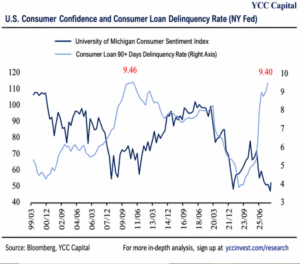
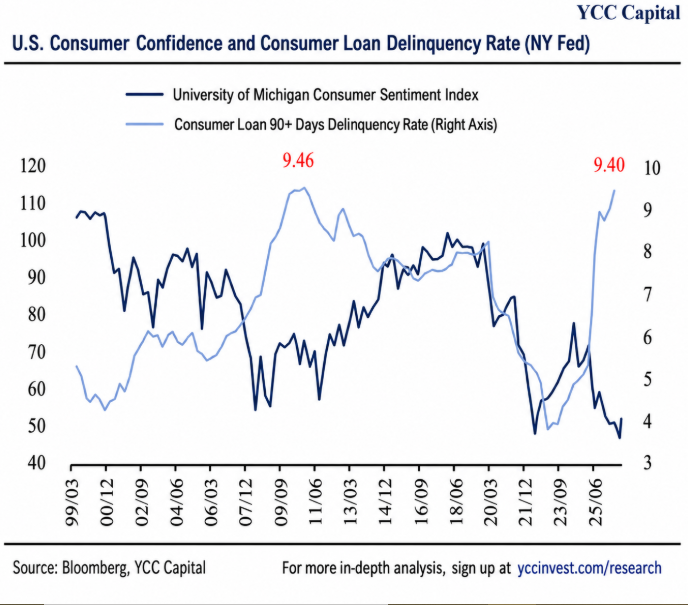
Every economic cycle has a statistic that dominates headlines. Today, it is America’s consumer credit delinquency rate. On the surface, the data appears alarming: auto loan delinquencies have reached their highest level since records began, while credit card delinquencies are hovering near post-Global Financial Crisis highs. At first glance, such figures seem to suggest that U.S. household balance sheets are deteriorating rapidly.
Our analysis reaches a more nuanced conclusion.
Much like a physician who distinguishes between a patient’s temperature and the underlying illness, investors should separate headline delinquency statistics from the actual trajectory of household financial health. Many of today’s elevated delinquency measures reflect statistical methodology, the normalization of extraordinary pandemic-era policies, and shifts in borrower credit composition rather than an economy-wide collapse in repayment capacity.
This distinction matters enormously. While the U.S. consumer is undoubtedly becoming more polarized, the evidence does not support the view that America is entering a broad-based household credit crisis comparable to 2008. Instead, the stress remains concentrated among lower-income households and subprime borrowers, illustrating a K-shaped recovery that continues to define the post-pandemic economy.
One useful analogy is traffic after a snowstorm. Even after the roads have been cleared, congestion remains because vehicles already caught in traffic continue moving slowly. Likewise, today’s stock of seriously delinquent loans reflects legacy stress accumulated over several years rather than an accelerating wave of new defaults.
Executive Summary
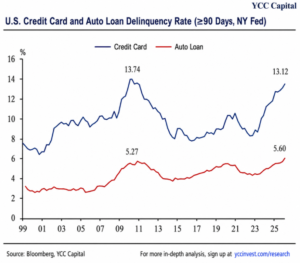
Since the pandemic, severe consumer credit delinquencies in the United States have climbed steadily. According to New York Federal Reserve data, serious delinquency rates (90+ days past due) for auto loans have reached record highs, while credit card delinquency rates have approached levels last seen following the Global Financial Crisis.
However, headline figures overstate the degree of deterioration.
YCC Capital finds that several technical factors—including statistical definitions, delayed recognition embedded in stock delinquency measures, and pandemic-driven credit rating migration—have materially exaggerated the apparent worsening in household credit conditions. When examining more forward-looking indicators such as new delinquency formation, the data suggest that consumer credit stress has largely stabilized rather than continuing to deteriorate.
Nevertheless, structural vulnerabilities remain significant. Credit stress is increasingly concentrated among lower-income households, subprime borrowers, and consumers with limited remaining credit availability. Until employment growth and real income continue broadening across income groups, this lower tier of the American consumer will remain one of the economy’s principal macro vulnerabilities.
America’s Household Credit Landscape
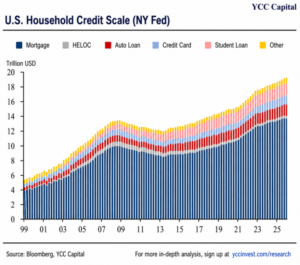
Household debt in the United States remains overwhelmingly dominated by residential mortgages.
As of the first quarter of 2026, total household debt stood at approximately $18.8 trillion, with mortgages representing roughly 70% of total liabilities. Consumer credit constitutes the remaining share, led primarily by:
- Auto loans (approximately 9%)
- Student loans (8.8%)
- Credit cards (6.7%)
This composition explains why headline household balance sheets continue to appear relatively resilient despite rising consumer credit stress.
Unlike previous tightening cycles, most American homeowners refinanced during the extraordinarily low interest-rate environment of 2020-2021. Millions effectively locked in mortgage rates below current market levels for decades, insulating housing-related debt service from the Federal Reserve’s subsequent tightening campaign.
As a result, mortgage delinquencies remain historically low.
Consumer credit tells a very different story.
Auto loans, credit cards and student loans have all experienced significant increases in serious delinquency rates over the past three years, creating an increasingly visible bifurcation within household balance sheets.
Rather than representing a nationwide deterioration, these figures demonstrate the growing divergence between households benefiting from appreciating assets and locked-in financing costs versus those relying heavily upon short-duration consumer borrowing.
Why Headline Delinquency Rates Overstate the Problem
The most widely cited measure comes from the New York Federal Reserve’s Household Debt and Credit Report, which tracks loans more than 90 days delinquent.
While useful, this metric contains important limitations.
Unlike commercial bank delinquency statistics, the New York Fed continues counting loans that have already entered severe distress—including charged-off loans and loans in foreclosure—until lenders cease reporting them. Consequently, the measure behaves like a stock variable, accumulating past problems long after new deterioration has slowed.
Imagine measuring rainfall by the water already collected inside a reservoir rather than the rain currently falling. Even after the storm ends, the reservoir remains full.
This is precisely what has occurred in consumer credit.
When examining new delinquency formation—both 30-day and 90-day transitions—the deterioration appears to have peaked before beginning a gradual moderation. Newly emerging repayment problems have eased even while legacy delinquent balances continue inflating headline statistics.
Commercial bank data tell a similar story.
Bank credit card delinquency rates have already begun gradually declining from recent highs, while charge-off rates have also started retreating. The divergence between banking data and New York Fed statistics largely reflects methodological differences, along with broader coverage of non-bank lenders such as auto finance companies and specialized consumer finance institutions, where credit quality is generally weaker.
For investors, this distinction is critical. Stock delinquency rates describe the legacy of previous stress; flow measures provide a clearer picture of current credit conditions.
The Hidden Legacy of Pandemic Credit Inflation
An overlooked driver behind today’s elevated delinquency rates is the extraordinary improvement in consumer credit scores during the pandemic.
Fiscal transfers, payment moratoriums, aggressive monetary easing and household deleveraging temporarily strengthened borrower balance sheets. Many consumers—particularly those previously categorized as subprime—experienced substantial improvements in measured credit scores.
On paper, this appeared highly encouraging.
In practice, it also produced unintended consequences.
As credit scores improved, banks and non-bank lenders expanded credit availability through larger credit limits and easier underwriting standards. Yet improvements in reported credit quality often exceeded improvements in borrowers’ long-term repayment capacity.
The result was effectively an inflation of credit ratings.
Once pandemic support faded and interest rates rose sharply, these expanded credit lines increasingly migrated into delinquency, particularly among lower-quality borrowers whose underlying income growth had not kept pace with rising borrowing costs.
Fortunately, this distortion has been gradually unwinding since lending standards tightened beginning in 2022.
More recent loan vintages already demonstrate improving repayment performance compared with loans originated during 2022, suggesting that the worst effects of pandemic-era credit inflation are fading.
Auto Loans: The Most Vulnerable Segment
Auto lending represents the weakest area of U.S. consumer finance today.
Several structural factors combined to produce today’s elevated risks.
First, pandemic-era supply chain disruptions severely constrained vehicle inventories, causing both new and used vehicle prices to surge. Combined with sharply higher interest rates after 2022, monthly loan payments increased dramatically.
Average monthly payments for new vehicles rose from roughly $574 in early 2020 to approximately $745 by late 2025—an increase approaching 30%.
Second, risk became increasingly concentrated outside traditional banking institutions.
Buy Here Pay Here (BHPH) dealerships expanded rapidly, providing financing to borrowers unable to qualify through conventional lenders. These loans frequently carry average interest rates exceeding 25%, alongside aggressive weekly or biweekly repayment schedules that substantially increase technical delinquency risk.
Although vehicle inventories have improved and repayment burdens have begun easing, two important risks remain.
First, auto loans typically extend nearly six years, meaning higher-risk loans originated during 2022-2023 will continue influencing delinquency statistics for several more quarters.
Second, repayment deterioration remains overwhelmingly concentrated among lower-income households. Should labor market conditions weaken meaningfully, this segment could experience another acceleration in defaults.
Credit Cards: A More Immediate Macro Barometer
Credit cards arguably provide an even more sensitive indicator of household financial stress than auto loans.
Unlike secured vehicle financing, credit card borrowing is unsecured, revolving, and closely linked to day-to-day consumption.
Following pandemic-era increases in credit limits, lower-quality borrowers expanded revolving balances considerably faster than prime consumers.
As interest rates increased and disposable income growth moderated, these households became increasingly vulnerable.
Recent Consumer Financial Protection Bureau data illustrate growing polarization.
Higher-credit households continue maintaining relatively healthy repayment behavior.
Lower-credit consumers increasingly rely upon minimum payments while exhausting available credit limits.
Unlike auto loans, whose repayment profiles evolve slowly, credit card performance can deteriorate rapidly when labor market conditions soften.
Consequently, while new credit card delinquency formation appears to have stabilized, overall delinquency rates are likely to remain elevated for an extended period.
Student Loans: Normalization Rather Than Crisis
Student loans present a unique case because recent delinquency movements primarily reflect policy normalization rather than broad deterioration in household finances.
Pandemic-era payment suspensions and temporary credit reporting relief significantly suppressed measured delinquencies for several years.
Following the expiration of these programs, delinquency rates rebounded sharply as borrowers resumed repayment.
Importantly, new delinquency formation has already slowed, suggesting the first phase of normalization may largely be complete.
However, an additional risk remains.
Approximately 7.5 million borrowers transitioning following the termination of the Biden administration’s SAVE repayment program entered a new repayment adjustment period during mid-2026. As temporary relief expires and regular monthly payments resume, student loan delinquencies could experience another moderate increase between late 2026 and early 2027.
While this development is unlikely to threaten banking system stability directly, weaker borrower credit scores may reduce consumer spending by limiting access to other forms of financing.
Investment Implications
The rise in U.S. consumer credit delinquencies should not be interpreted as evidence of an imminent household debt crisis.
Instead, investors should recognize two simultaneous realities.
The first is encouraging: underlying household balance sheets remain substantially healthier than headline delinquency statistics imply, supported by resilient mortgage structures, moderating new delinquency formation, and tighter lending standards.
The second is more cautionary: America’s post-pandemic recovery remains deeply uneven. Structural weakness continues concentrating among lower-income consumers, subprime borrowers, and households with limited financial flexibility.
For markets, this means consumer spending should remain resilient overall, but increasingly dependent upon higher-income households. The U.S. economy is unlikely to experience a broad consumer collapse absent a meaningful deterioration in employment. Nevertheless, investors should continue monitoring labor market conditions closely, as any significant rise in unemployment would disproportionately affect the most financially fragile segments of the consumer economy.
Risks to Our View
While the evidence suggests that the current rise in U.S. consumer credit delinquencies reflects normalization rather than systemic deterioration, several macro risks could alter this assessment.
The first is an adverse inflation shock. Renewed geopolitical tensions in the Middle East or a sustained increase in global energy prices could reignite inflation, eroding real household purchasing power just as excess pandemic savings have largely been exhausted. Higher gasoline and utility bills tend to act like a tax on lower-income consumers, the very cohort already experiencing the greatest repayment stress. Under such a scenario, today’s localized credit weakness could broaden into more generalized consumer deterioration.
A second risk would be a more restrictive Federal Reserve policy path than markets currently anticipate. If inflation proves sticky and policy rates remain elevated for longer, financial conditions could tighten further. Higher borrowing costs would continue pressuring revolving credit balances while also limiting refinancing opportunities across consumer lending markets. Although mortgage borrowers remain largely insulated because of historically low fixed-rate mortgages originated during 2020–2021, unsecured consumer credit would remain vulnerable.
Finally, labor market deterioration represents the most important downside risk. Throughout the post-pandemic expansion, employment growth has been the principal pillar supporting household consumption despite higher interest rates. Should unemployment rise materially, delinquency rates among lower-income and subprime borrowers could accelerate rapidly, particularly in auto lending and credit cards where repayment capacity is closely linked to monthly cash flow rather than accumulated household wealth.
YCC Capital Strategic View
Financial markets often gravitate toward simple narratives. Today, the prevailing narrative suggests that record consumer credit delinquencies inevitably foreshadow recession.
Our assessment is more balanced.
The United States remains an economy of two consumers.
One America owns appreciating assets, refinanced mortgages near historic lows, and maintains substantial financial flexibility. The other relies increasingly on revolving credit, higher-cost auto financing, and income that has struggled to keep pace with cumulative inflation.
This divergence explains why aggregate economic data continue to appear remarkably resilient even as pockets of financial stress intensify beneath the surface.
For investors, the implication is clear: the credit cycle should be viewed less as a systemic warning and more as a distributional story.
Consumer credit stress has undoubtedly increased, but it remains concentrated rather than universal. The broader household sector continues to benefit from historically strong housing equity, fixed-rate mortgage insulation, and comparatively healthy aggregate balance sheets. Meanwhile, the weakest households continue absorbing the cumulative effects of elevated living costs, tighter lending standards, and the gradual exhaustion of pandemic-era financial buffers.
From an asset allocation perspective, we continue to view the U.S. economy as capable of sustaining moderate growth despite elevated interest rates. While pockets of consumer weakness warrant close monitoring, they do not yet justify positioning for a repeat of the broad-based household deleveraging that characterized the 2008 financial crisis.
Instead, investors should focus on the evolution of three leading indicators over coming quarters:
First, whether new delinquency formation continues moderating rather than reaccelerating.
Second, whether labor market conditions remain sufficiently strong to stabilize lower-income household cash flows.
Third, whether banks maintain disciplined underwriting standards as policy rates gradually normalize.
If these conditions hold, consumer credit should continue progressing through a prolonged normalization process rather than a systemic credit event.
Editorial Board
Ken Cao
Chief Strategist, Global Investment Strategy
Le Gao
Managing Analyst
Yui Nabeshima
Strategist
Mai Ikeda
Research Analyst
IMPORTANT DISCLAIMER
This research report is provided for informational and educational purposes only and does not constitute an offer to sell or a solicitation of an offer to buy any securities, financial instruments, or investment products. It is not intended as investment, legal, accounting, or tax advice and should not be relied upon as such. The views, opinions, and projections expressed herein are those of YCC Capital Management and its research personnel as of the date of publication and are subject to change without notice. Past performance is not indicative of future results.
YCC Capital Management, its affiliates, principals, and employees may hold long or short positions in securities or instruments discussed in this report and may trade for their own accounts or for client accounts in a manner inconsistent with the recommendations herein. This report is based on publicly available information and data believed to be reliable, but YCC Capital makes no representation or warranty, express or implied, as to the accuracy, completeness, or timeliness of such information. Forward-looking statements involve risks and uncertainties that could cause actual results to differ materially from those projected.
Recipients of this report should conduct their own independent due diligence and consult with their own financial, legal, and tax advisors before making any investment decisions. YCC Capital accepts no liability for any loss or damage arising from the use of or reliance on this report or its contents.
This report is intended solely for the use of the intended recipient(s) and may not be reproduced or redistributed for commercial purposes without the prior written consent of YCC Capital.
© 2026 YCC Capital. All rights reserved.
YCC Capital’s flagship vehicle, the YCC International Value Fund, LP, maintains a concentrated global macro value strategy with a focus on capital-flow-driven mispricings and asymmetric hedging opportunities. The Fund is registered in the State of Delaware, U.S. and structured as a Rule 506(c) fund. Performance data, where referenced, has been verified by independent third parties including NAV Consulting; however, individual investor results may vary.
Contact Us
YCC Capital Research
For complimentary daily macro research, market commentary, and investment insights, sign up for our free newsletter at www.yccinvest.com.
YCC CAPITAL U.S. Themes & Strategy
────────────────────────────────────────
YCC Capital Research | Sign up for free daily market insight at www.yccinvest.com
For more related research:
The Era of the Creditless Recovery: Why China’s New Economy Is Breaking the Old Financial Cycle
China’s Uneven Recovery: Exports Power Ahead While Domestic Demand Remains Stuck in Low Gear