YCC CAPITAL
U.S. Themes & Strategy
July 29, 2026
Executive Summary
Inflation is often compared to the dashboard of a car. Investors obsess over the speedometer, yet experienced drivers know that watching only one gauge can be dangerous. Engine temperature, fuel consumption, road conditions, and weather frequently matter just as much. For more than a decade, financial markets have largely treated CPI and PCE as America’s economic speedometer. Every monthly release has generated violent swings across Treasury yields, equities, currencies, and commodities.
YCC Capital believes this framework is approaching an inflection point.
Under Chairman Kevin Warsh’s emerging reform agenda, the Federal Reserve appears increasingly willing to modernize not only how it conducts monetary policy but also how it measures inflation itself. Rather than relying heavily on a handful of backward-looking indicators designed decades ago, the Fed is likely to transition toward a broader ecosystem of statistical measures, structural inflation models, and high-frequency private-sector datasets.
Such a transition would represent one of the most consequential institutional changes since the Fed formally adopted its 2% inflation target. The immediate implication is not simply better inflation measurement—it is a fundamental shift in how markets interpret incoming data. Investors may gradually move away from reacting to a single monthly CPI surprise and instead focus on persistent inflation trends, demand-driven price pressures, labor-market dynamics, and the breadth of inflation across the economy.
Why Traditional Inflation Measures Need Modernization
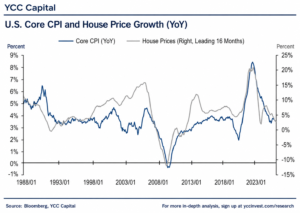
The Federal Reserve currently relies primarily on two official measures of inflation:
- Consumer Price Index (CPI), published by the Bureau of Labor Statistics.
- Personal Consumption Expenditures Price Index (PCE), produced by the Bureau of Economic Analysis.
Although PCE remains the Fed’s formal inflation target, both indicators were designed around statistical frameworks that increasingly struggle to capture a rapidly evolving digital economy.
Much like navigating today’s traffic using a map printed twenty years ago, these indicators remain useful—but they no longer provide the complete picture.
YCC Capital believes three structural shortcomings explain why reform has become increasingly necessary.
1. Spending Weights Adjust Too Slowly
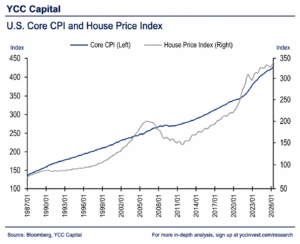
The CPI continues to rely on expenditure weights that are updated only annually and reflect consumer spending patterns from roughly two years earlier.
This creates a well-known substitution bias.
Consumers naturally respond to inflation by purchasing cheaper alternatives when prices rise. However, an index built using outdated spending weights continues assuming households purchase the same basket of goods regardless of changing behavior.
Consequently, CPI often overstates actual inflation during periods of rapid price adjustment.
By comparison, PCE updates its expenditure weights quarterly and therefore captures consumer substitution more effectively. Even so, neither measure fully reflects today’s increasingly dynamic consumption patterns.
For policymakers attempting to calibrate interest rates precisely, this lag can produce systematic policy errors.
2. Methodological Distortions Create Significant Measurement Errors
Housing illustrates perhaps the largest weakness.
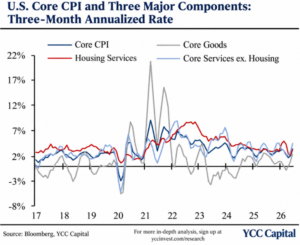
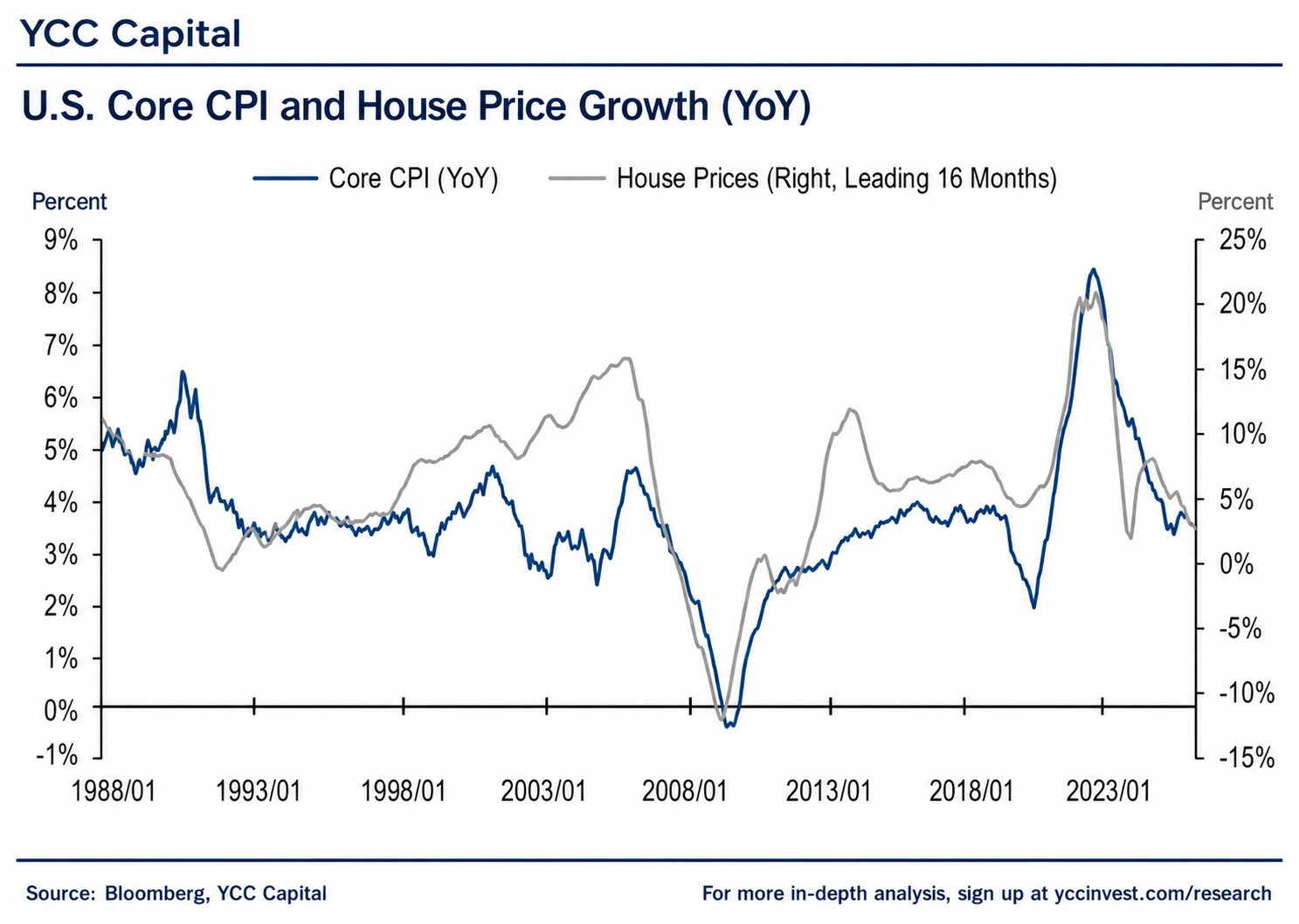
Shelter represents the single biggest component of CPI, yet official shelter inflation typically trails real market rents by roughly 12 to 18 months.
The reason is structural rather than statistical.
Most American leases renew annually, meaning existing tenants continue paying yesterday’s rents while only new leases reflect today’s market conditions. Meanwhile, the Bureau of Labor Statistics surveys rental units on rotating schedules that require months before new pricing is incorporated into official data.
The result resembles steering a ship while looking through the rear-view mirror.
Even after market rents begin falling, official shelter inflation frequently continues rising.
Healthcare presents another distortion.
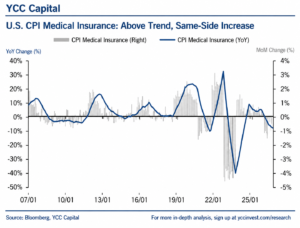
Rather than measuring what households actually pay for insurance premiums, CPI largely estimates insurance costs through insurers’ retained earnings. During extraordinary periods such as the pandemic, changing medical utilization dramatically altered insurer profitability, causing CPI’s health insurance component to swing wildly despite consumers experiencing much smaller changes in actual insurance costs.
Such methodological quirks have occasionally influenced financial markets far more than underlying inflation fundamentals justified.
3. Artificial Intelligence Is Challenging Traditional Price Measurement
Perhaps the most important future challenge lies in measuring technological progress.
Historically, government statisticians adjusted prices for improvements in product quality through hedonic adjustments.
For example, if a computer processor became 30% more powerful while its price also increased 30%, economists would conclude that its effective price had not changed because consumers received proportionally greater value.
Generative AI complicates this framework considerably.
Software subscriptions increasingly bundle sophisticated AI capabilities into existing products.
Consumers may pay slightly higher subscription fees, but those increases often reflect dramatically expanded functionality rather than traditional inflation.
Current CPI and PCE methodologies only partially capture these quality improvements.
As AI becomes embedded throughout enterprise software, productivity tools, education, healthcare, and professional services, distinguishing genuine inflation from improvements in product quality will become increasingly difficult.
Recent Federal Reserve research suggests that correcting these measurement issues would produce meaningfully lower estimates of both Core PCE and Core Goods inflation, reinforcing the argument that official inflation statistics may currently overstate underlying price pressures in certain technology-intensive sectors.
The Next Generation of Inflation Indicators
Rather than replacing CPI and PCE outright, Warsh’s likely strategy appears focused on supplementing them with more sophisticated analytical tools.
These can be grouped into three broad categories.
Statistical Measures That Remove Noise
Traditional inflation reports often suffer from extreme monthly volatility caused by energy prices, weather events, supply disruptions, or isolated product categories.
Several Federal Reserve Banks have already developed statistical techniques designed to filter out this noise.
Among the most influential are:
- Median Inflation
- Trimmed Mean CPI
- Trimmed Mean PCE
- Sticky Price Inflation
- Diffusion Indexes
Median and trimmed-mean measures remove the most extreme monthly price movements before calculating overall inflation, producing considerably smoother estimates of underlying price trends.
Sticky inflation measures focus on prices that change infrequently, providing insight into long-term inflation expectations rather than temporary fluctuations.
Diffusion indexes examine how broadly inflation is spreading across the economy instead of measuring only the magnitude of price increases. Broad-based inflation is generally more persistent—and therefore more relevant for monetary policy—than isolated price spikes.
These statistical measures effectively reduce the “noise” surrounding monthly inflation releases, allowing policymakers to focus on persistent signals rather than temporary volatility.
The Next Generation of Inflation Indicators
Rather than abandoning official inflation statistics altogether, the Federal Reserve under Kevin Warsh is more likely to build a multi-layered analytical framework. Instead of asking a single question—”What was CPI this month?”—policymakers will increasingly ask a more sophisticated set of questions: Is inflation broad or narrow? Is it demand-driven or supply-driven? Is it temporary or persistent? Is it responding to labor market conditions? Is it accelerating in real time?
The report identifies three major categories of alternative inflation measures already available within the Federal Reserve system and private-sector research.
Statistical Inflation Measures: Extracting the Underlying Trend
The first group consists of statistical techniques designed to remove excessive volatility from traditional inflation readings.
Median and Trimmed Mean Inflation
One of Kevin Warsh’s earliest public comments emphasized greater use of Trimmed Mean Inflation, reflecting his belief that policymakers should focus on persistent price movements rather than temporary shocks.
These measures work differently from conventional Core CPI.
Instead of permanently excluding food and energy, trimmed-mean inflation removes whichever categories experienced the largest monthly increases and declines, regardless of sector. This produces a cleaner estimate of underlying inflation by filtering out statistical outliers.
Similarly, Median CPI and Median PCE identify the price change occurring at the middle of the weighted distribution rather than averaging every component equally.
The practical implication is straightforward.
If airline fares surge 25% while used-car prices collapse 18%, traditional inflation measures may swing sharply. Median and trimmed measures largely ignore these temporary extremes and instead capture what is happening across the typical consumer basket.
For policymakers attempting to determine whether inflation has genuinely become entrenched, these indicators often provide a more reliable signal than headline data.
Sticky versus Flexible Inflation
Another valuable statistical framework divides prices into two categories.
Flexible prices change frequently.
These include:
- Gasoline
- Food
- Apparel
- Vehicles
- Commodities
These components respond rapidly to market forces but also reverse quickly.
Sticky prices, by contrast, adjust only occasionally.
Examples include:
- Medical services
- Education
- Housing contracts
- Personal services
Because these prices change infrequently, they tend to better reflect longer-term inflation expectations rather than temporary market fluctuations.
YCC Capital expects sticky inflation measures to receive increasing attention because they align closely with monetary policy’s long transmission lags. Central banks cannot respond effectively to every oil-price spike, but they can influence persistent inflation embedded within wages and services.
Diffusion Indexes: Measuring Inflation Breadth
Another increasingly important concept is inflation breadth.
Markets traditionally ask:
“How much did prices rise?”
Diffusion indexes instead ask:
“How many prices are rising?”
This distinction matters enormously.
If only gasoline prices rise, inflation may fade naturally.
If three-quarters of consumer categories begin rising simultaneously, inflation becomes far more persistent.
Federal Reserve research highlighted in the report suggests that broader inflation typically proves much harder to reverse than concentrated inflation, making diffusion measures valuable leading indicators of persistence.
Economic Models Reveal Inflation’s True Drivers
Statistics reduce noise.
Economics explains causes.
The second group of inflation indicators attempts to identify why inflation is occurring rather than simply measuring its magnitude.
Super Core Inflation
Perhaps the best-known example is Super Core Inflation, a concept introduced by Jerome Powell during the post-pandemic inflation cycle.
Super Core Inflation removes:
- Food
- Energy
- Housing
What remains is primarily labor-intensive service industries including:
- Healthcare
- Education
- Hotels
- Restaurants
- Transportation
- Personal services
These sectors depend heavily on wages rather than commodity prices.
Consequently, Super Core Inflation provides one of the clearest windows into domestically generated inflation pressure.
Because housing inflation enters official statistics with substantial delays, excluding shelter also produces a timelier reading of current price dynamics.
Should Super Core Inflation continue moderating, policymakers gain greater confidence that wage pressures are easing sustainably.
Wage Growth Tracker
Inflation ultimately begins with costs.
For service industries, labor represents the largest cost input.
The Atlanta Fed’s Wage Growth Tracker therefore occupies an increasingly central role in inflation analysis.
Unlike average hourly earnings—which fluctuate with changes in workforce composition—the Wage Growth Tracker follows the same workers over time, producing a cleaner measure of underlying wage inflation.
Historically, wage acceleration has preceded sustained service-sector inflation.
Conversely, moderating wage growth often signals that inflationary pressures will continue easing.
Warsh’s emphasis on structural inflation trends suggests labor-market indicators such as wage trackers could become more influential than monthly CPI surprises.
Cyclical versus Acyclical Inflation
Not every inflation episode originates from excessive demand.
Some arise from:
- Supply chain disruptions
- Natural disasters
- Energy shocks
- Industry-specific bottlenecks
The San Francisco Federal Reserve separates Core PCE into:
Cyclical inflation
These prices move with overall economic conditions and therefore respond to monetary policy.
Acyclical inflation
These largely reflect sector-specific or supply-driven developments that interest-rate policy cannot easily influence.
This distinction helps policymakers avoid unnecessary tightening when inflation results primarily from temporary supply disturbances rather than overheating demand.
Demand-Driven versus Supply-Driven Inflation
A related framework decomposes monthly inflation into demand and supply contributions.
If prices rise because consumers spend aggressively, higher interest rates may effectively reduce inflation.
If prices rise because geopolitical events restrict oil production or disrupt shipping lanes, tighter monetary policy becomes far less effective.
YCC Capital believes this distinction will become increasingly important in a world characterized by:
- Geopolitical fragmentation
- Trade realignment
- Energy security concerns
- Supply-chain diversification
As recent history has demonstrated, inflation generated by supply constraints requires different policy responses than inflation generated by excessive domestic demand.
Multivariate Core Trend (MCT)
Among the most sophisticated indicators discussed in the report is the New York Federal Reserve’s Multivariate Core Trend (MCT) measure.
Unlike traditional Core PCE, which simply excludes certain categories, MCT employs dynamic factor models across seventeen major sectors of the economy.
It separates inflation into:
- Common long-term trends
- Sector-specific trends
- Temporary common shocks
- Temporary sector shocks
By filtering out transitory disturbances while preserving persistent movements, MCT often identifies turning points in inflation earlier than conventional measures.
Rather than asking whether inflation moved this month, MCT asks whether the underlying inflation process itself has fundamentally changed.
For central bankers, that distinction is invaluable.
High-Frequency Inflation: The Future Is Real Time
Traditional inflation statistics arrive with unavoidable delays.
June CPI is typically published in mid-July.
PCE often arrives even later.
Financial markets, however, cannot afford to wait several weeks before reassessing economic conditions.
This has accelerated interest in real-time inflation tracking.
Inflation Nowcasting
Nowcasting attempts to estimate current inflation before official government releases become available.
Rather than forecasting several months into the future, nowcasting answers a much simpler question:
“If the government published inflation today, what would the number likely be?”
The Cleveland Federal Reserve’s Inflation Nowcasting framework integrates:
- Daily oil prices
- Weekly gasoline prices
- Recently released economic data
- Mixed-frequency statistical models
The result is a continuously updated estimate of current CPI and PCE.
Bloomberg Economics has developed similar models for institutional investors.
These tools have become increasingly valuable because financial markets respond immediately to changing economic conditions rather than waiting for official publication schedules.
Truflation: Private-Sector Inflation Intelligence
Private-sector innovation is also reshaping inflation measurement.
Truflation aggregates more than fifteen million daily price observations across dozens of independent data sources to generate a continuously updated inflation index.
Unlike traditional government surveys relying on fixed consumer baskets, Truflation dynamically adjusts its weights while incorporating real-time housing costs, retail pricing, and market-based expenditures.
According to the report, Truflation’s proprietary PCE equivalent exhibits a very high historical correlation with official PCE while typically leading government releases by approximately one month.
If private-sector datasets continue demonstrating reliability, YCC Capital believes future Federal Reserve decision-making may incorporate these alternative information sources alongside traditional government statistics rather than treating official data as the exclusive benchmark.
Strategic Investment Implications
YCC Capital View: A Smarter Inflation Framework Will Produce Smarter Markets
The most important implication of Kevin Warsh’s evolving inflation framework is not that CPI or PCE will disappear. Rather, the Federal Reserve is likely to place less weight on any single monthly data release and greater emphasis on a broad collection of complementary indicators. This represents an institutional evolution rather than a wholesale replacement of the existing framework.
For investors, this distinction is critical.
Over the past decade, markets have often behaved as though one CPI report could fundamentally alter the path of monetary policy. Treasury yields have swung sharply within minutes of inflation releases, equity valuations have been repriced almost instantaneously, and currency markets have frequently experienced their largest daily moves around inflation announcements.
That behavior made sense when policymakers themselves relied heavily on a narrow set of backward-looking indicators.
If future Federal Reserve decisions incorporate multiple statistical filters, labor-market measures, diffusion indexes, nowcasting models, and high-frequency private-sector data simultaneously, the market’s dependence on one monthly inflation print may gradually diminish.
In practical terms, investors should expect monetary policy to become somewhat less reactive and more evidence-based. While volatility surrounding official data releases is unlikely to disappear, policy decisions may increasingly reflect sustained inflation trends rather than isolated monthly surprises.
This evolution is analogous to how modern aircraft are flown. Pilots no longer rely on a single mechanical gauge; they monitor an integrated cockpit of instruments, each measuring different aspects of the aircraft’s condition. Monetary policymakers appear to be moving toward a similar philosophy.
Implications Across Asset Classes
U.S. Treasury Market
A more comprehensive inflation framework could reduce the frequency of abrupt policy reversals driven by temporary statistical distortions.
That should support greater stability at the front end of the Treasury curve, where interest-rate expectations are most sensitive to Federal Reserve communications.
Longer-term Treasury yields, meanwhile, are likely to depend increasingly on structural inflation expectations rather than individual CPI reports.
YCC Capital continues to believe that long-duration U.S. government bonds regain strategic value once inflation expectations become better anchored by improved measurement rather than by aggressive policy tightening alone.
U.S. Equities
Equity markets stand to benefit from a policy framework that places greater emphasis on persistent economic trends rather than month-to-month volatility.
Growth sectors—including technology, software, artificial intelligence, and digital services—have often been disproportionately affected by abrupt shifts in interest-rate expectations following inflation surprises.
As inflation measurement improves, valuation multiples may become less sensitive to temporary statistical noise.
Companies whose revenues depend on long-duration growth assumptions should benefit from a more predictable monetary policy environment, provided inflation continues to moderate over the medium term.
U.S. Dollar
The U.S. dollar has historically strengthened when inflation surprises forced markets to price additional Federal Reserve tightening.
Should policymakers become more selective in interpreting inflation data, foreign exchange markets may experience fewer episodes of rapid repricing based solely on one economic release.
Nevertheless, YCC Capital remains cautiously constructive on the U.S. dollar over the longer horizon. Compared with most developed economies, the United States continues to exhibit stronger productivity growth, healthier demographic trends, deeper capital markets, and greater innovation capacity.
Commodities
Commodity markets will remain an important source of inflation volatility, particularly in an increasingly fragmented geopolitical environment.
However, policymakers appear increasingly willing to distinguish between temporary commodity-driven price shocks and persistent domestic inflation.
That distinction reduces the probability that every energy-related inflation spike automatically triggers additional monetary tightening.
For commodity investors, this implies that geopolitical developments may exert a greater direct influence on prices, while central-bank reactions become somewhat more measured.
Risks to the New Framework
Despite its advantages, a broader inflation framework introduces several challenges.
First, increased complexity may complicate Federal Reserve communication.
Financial markets generally prefer simple reference points. Replacing a widely understood CPI figure with a collection of statistical models and alternative indicators risks creating uncertainty regarding the central bank’s reaction function.
Second, private-sector datasets have not yet been tested across multiple economic cycles.
Although high-frequency measures such as Truflation have demonstrated encouraging historical performance, their methodologies continue to evolve and may not fully capture shifts in consumer behavior during periods of severe economic stress.
Third, expanding the range of indicators increases the possibility that different measures send conflicting signals.
One dataset may indicate easing inflation while another points toward persistent price pressures. Policymakers will need to exercise greater judgment in balancing competing evidence, making communication and transparency even more important.
Finally, no statistical framework can eliminate uncertainty. Inflation remains influenced by geopolitical shocks, fiscal policy, technological change, demographics, productivity, and consumer psychology—factors that no model can fully predict.
Conclusion
YCC Capital believes the Federal Reserve is entering the early stages of a significant modernization in how inflation is evaluated.
Kevin Warsh’s emerging approach should not be viewed as an attempt to replace CPI or PCE. Instead, it reflects an effort to construct a richer analytical framework capable of capturing a twenty-first-century economy that is increasingly digital, service-oriented, and driven by rapid technological innovation.
The transition is likely to be gradual rather than revolutionary. Official inflation measures will remain central to monetary policy, but they will increasingly be interpreted alongside complementary indicators that distinguish temporary volatility from persistent inflationary trends.
For investors, the implication is clear. The investment landscape may gradually shift away from an excessive focus on one monthly data release toward a broader assessment of inflation’s underlying trajectory. Portfolio construction will therefore require greater attention to structural forces—including labor-market dynamics, productivity growth, artificial intelligence, and long-term inflation expectations—rather than simply anticipating the next CPI print.
As with every major institutional evolution, the benefits will emerge over time rather than overnight. Yet history suggests that improvements in economic measurement often lead to better policy decisions, more efficient capital allocation, and ultimately more resilient financial markets.
At YCC Capital, we believe understanding how inflation is measured will increasingly become just as important as understanding whether inflation is rising or falling.
Sources: Bloomberg, YCC Capital.
Editorial Board
Ken Cao
Chief Strategist, Global Investment Strategy
Le Gao
Managing Analyst
Yui Nabeshima
Strategist
Mai Ikeda
Research Analyst
IMPORTANT DISCLAIMER
This research report is provided for informational and educational purposes only and does not constitute an offer to sell or a solicitation of an offer to buy any securities, financial instruments, or investment products. It is not intended as investment, legal, accounting, or tax advice and should not be relied upon as such. The views, opinions, and projections expressed herein are those of YCC Capital Management and its research personnel as of the date of publication and are subject to change without notice. Past performance is not indicative of future results.
YCC Capital Management, its affiliates, principals, and employees may hold long or short positions in securities or instruments discussed in this report and may trade for their own accounts or for client accounts in a manner inconsistent with the recommendations herein. This report is based on publicly available information and data believed to be reliable, but YCC Capital makes no representation or warranty, express or implied, as to the accuracy, completeness, or timeliness of such information. Forward-looking statements involve risks and uncertainties that could cause actual results to differ materially from those projected.
Recipients of this report should conduct their own independent due diligence and consult with their own financial, legal, and tax advisors before making any investment decisions. YCC Capital accepts no liability for any loss or damage arising from the use of or reliance on this report or its contents.
This report is intended solely for the use of the intended recipient(s) and may not be reproduced or redistributed for commercial purposes without the prior written consent of YCC Capital. © 2026 YCC Capital. All rights reserved. YCC Capital’s flagship vehicle, the YCC International Value Fund, LP, maintains a concentrated global macro value strategy with a focus on capital-flow-driven mispricings and asymmetric hedging opportunities. The Fund is registered in the State of Delaware, U.S. and structured as a 506(c) fund. Performance data, where referenced, has been verified by independent third parties including NAV Consulting; however, individual investor results may vary.
Contact Us
YCC Capital Management
Email: ir@yccinvest.com
For free daily macro research, market insights, and investment commentary, sign up at www.yccinvest.com.
YCC Capital Research | Sign up for free daily market insight at www.yccinvest.com
For more related research:
China’s Uneven Recovery: Exports Power Ahead While Domestic Demand Remains Stuck in Low Gear
Trump’s Political Playbook: Winning Abroad to Stabilize at Home