YCC CAPITAL
U.S. Themes & Strategy
A Softer Employment Picture Lowers the Odds of Further Fed Tightening, but the Path to Rate Cuts Remains Narrow
July 9, 2026
Executive Summary
For many households, the labor market is the economy they experience every day. It determines whether a recent graduate lands their first job, whether a mid-career engineer feels confident changing employers, or whether a small business owner decides to expand payroll. Financial markets may celebrate lower inflation or stronger earnings, but employment ultimately determines whether economic momentum feels real.
June’s U.S. employment report suggests that this everyday economy is gradually cooling. The deterioration is not dramatic enough to imply recession, yet it is broad enough to indicate that the labor market has entered a new phase characterized by slower hiring, weaker labor-force participation, and increasingly cautious corporate behavior.
Nonfarm payrolls rose by just 57,000, well below both consensus expectations of 110,000 and the previous month’s 172,000 increase. Even more importantly, April and May payrolls were revised downward by a combined 74,000, reinforcing the message that employment momentum has been fading for several months rather than collapsing suddenly.
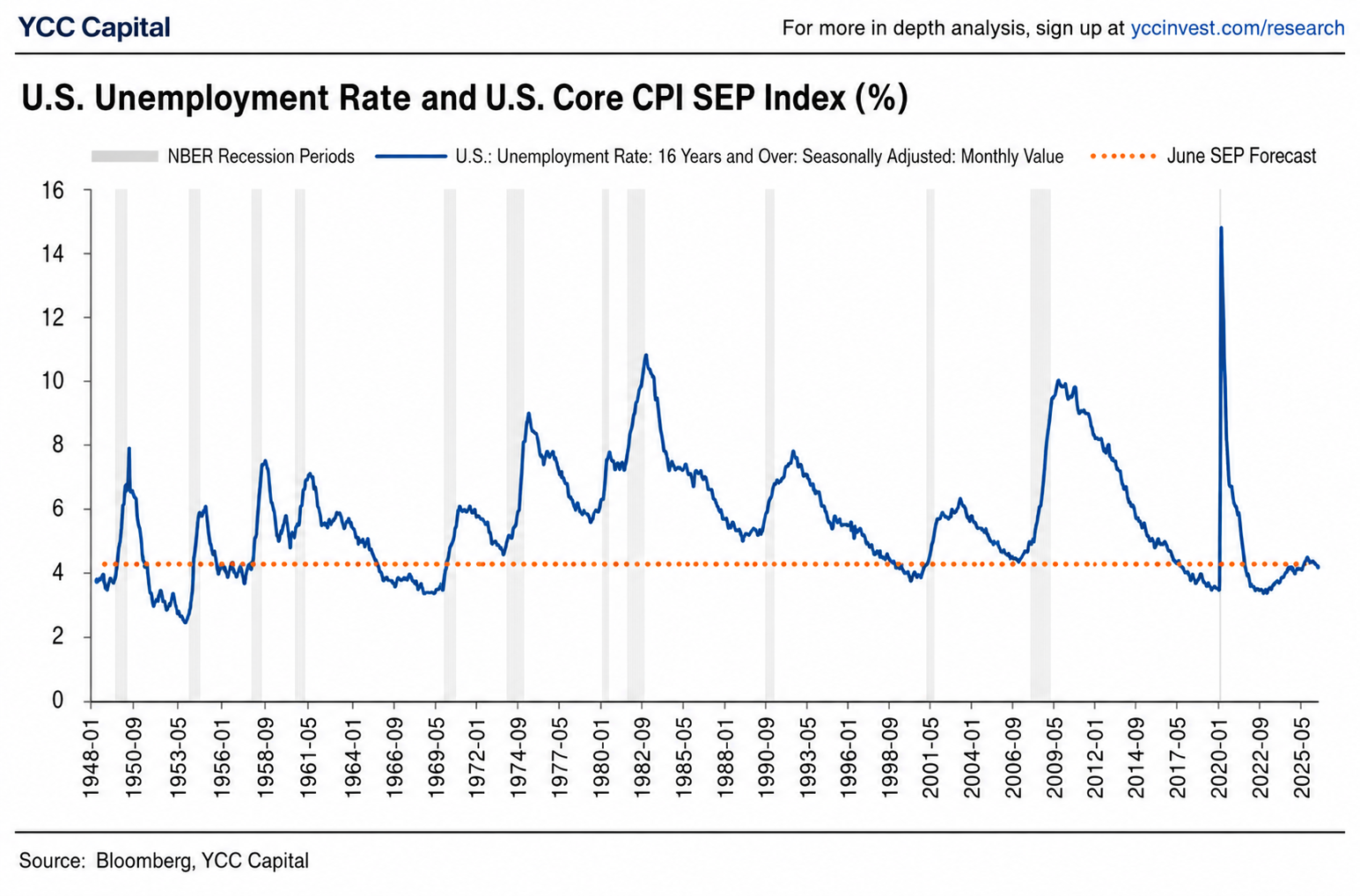
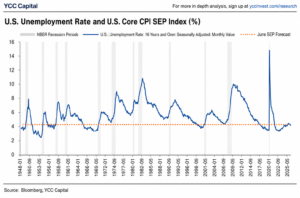
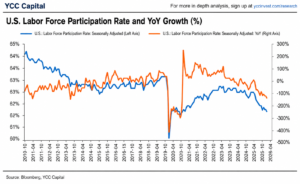
At first glance, the decline in the unemployment rate to 4.2% appears encouraging. A closer examination tells a different story. Rather than reflecting stronger hiring, the improvement was driven primarily by a fall in labor-force participation from 61.8% to 61.5%, meaning many workers simply exited the labor market altogether.
From YCC Capital’s perspective, the report reinforces a theme that has gradually emerged throughout 2026: the U.S. economy is not overheating anymore, but neither is it sliding into recession. Instead, it is settling into a slower-growth equilibrium in which businesses are increasingly reluctant to both hire and fire while the Federal Reserve remains constrained by sticky wage inflation.
The Headline Payroll Miss Masks a Broader Loss of Momentum
The most striking feature of June’s employment report was not simply the weak headline figure but the consistency of weakness across multiple indicators.
Payroll growth slowed to just 57,000, marking one of the weakest monthly gains since the post-pandemic recovery began. The downward revisions to previous months significantly altered the underlying trend, reducing the three-month average employment gain to levels substantially below those recorded earlier this year.
Taken together, the latest data suggest that the U.S. labor market is no longer experiencing merely a temporary slowdown. Instead, hiring demand has entered a sustained moderation phase.
Importantly, layoffs remain relatively contained. Rather than aggressively reducing headcount, companies appear increasingly willing to postpone recruitment while maintaining existing employees. This distinction matters because recessions typically begin with accelerating layoffs, whereas today’s environment resembles an economy caught in a prolonged hiring freeze.
Corporate America appears increasingly comfortable waiting for greater clarity regarding inflation, interest rates, artificial intelligence adoption, and consumer demand before making long-term staffing commitments.
Falling Unemployment Is More Illusion Than Improvement
Perhaps the most misleading headline was the decline in the unemployment rate.
Normally, falling unemployment signals strengthening labor demand. June’s data tell a very different story.
The labor-force participation rate declined to 61.5%, indicating that labor supply contracted even faster than labor demand. As workers exited the workforce, the unemployment rate mechanically declined despite only modest job creation.
This distinction carries important policy implications.
A healthier labor market would generate falling unemployment because businesses are hiring aggressively. Today’s labor market instead reflects declining participation, suggesting that many individuals are simply choosing—or being forced—to stop searching for work.
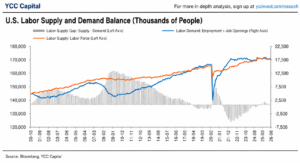
Measured differently, labor supply has now fallen below labor demand by approximately 287,000 workers, a wider imbalance than observed only two months earlier.
This shift reflects a cooling market rather than a stronger one.
Hiring Has Become Increasingly Uneven
The employment slowdown was particularly evident across service industries, where hiring weakened substantially.
Private-sector payrolls increased by only 49,000, dramatically below the recent three-month average of approximately 150,000.
Within the goods-producing sectors, conditions remained relatively resilient.
Construction employment expanded by 11,000, while manufacturing added 3,000 jobs. These gains suggest that infrastructure investment and ongoing industrial reshoring continue to provide a modest cushion against broader economic slowing.
Services, however, told a more complicated story.
Professional and business services remained among the strongest contributors, adding 36,000 jobs and extending six consecutive months of positive employment growth. Education and healthcare once again demonstrated remarkable resilience by creating 69,000 new positions, reflecting demographic demand that remains relatively insulated from short-term economic cycles.
Consumer-facing industries painted a less encouraging picture.
Leisure and hospitality employment plunged by 61,000 following an unusually strong gain during the previous month that had likely been boosted by temporary World Cup-related tourism demand and seasonal hiring.
Trade, transportation, and utilities also slipped into negative territory, suggesting softer consumer spending and moderating logistics demand.
Government hiring similarly lost momentum as local government employment slowed sharply, reducing an important source of recent payroll support.
Artificial Intelligence Is Beginning to Reshape White-Collar Employment
One increasingly notable feature of the current labor market is the growing divergence between traditional employment indicators and technological change.
The information sector lost 9,000 jobs during June, extending an already weakening trend.
According to Challenger data, artificial intelligence has now been cited as a leading reason for technology-sector layoffs for four consecutive months, with technology accounting for nearly one-third of announced job reductions this year.
While AI is unlikely to produce economy-wide labor displacement overnight, its influence is becoming increasingly visible within high-income knowledge industries.
Companies appear to be slowing recruitment while simultaneously increasing investment in automation, particularly across software development, administrative functions, customer support, and data analysis.
Rather than eliminating millions of jobs immediately, AI’s first macroeconomic effect may simply be reducing the need to replace departing employees.
That process is already beginning to appear within today’s hiring data.
Businesses Prefer Fewer Hours to More Layoffs
One encouraging aspect of the report is that employers continue to avoid aggressive workforce reductions.
Average weekly hours worked remained stable at 34.3 hours, while manufacturing hours eased only slightly from 40.4 to 40.3 hours.
Historically, employers often reduce overtime and working hours before resorting to layoffs. Current data suggest businesses are following precisely that pattern.
This reflects caution rather than distress.
Companies appear unwilling to lose experienced workers after enduring several years of labor shortages. Instead, they are choosing incremental adjustments that preserve workforce flexibility while lowering labor costs.
Such behavior reduces recession risks but also implies slower employment growth over coming quarters.
Wage Growth Remains Too Firm for the Federal Reserve to Relax
Despite slowing hiring, wage pressures have not disappeared.
Average hourly earnings rose 3.52% year-over-year, while monthly wage growth accelerated to 0.35%, above the twelve-month average.
Importantly, much of this increase appears structural rather than inflationary.
Higher-paying sectors such as information technology and finance experienced employment declines while average wages increased, suggesting lower-paid workers were disproportionately leaving payrolls.
This compositional effect mechanically pushes average earnings higher without necessarily indicating broad-based wage acceleration.
Nevertheless, Federal Reserve policymakers are unlikely to ignore persistent wage growth.
Services inflation remains closely linked to labor costs, meaning officials will require additional evidence before concluding inflation risks have fully subsided.
Consumer Confidence Is Improving—But Workers Feel Less Secure
Consumer confidence improved modestly during June, reflecting growing optimism regarding future income prospects and business conditions.
However, perceptions of current employment opportunities deteriorated.
The share of Americans reporting that jobs are “hard to get” climbed to 22.5%, the highest reading since 2021.
Historically, household perceptions often deteriorate before official labor statistics fully reflect weakening employment conditions.
Workers appear increasingly reluctant to voluntarily leave existing jobs, while voluntary quits have continued to decline.
The message is subtle but important.
Confidence in future inflation may be improving, yet confidence in personal employment prospects is becoming noticeably weaker.
That divergence often precedes slower household spending growth.
Financial Markets Have Repriced Fed Expectations
Markets responded to the employment report by reducing expectations for further Federal Reserve tightening.
Interest-rate futures now assign roughly an 82% probability that the Federal Reserve leaves rates unchanged at its July meeting.
Expectations for multiple additional rate increases later this year also declined meaningfully.
Asset prices reflected this reassessment.
The U.S. dollar weakened.
Gold advanced approximately 1.3%.
Treasury yields remained relatively stable near 4.47%, while equity performance was mixed, with defensive sectors outperforming many growth-oriented technology shares.
The market’s interpretation is straightforward.
The economy is slowing sufficiently to reduce fears of further aggressive tightening but not enough to justify immediate monetary easing.
YCC Capital Strategic View
The June employment report represents another step in America’s transition toward a slower—but still fundamentally resilient—economic expansion.
The Federal Reserve’s challenge is becoming increasingly delicate.
Employment is cooling.
Hiring intentions are weakening.
Consumer perceptions are softening.
Yet wage inflation remains sufficiently firm to prevent policymakers from declaring victory over inflation.
In our assessment, the most likely scenario is neither recession nor renewed overheating.
Instead, the U.S. economy appears to be entering an extended period of below-trend growth characterized by cautious corporate hiring, stable consumer spending, and gradually easing inflation.
For investors, this environment continues to favor high-quality duration assets, selective exposure to defensive equities, and companies capable of generating earnings growth independent of broad economic acceleration.
While financial markets have become increasingly focused on the timing of future Federal Reserve easing, the more important development is the gradual normalization of labor-market conditions after several extraordinary years of post-pandemic imbalance.
America’s employment engine is no longer running at full throttle.
But it is still running.
The distinction may ultimately define the investment landscape for the remainder of 2026.
Editorial Board
Ken Cao
Chief Strategist, Global Investment Strategy
Le Gao
Managing Analyst
Yui Nabeshima
Strategist
Mai Ikeda
Research Analyst
IMPORTANT DISCLAIMER
This research report is provided for informational and educational purposes only and does not constitute an offer to sell or a solicitation of an offer to buy any securities, financial instruments, or investment products. It is not intended as investment, legal, accounting, or tax advice and should not be relied upon as such. The views, opinions, and projections expressed herein are those of YCC Capital Management and its research personnel as of the date of publication and are subject to change without notice. Past performance is not indicative of future results.
YCC Capital Management, its affiliates, principals, and employees may hold long or short positions in securities or instruments discussed in this report and may trade for their own accounts or for client accounts in a manner inconsistent with the recommendations herein. This report is based on publicly available information and data believed to be reliable, but YCC Capital makes no representation or warranty, express or implied, as to the accuracy, completeness, or timeliness of such information. Forward-looking statements involve risks and uncertainties that could cause actual results to differ materially from those projected.
Recipients of this report should conduct their own independent due diligence and consult with their own financial, legal, and tax advisors before making any investment decisions. YCC Capital accepts no liability for any loss or damage arising from the use of or reliance on this report or its contents.
This report is intended solely for the use of the intended recipient(s) and may not be reproduced or redistributed for commercial purposes without the prior written consent of YCC Capital.
© 2026 YCC Capital. All rights reserved.
YCC Capital’s flagship vehicle, the YCC International Value Fund, LP, maintains a concentrated global macro value strategy focused on identifying capital-flow-driven mispricings and asymmetric hedging opportunities across global markets. The Fund is registered in the State of Delaware, United States, and is structured as a Rule 506(c) private investment fund. Performance data, where referenced, has been independently verified by third-party administrators, including NAV Consulting; however, individual investor outcomes may differ depending on subscription timing, fee arrangements, and investment circumstances.
Contact Us
For institutional inquiries, media requests, or research subscriptions, please contact:
YCC Capital Research
Sign up for our free daily market insights and receive concise macro commentary, investment strategy updates, and thematic research delivered directly to your inbox.
Risk Factors
While we believe the June employment report marks another step toward a better-balanced U.S. labor market, investors should continue monitoring several risks that could materially alter the outlook.
First, labor market conditions could prove more resilient than current data suggest. Hiring may rebound if corporate confidence improves following additional progress on inflation or stronger-than-expected consumer spending.
Second, inflation remains the single largest uncertainty for Federal Reserve policy. Wage growth continues to exceed levels historically associated with the Fed’s 2% inflation objective. Should services inflation remain sticky or commodity prices rise unexpectedly, policymakers may be forced to maintain restrictive policy for longer than markets currently anticipate.
Third, geopolitical developments—including renewed tensions in the Middle East, disruptions to global shipping routes, or an escalation of strategic competition between the United States and China—could produce fresh inflationary pressures and increase financial-market volatility.
Finally, productivity gains from artificial intelligence remain difficult to quantify. While AI adoption may support long-term economic efficiency, its near-term effects on employment, wages, and corporate profitability are likely to vary substantially across industries, creating both opportunities and adjustment risks for investors.
Concluding Perspective
Economic cycles rarely end with dramatic headlines alone. More often, they evolve through a gradual accumulation of subtle shifts—fewer job postings, slower hiring, workers becoming less willing to change employers, and businesses choosing caution over expansion. June’s employment report reflects precisely this kind of transition.
For policymakers, the message is one of growing balance. The labor market is no longer generating the intense inflationary pressure that characterized the post-pandemic recovery, yet it has not deteriorated enough to warrant an aggressive policy reversal.
For investors, patience may prove the most valuable asset. As markets increasingly focus on the exact timing of the Federal Reserve’s next move, the broader investment opportunity lies in recognizing that the U.S. economy remains remarkably resilient even as growth normalizes.
At YCC Capital, we continue to view the United States as the strongest major developed economy over the medium term. While cyclical headwinds persist, healthy corporate balance sheets, continued innovation, robust capital markets, and leadership in artificial intelligence provide a durable foundation for long-run investment returns.
The labor market may be cooling, but it is cooling from exceptional strength—not collapsing into recession. That distinction is likely to matter far more than the next payroll headline.
YCC Capital Research | Sign up for free daily market insight at www.yccinvest.com
For more related research:
The World Cup Jobs Boom: Reality, Hype, and What FIFA 2026 Means for the U.S. Labor Market
China’s Consumer Mirage: Why Better Employment Data Is Hiding a More Fragile Recovery
Trump’s Political Playbook: Winning Abroad to Stabilize at Home